
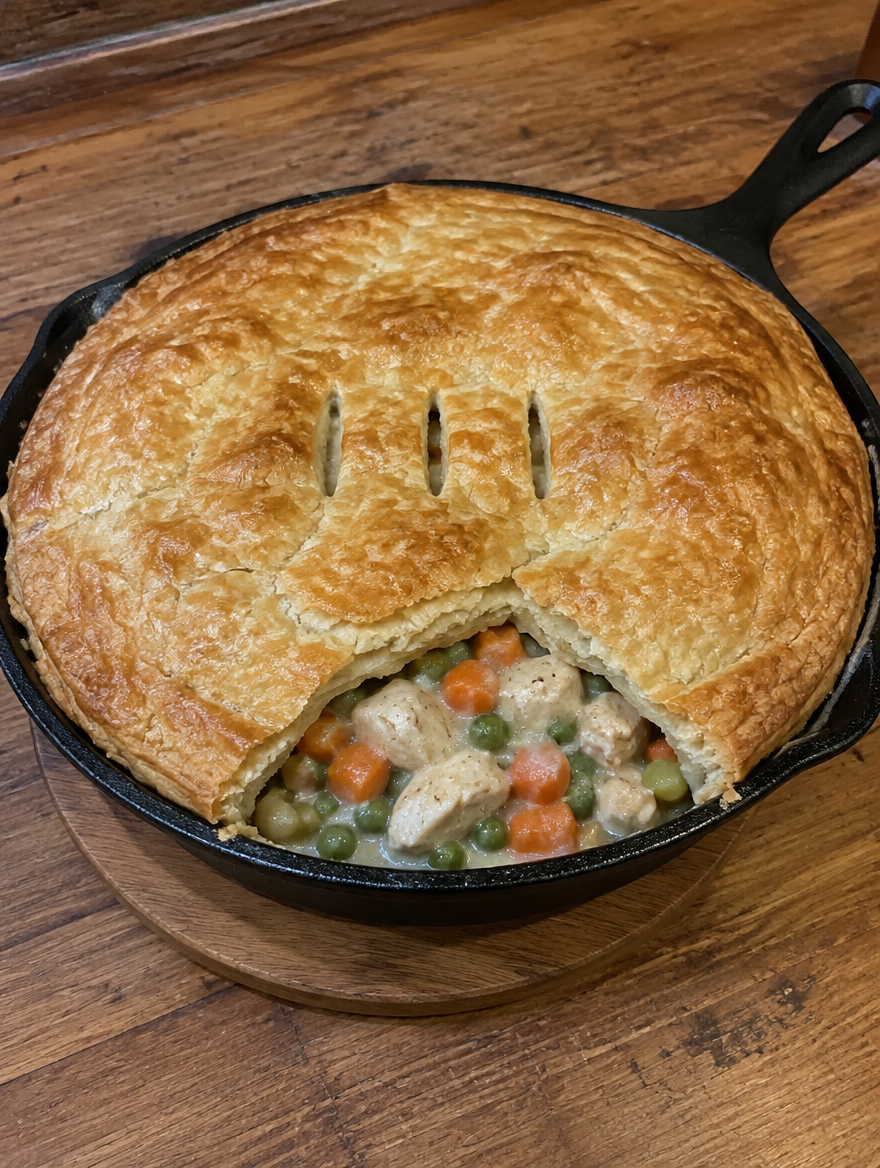
This easy chicken pot pie with puff pastry delivers the familiar comfort-food combination of tender chicken, carrots, peas, celery and a savory creamy filling beneath a flaky golden top. It uses cooked chicken and a single sheet of store-bought puff pastry instead of requiring a homemade double crust. The filling comes together in an oven-safe skillet, and the pie finishes in the oven with a crisp pastry lid.
Quick answer: soften 1 medium onion (140 g), 2 carrots (150 g) and 2 celery stalks (90 g) in 2 tablespoons (28 g) unsalted butter. Add 2 minced garlic cloves and ⅓ cup (42 g) all-purpose flour, then gradually stir in 2 cups (480 ml) low-sodium chicken broth and ½ cup (120 ml) whole milk. Season with 1 teaspoon dried thyme, ½ teaspoon salt, and ½ teaspoon black pepper. Fold in 3 cups (about 420 g) fully cooked shredded chicken and 1 cup (150 g) frozen green peas. After the filling thickens and cools slightly, place one thawed 8½-ounce (240 g) puff pastry sheet across the top, cut a few vents, brush with one beaten egg, and bake at 400°F (205°C) for about 25–35 minutes. The pastry should be baked through and the filling must reach 165°F (74°C) when checked with a thermometer. Let the pie settle about 10 minutes before serving. Yield: approximately six servings.
Editorial disclosure: this is an original AI-assisted recipe formulation, not independently tested in a physical kitchen. Pan dimensions, filling depth, puff pastry brand and oven performance affect cooking time. An accompanying food image, if published, is AI-generated illustration, not a photograph of an actual kitchen test. No laboratory-verified nutrition or cooking measurements are claimed.
Why This Chicken Pot Pie Is Easier
The classic double-crust pot pie can be satisfying, but rolling two layers of dough and preparing raw chicken make it a more involved project. This version cuts out two substantial tasks: use already-cooked chicken and cover the filling with one sheet of refrigerated-thawed puff pastry. There is no bottom crust to line or blind-bake.
The filling is built in one skillet. Butter softens diced vegetables, flour forms the base of a thickened gravy, and broth plus milk create a pourable sauce. Once the cooked chicken and peas go in, the pan is ready for its pastry lid. It is important not to make the filling excessively watery: a thin sauce releases more steam and can make the underside of the pastry damp.
Convenience does not eliminate food safety. Using rotisserie chicken or leftover cooked chicken means the filling needs to be heated thoroughly to 165°F in the completed pie, especially when previously refrigerated. Raw flour in the roux also needs proper cooking, while the puff pastry must be thoroughly baked.
Ingredients for Six Servings
Use a 10-inch deep oven-safe skillet or similarly sized suitable baking dish, with a rim or enough depth to contain the filling.
- 2 tablespoons (28 g) unsalted butter for the vegetable base.
- 1 medium yellow onion (about 140 g), finely diced.
- 2 medium carrots (about 150 g), peeled if desired and diced small.
- 2 celery stalks (about 90 g), trimmed and diced small.
- 2 garlic cloves, finely minced.
- ⅓ cup (42 g) all-purpose wheat flour.
- 2 cups (480 ml) low-sodium chicken broth.
- ½ cup (120 ml) whole dairy milk.
- 1 teaspoon dried thyme.
- ½ teaspoon fine salt, to adjust after tasting depending on the chicken and broth.
- ½ teaspoon ground black pepper.
- 3 cups (approximately 420 g) fully cooked, boneless chicken, diced or shredded, safely refrigerated until use.
- 1 cup (about 150 g) frozen green peas, added frozen.
- One 8½-ounce (approximately 240 g) sheet of frozen puff pastry, thawed in the refrigerator according to package instructions.
- 1 large egg, beaten with 1 teaspoon water for brushing the puff pastry top.
The recipe has intentional milk, wheat and egg ingredients. Commercial puff pastry may contain wheat, dairy, soy or other allergens depending on its brand, even if the filling is made in a clean pan. Read all labels for guests with allergies and avoid calling this version dairy-free or gluten-free.
Choose fully cooked chicken from a trusted, safely handled source. Raw chicken cannot simply be tossed into the finished filling with the expectation that a short pastry bake will safely cook all uneven chunks. If you begin with raw chicken, cook it fully to the appropriate safe temperature in a separate step before using this recipe.
Can You Use Rotisserie Chicken?
Yes, refrigerated fully cooked rotisserie chicken is a practical choice. Remove the bones and skin as desired, then measure about three cups of cooked meat. The exact weight depends on whether the meat is diced tightly or loosely shredded, so using about 420 g helps keep the chicken-to-gravy ratio consistent.
Handle store-bought hot or chilled chicken according to its label and safe cooling rules. Do not use a bird that has been left on a kitchen counter for many hours. If you bought a hot rotisserie chicken, refrigerate unused portions promptly instead of leaving it at room temperature overnight.
If you prefer to cook chicken specifically for the pie, season and cook boneless chicken separately until it reaches a verified 165°F internal temperature, then chop it. That extra step changes the total cooking time beyond the convenience version described here.
How to Choose the Right Puff Pastry
A single sheet of store-bought puff pastry creates a flaky lid because its laminated layers separate and crisp in the oven. It is different from biscuit dough, crescent-roll dough, phyllo pastry or ordinary pie crust. Those substitutions need different handling and should not be described as identical without testing.
Read the specific package’s refrigerator-thawing directions. Puff pastry needs to be pliable enough to unfold without breaking, while remaining relatively cool so its layers handle well. If the sheet becomes very warm or sticky, return it briefly to the refrigerator while preparing the filling.
For a 10-inch skillet, the sheet should cover the opening with a small overhang or be gently rolled just enough to fit. Avoid stretching it thin or repeatedly kneading the folds. Use a sharp knife to cut three or four small steam vents in the top, which helps moisture escape during baking.
Which Skillet Is Best?
Choose a deep oven-safe 10-inch cast-iron skillet, or an equivalent oven-safe pan with a secure handle and enough capacity for the filling. Do not place plastic-handled or unknown cookware into a 400°F oven. Check the actual manufacturer rating, including lid knobs, detachable components and handle coatings.
If your skillet is shallow, transfer the filling into a properly sized baking dish rather than overfilling and allowing hot gravy to spill onto the oven. A baking sheet under the skillet catches any drips, but it does not make a dangerously overfilled pan appropriate.
The skillet gets extremely hot while the pastry bakes. Use sturdy dry oven mitts and set the hot pan on a trivet. Warn anyone at the table about the handle, which stays hot after the pan is removed from the oven.
How to Make Easy Chicken Pot Pie in Eight Steps
1. Prepare the Chicken, Vegetables and Pastry
Preheat the oven to 400°F (205°C). Thaw the puff pastry in the refrigerator as directed by its package. Dice 140 g onion, 150 g carrots and 90 g celery into relatively small, similar pieces. Mince two garlic cloves and measure the flour, broth, milk and seasonings.
Keep the 420 g fully cooked chicken refrigerated until needed. You can use frozen peas straight from the freezer. Having everything ready means the filling can be finished without stopping the skillet halfway through to chop vegetables.
2. Soften the Vegetables in Butter
Place 28 g unsalted butter into a deep, oven-safe skillet over medium heat. Add the onion, carrots and celery. Stir for approximately 7–9 minutes, or until the onion is translucent and the diced carrots are beginning to soften. The vegetables will continue cooking in the sauce and oven.
Do not rush at very high heat. You want a tender vegetable base rather than blackened onion edges. If the butter browns too quickly, reduce the burner. The pan should be roomy enough for the finished filling.
3. Add Garlic, Flour and Seasonings
Add two minced garlic cloves and stir for 30 seconds, just until fragrant. Sprinkle in 42 g flour along with 1 teaspoon thyme, ½ teaspoon salt and ½ teaspoon pepper. Stir continuously for about one minute so that the flour mixes with the melted butter and coats the vegetables.
This forms a simple roux-like base that thickens the sauce. Do not leave dry flour in corners of the pan. Avoid scorching the mixture: a pale, cooked flour base is the goal, not a dark gumbo roux.
4. Build the Creamy Gravy
Pour in 480 ml low-sodium chicken broth gradually while stirring to dissolve the flour. Follow with 120 ml whole milk. Simmer gently for 3–5 minutes, stirring often, until the sauce becomes noticeably thickened and coats a spoon.
The consistency should be thick but not pasty. It needs enough moisture for the chicken and peas, but should not run across the skillet like water. If the sauce seems thin, keep it at a controlled simmer and stir until it thickens rather than dumping in unmeasured extra flour.
Taste for salt after accounting for the broth and precooked chicken. Many rotisserie chickens are already seasoned, so blindly adding more salt at every step can make the pie too salty.
5. Fold in Cooked Chicken and Frozen Peas
Turn the heat to low. Add 420 g cooked diced or shredded chicken and 150 g frozen green peas, folding gently until distributed throughout the creamy sauce. Warm for 2–3 minutes as the peas thaw and the chicken begins heating, then turn off the burner.
The ingredients should remain distinct: recognizable chicken, little peas, orange carrots, translucent celery and creamy gravy. The filling is not meant to be pureed into one color. Avoid adding potatoes, broccoli or cheese to the named version without reformulating the recipe.
6. Cool Briefly and Fit the Puff Pastry
Let the filling stand in the skillet for about five minutes so that it is no longer bubbling vigorously. Unfold the cool, thawed puff pastry sheet and place it over the skillet opening, trimming or gently rolling only as needed. Tuck or fold the edge where appropriate without sealing it into a thick, doughy rim.
Cut three or four small steam vents with a sharp knife. Beat the egg with one teaspoon water and brush a thin layer over the top pastry only, keeping excess egg wash from pooling along the skillet edge. Never put uncooked puff pastry under the already-made filling; this is a top-crust-only pot pie.
7. Bake Until Golden and the Filling Is 165°F
Place the oven-safe skillet on a rimmed baking sheet and bake at 400°F (205°C) for about 25–35 minutes. The pastry should be deeply golden and fully puffed, without raw dough patches. The hot filling should bubble near some of the vents or edges, but visual bubbling alone is not a food-safety temperature test.
Use an instant-read food thermometer inserted carefully through a vent or exposed edge of the filling; it must read 165°F (74°C) in the filling. Check more than one spot if the skillet is large or dense. If the pastry browns too quickly before the middle reaches the safe temperature, loosely shield the top with foil and continue baking as needed. Oven performance and pastry thickness vary.
8. Rest, Portion and Serve
Remove the skillet carefully with dry oven mitts, set it on a heatproof trivet, and let the pot pie rest about 10 minutes before serving. The gravy will settle and become easier to spoon, while the pastry remains flaky. The skillet handle stays hot; consider placing a visible mitt or handle cover over it during serving.
Spoon a serving containing both flaky pastry and hot filling onto a clean plate. For a home-cooked dinner, no salad, mashed potatoes or extra cheese needs to be added to the pie itself.
How to Get a Crisp, Flaky Puff Pastry Top
The first requirement is a thickened filling. If a watery sauce is poured under the pastry, steam rises into the layers and can make the underside soft. Thicken the broth-and-milk sauce before assembling, and avoid loading the skillet with additional liquid from canned vegetables.
The second requirement is to keep the pastry cool before baking. Warm pastry becomes sticky and may not puff as well. Store it refrigerated until the filling has finished and settled slightly.
Third, do not seal the entire edge with a thick band of folded pastry that cannot cook through. Make a modest edge, cut steam vents and apply a thin egg wash so the top browns evenly.
Finally, do not remove the pot pie simply because the top looks golden. The pastry must be cooked through and the filling must measure 165°F. Appearance is helpful for texture, but a thermometer verifies the temperature.
Pot Pie With Puff Pastry vs. Pie Crust
A traditional pie crust is a more compact pastry that can be used both under and over a filling. Puff pastry is laminated dough designed to expand into flaky layers during baking. Both can taste good, but they are not interchangeable without changing technique.
A top-only puff pastry method is well suited to a skillet because you do not have to keep a bottom crust dry. The filling can be made on the stovetop first and covered directly before the oven bake. That is what makes this recipe especially accessible for a weekday dinner.
Using canned biscuits, crescent rolls or phyllo sheets would change bake times, sealing, thickness and texture. Treat those as different recipes rather than casually substituting them into the exact directions on this page.
Why You Should Use Fully Cooked Chicken
The core ingredient is already cooked chicken, whether from a safely handled rotisserie bird or leftovers that were refrigerated properly. The skillet stage warms it in the gravy, and the oven completes heating the assembled dish until it reaches 165°F. That method is not written for raw chicken cubes.
Adding raw chicken would require a separate cooking process and a different food-safety plan. Do not assume the pastry’s golden color proves raw chicken beneath it has cooked. The CDC’s food-safety guide165°F for poultry and casseroles and advises using a food thermometer, rather than appearance alone, to establish safe cooking temperatures.
If using leftover chicken, make sure it was kept safely refrigerated after its original preparation. Reheating unsafe leftovers cannot compensate for unknown periods of improper storage.
Fixing a Filling That Is Too Runny or Thick
If the filling is watery before the pastry goes on, simmer it uncovered for a few more minutes while stirring, so moisture evaporates and the flour thickens. Do not sprinkle dry flour directly onto the finished filling: lumps are difficult to remove after the chicken and peas have been added.
If the gravy is excessively thick and pasty, add a small measured splash of broth, stir, and reassess. A large pour may undo the thickening work. Remember that frozen peas can release some moisture as they warm.
A practical test is to drag a spoon across the skillet bottom. The sauce should briefly show a trail before closing, not flow instantly like milk. The actual viscosity varies with flour type, cooking time, and the amount of liquid released by vegetables.
How to Prevent Soggy Puff Pastry
The filling should be hot but not violently bubbling when the pastry is added, and the pastry should still be cool and pliable. Cutting the vents allows moisture to escape instead of becoming trapped beneath the lid.
Do not overload the skillet with extra vegetables that release water. This formulation uses measured carrots, celery and peas, with no watery squash or mushrooms in the core mixture. If you change the vegetables significantly, you may need to rebalance the thickening and bake time.
Also choose a skillet with enough depth. A filling that reaches the very brim will wet the pastry edge repeatedly. Leave some space, or transfer to a suitably sized oven-safe baking dish.
Four Mistakes to Avoid
Using raw chicken without adjusting the method. The recipe requires fully cooked meat and a final measured 165°F filling. Raw meat needs separately verified cooking.
Putting the pastry on a watery filling. Reduce and thicken the gravy on the stove before topping. Otherwise the pastry can become soggy and the filling may leak.
Overfilling a shallow skillet. Leave enough space for bubbling and rising pastry. Hot gravy spills are dangerous and can burn in the oven.
Skipping the temperature check. Golden pastry does not prove the filling reached 165°F. Use a thermometer in the center, especially when using chilled cooked chicken.
Cutting immediately from the oven. A 10-minute rest lets the very hot filling settle and makes serving cleaner. Use care around the hot handle.
Make-Ahead Options
You can dice the vegetables in advance and refrigerate them appropriately. Cooked chicken can be prepared or purchased ahead if stored safely. If you make the gravy-and-chicken filling earlier, refrigerate it promptly in shallow containers until it is time to assemble.
When ready to bake, heat the filling safely and thoroughly, transfer it to an oven-safe skillet or dish, apply the cool puff pastry and finish baking until the entire filling measures 165°F. You may need to adjust baking time compared with an immediately assembled warm filling.
Do not leave a deep skillet of cooked filling on the counter for many hours while waiting for dinner. Divide larger volumes into shallow containers for quick refrigeration, as recommended by federal food-safety guidance.
What to Serve With Chicken Pot Pie
A generous scoop of pot pie already contains chicken, vegetables, sauce and pastry. It is satisfying as a standalone dinner. If you want a different baked chicken-and-vegetable dish for another night, see our creamy chicken and broccoli rice casserole, which uses rice rather than puff pastry and has a separate recipe.
For a prep technique focused on cooking a whole chicken rather than using rotisserie meat, our chicken brine recipe for oven-roasted chicken
Another pantry-friendly comfort-food format is creamy Parmesan garlic orzo in one pot. Its pasta base is not a substitute for the pot-pie gravy, but it offers an alternative one-pan meal idea.
Storage and Reheating
Chicken pot pie contains cooked poultry, milk and pastry. Refrigerate leftovers in clean shallow containers within two hours, or within one hour if ambient temperature exceeds 90°F (32°C). Keep your refrigerator at 40°F (4°C) or lower and avoid leaving the large cast-iron skillet with warm filling out overnight.
For safely handled, properly refrigerated leftovers, a common federal food-safety window is 3–4 days, but this does not guarantee the shelf life of a batch that was handled improperly. When reheating, make sure the filling reaches 165°F in several places. The USDA FSIS reheating guidance
Reheating can soften puff pastry, so its texture may be less flaky than freshly baked. If you warm in an oven, use a heat-safe dish and check that the filling is hot all the way through. Do not assume a hot crust means the center has reached temperature.
For freezing, the texture of pastry and dairy gravy may change and this particular formulation has not been tested through freezing and thawing. Follow safe freezing, thawing and reheating procedures if you choose to freeze leftovers, and avoid inventing a product-specific guaranteed storage period.
Frequently Asked Questions
Can I make chicken pot pie with puff pastry instead of pie crust?
Yes. This recipe uses one puff pastry sheet as the top crust. There is no bottom crust, and the filling is thickened on the stovetop before the oven bake. Puff pastry produces a different texture from traditional pie dough.
Can I use rotisserie chicken?
Yes, provided the chicken is fully cooked and has been handled and refrigerated safely. Measure about three cups (420 g) of boneless meat and heat the completed pot pie filling to 165°F.
How do I stop the pastry getting soggy?
Thicken the gravy before assembly, avoid extra liquid, let the filling stop bubbling aggressively and use a cool thawed pastry sheet with small steam vents. Bake fully and check the filling temperature.
What temperature should chicken pot pie reach?
The center of the filling must reach 165°F (74°C), checked with a food thermometer. Chicken and casseroles are covered by this federal minimum. A brown pastry lid alone cannot verify it.
Do I cook the vegetables before baking?
Yes. Diced carrots, onion and celery soften in butter before the gravy is prepared. Frozen peas are added later with fully cooked chicken, then the pie finishes in the oven.
Can I make it without milk?
Not by simply omitting the milk without adjustment. This version has 120 ml whole milk and 28 g butter. A dairy-free change requires an adjusted filling and careful packaged-pastry label checks.
Can I use leftover cooked chicken?
Yes if it was refrigerated promptly and safely, then reheated thoroughly in the finished casserole. Do not use chicken that has been left at unsafe room temperature for hours.
Do I need a bottom crust?
No. This is specifically a top-only puff pastry pot pie. The filling is cooked in an oven-safe skillet, and a single pastry sheet becomes the lid.
Can I add potatoes?
Potatoes would change the measured filling volume and cooking time. This version uses carrots, celery, peas and chicken, with no potatoes. Use a specifically developed potato version if that is your preference.
How long does puff pastry pot pie bake?
Approximately 25–35 minutes at 400°F, depending on the oven, pastry thickness and filling temperature. Continue until the pastry is baked and the filling measures 165°F in the center.
Why is my sauce too thin?
The flour may not have simmered sufficiently, or extra liquid may have been added. Simmer gently and stir until the gravy thickens before adding the puff pastry.
How long can I keep leftovers?
Safely handled pot pie should be refrigerated promptly at 40°F or less. A general USDA leftover guidance window is three to four days, with full reheating to 165°F, but storage conditions matter.
Final Thoughts
For an easy chicken pot pie recipe, use fully cooked chicken, measured vegetables, a properly thickened homemade gravy, and one refrigerated-thawed puff pastry sheet over the top. Bake in an oven-safe skillet until the pastry is golden and the filling reads 165°F, then allow the casserole to settle before serving.
The result is a straightforward, familiar chicken dinner designed for a U.S. home kitchen. It contains dairy, eggs and wheat, so it is not suitable for those avoiding these ingredients without a separate modified recipe.
Transparency statement: Original AI-assisted editorial recipe; no independent physical cooking test was performed. Image, if present, is an AI-generated representation, not an actual cooked trial or thermometer measurement. Nutrition estimates have not been manufactured.
This original AI-assisted recipe has not been independently kitchen-tested. The food photo is an AI-generated illustration, not documentation of a physical kitchen test.
Print
Easy Chicken Pot Pie With Puff Pastry
- Prep Time: 30 minutes
- Cook Time: 35 minutes
- Total Time: Approximately 1 hour 15 minutes, including 10-minute rest; excludes pastry refrigerator thawing
- Yield: About 6 servings 1x
- Category: Chicken & Poultry Creations
- Method: Skillet-made cooked chicken gravy filling, puff pastry top and oven bake at 400°F
- Cuisine: American home comfort food
Description
Easy chicken pot pie topped with one sheet of flaky puff pastry and filled with fully cooked chicken, carrots, celery, peas, and a creamy chicken gravy, baked in an oven-safe skillet.
Ingredients
2 tablespoons (28 g) unsalted butter
1 medium yellow onion (140 g), finely diced
2 medium carrots (150 g), finely diced
2 celery stalks (90 g), finely diced
2 minced garlic cloves
1/3 cup (42 g) all-purpose wheat flour
2 cups (480 ml) low-sodium chicken broth
1/2 cup (120 ml) whole dairy milk
1 teaspoon dried thyme
1/2 teaspoon fine salt, adjust for broth and seasoned chicken
1/2 teaspoon ground black pepper
3 cups (about 420 g) FULLY COOKED boneless chicken, shredded or diced
1 cup (150 g) frozen green peas
1 sheet frozen puff pastry (about 8 1/2 oz / 240 g), thawed in refrigerator according to package
1 large egg beaten with 1 teaspoon water for puff pastry top glaze
Instructions
Preheat oven to 400°F (205°C), thaw puff pastry in refrigerator per package. Dice 140 g onion, 150 g carrots and 90 g celery, mince 2 garlic cloves and measure remaining ingredients, keeping 420 g FULLY COOKED chicken chilled until needed.
In a deep oven-safe 10-inch skillet over medium heat, melt 28 g unsalted butter. Add onion, carrots and celery; stir approximately 7–9 minutes to soften without browning or burning.
Add minced garlic for about 30 seconds. Sprinkle 42 g wheat flour, 1 tsp thyme, 1/2 tsp salt and 1/2 tsp pepper; stir one minute so flour is incorporated into the butter-vegetable base.
Gradually add 480 ml low-sodium chicken broth while stirring, followed by 120 ml whole milk. Simmer gently about 3–5 minutes, stirring until a thick spoon-coating gravy forms.
Fold in 420 g fully cooked shredded chicken and 150 g frozen peas. Warm 2–3 minutes at low heat, then remove pan from burner. The sauce should be thick, not watery; let filling cool about 5 minutes until not violently bubbling.
Drape one thawed, still-cool puff pastry sheet over skillet opening, rolling only enough to cover; make 3–4 steam vents. Beat one egg with 1 tsp water and brush a thin layer on top, not the exposed filling. Skillet must have an oven-safe handle.
Bake skillet on rimmed sheet pan in 400°F oven approximately 25–35 minutes until pastry fully puffed and deeply golden and an instant-read thermometer shows the FILLING has reached at least 165°F (74°C), checking multiple sites. If pastry browns before filling reaches temp, tent loosely with foil.
Using dry oven mitts transfer hot skillet to heatproof trivet, rest about 10 minutes, portion and serve. Warn that handle is still very hot. Refrigerate leftovers within 2 hours (or 1 hour when above 90°F), 40°F or cooler, reheat fully to 165°F.
Notes
Original AI-assisted recipe is NOT independently kitchen-tested. Featured photo, if attached, is an AI-generated illustration and not a documented physical bake. The recipe calls for FULLY COOKED chicken only, NOT raw chicken cubes. Chicken casseroles/reheated filling must reach 165°F in the center by thermometer, not inferred from pastry browning. Check puff pastry product temperature, thawing instructions and oven-safe skillet handle. Core allergens WHEAT, MILK (whole milk and butter), and EGG (egg wash); some packaged pastry may carry additional allergens, check labels/cross-contact. No bottom crust or potatoes in the original formula. Federal CDC and USDA FSIS advise refrigerating cooked leftovers within two hours and reheating leftovers to 165°F; 3–4 days general refrigerator guidance under safe handling, not a guaranteed shelf life. No invented calorie/nutrition information.
Nutrition
- Serving Size: 1/6 of a 10-inch skillet pot pie
Keywords: chicken pot pie recipe easy, easy chicken pot pie with puff pastry, skillet chicken pot pie, rotisserie chicken pot pie
1 thought on “Easy Chicken Pot Pie With Puff Pastry”