
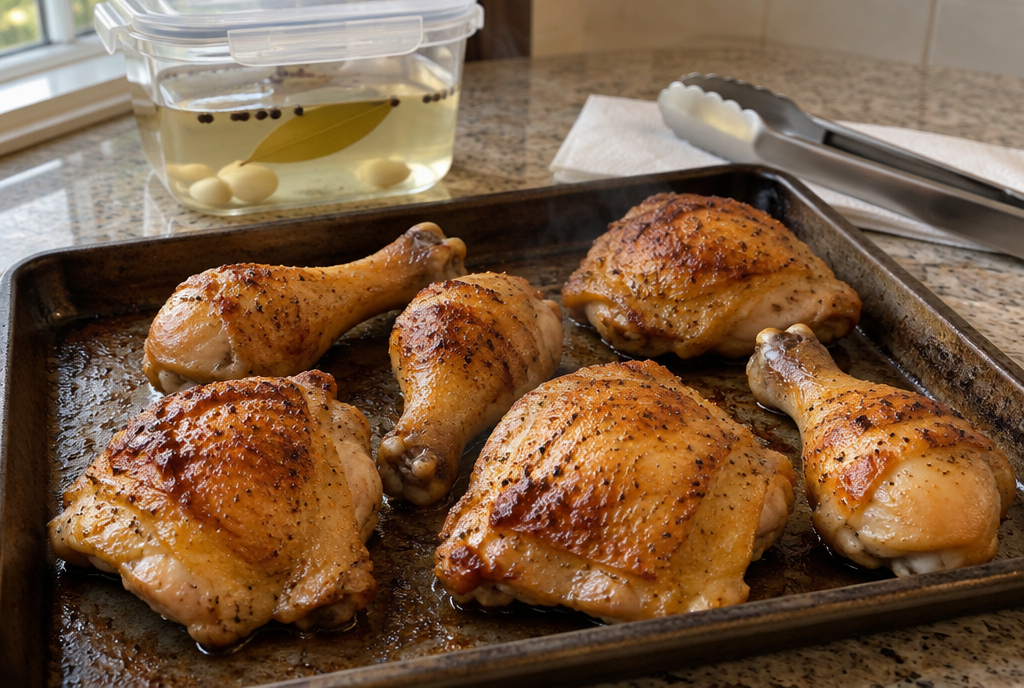
Chicken Brine Recipe for Juicy Oven-Roasted Chicken
Quick answer
For a simple wet chicken brine, dissolve 60 g fine sea salt and 35 g sugar in 1 liter of water, chill thoroughly, then refrigerate approximately 2 lb (900 g) of bone-in chicken pieces fully submerged for 2–4 hours. Remove the chicken, discard the used brine, pat dry with clean paper towels, and cook promptly to an internal temperature of 165°F (74°C), checked with a food thermometer. Salt concentration is measured by weight because a tablespoon of kosher salt and a tablespoon of fine salt do not weigh the same.
Ingredients and yield
Makes approximately 1 liter brine, enough to cover about 2 lb (900 g) bone-in chicken thighs or drumsticks in a snug, food-safe nonreactive container.
- 1 liter (about 4¼ US cups) cold potable water, divided
- 60 g (2.1 oz) fine sea salt, weighed
- 35 g (1.2 oz) granulated sugar, weighed
- 2 dried bay leaves, optional
- 1 tsp whole black peppercorns, optional
- 2 peeled garlic cloves, lightly crushed, optional
The aromatics are optional; they must be clean and added to a cold brine. Do not include extra salt in the seasoning rub after brining without first tasting the cooked chicken.
Method
- Wash hands and sanitize the work area. Use a food-safe, nonreactive container large enough for the chicken and brine. Do not wash or rinse raw poultry.
- Heat about 250 ml of the water in a saucepan, then stir in the weighed salt and sugar until dissolved. Add bay leaves, peppercorns, and garlic if using. This is a dissolving step, not a step for cooking the chicken.
- Add the remaining 750 ml cold water and refrigerate the mixture until thoroughly cold, 40°F (4°C) or below. Never immerse raw poultry in warm brine.
- Place the chicken in the container and pour over the chilled brine. Keep it covered and refrigerated at or below 40°F (4°C) for 2–4 hours. Do not leave it on a counter or at room temperature.
- Lift out the chicken using clean utensils. Discard all used brine; never use it as a sauce or marinade for ready-to-eat food. Avoid splashing raw juices. Pat the chicken dry with disposable paper towels.
- Cook the chicken immediately, using an oven, skillet, or other suitable method. For bone-in thighs, an oven around 425°F (220°C) can provide browned skin, but actual cooking time varies by piece size, oven, and pan. Check the thickest part without touching bone: chicken must reach 165°F (74°C).
- Transfer cooked chicken to a clean platter, not the raw-chicken plate. Refrigerate leftovers promptly in shallow covered containers within 2 hours (within 1 hour when ambient temperature is above 90°F/32°C), and use refrigerated leftovers within 3–4 days.
Why salt weight matters
Salt crystal sizes vary dramatically. A volume measure that works for one brand of kosher salt may be much saltier with fine table salt. Weighing 60 g per liter produces a reproducible approximately 6% salt-by-water-weight solution, before considering the chicken’s moisture and any additional ingredients. This is a concentrated wet brine intended for a relatively short exposure. It is not a shelf-stable preservation method and does not make poultry safe without proper refrigeration and cooking.
Timing and food safety
The prep work takes roughly 10 minutes, followed by cooling time, 2–4 hours of refrigerator brining, and a separate cooking stage. Total elapsed time depends on how quickly the brine chills and which chicken pieces are used. Never count brining as a replacement for safe cooking. A thermometer, not appearance or clear juices, determines doneness. Keep raw poultry away from produce, bread, and ready-to-eat ingredients. Wash utensils, boards, sinks, and hands after contact.
Troubleshooting
If chicken tastes too salty, first check whether the salt was measured by weight and whether the meat was brined longer than the specified range. Some packaged poultry is already enhanced with a salt solution; inspect the label before adding a wet brine. If the chicken browns poorly, ensure its surface is thoroughly patted dry and avoid overcrowding the pan. If the brine remains warm after mixing, refrigerate it until it reaches 40°F (4°C) or colder before adding the chicken. Do not speed this process by adding raw chicken to warm liquid.
Frequently asked questions
Can I brine chicken overnight?
Not with this relatively concentrated formulation. Use the stated 2–4 hour range for bone-in pieces. Overnight brining may make the meat excessively salty and change the texture.
Can I use table salt?
Yes, provided it is weighed rather than substituted tablespoon for tablespoon. A scale is the most reliable approach.
Can I brine frozen chicken?
Thaw poultry safely in the refrigerator first. Do not leave frozen poultry at room temperature to thaw in brine.
Can I reuse chicken brine?
No. Discard brine after it contacts raw poultry; it can contain harmful microorganisms.
Should I rinse chicken after brining?
No. Rinsing raw poultry spreads droplets and increases cross-contamination risk. Pat it dry instead.
Can I use this for a whole chicken?
The amount and brining duration would require separate validation. This version is specifically for approximately 2 lb of bone-in pieces.
Does brining cook chicken?
No. The chicken still must reach 165°F (74°C) as measured with a food thermometer.
Can I add lemon?
Lemon can change flavor and texture; the base formulation does not require it. Avoid altering the tested-as-written ingredient ratios until an appropriate culinary review.
Choosing the right chicken pieces
This recipe is deliberately written for approximately two pounds of bone-in chicken thighs or drumsticks, not for an entire turkey, whole chicken, or boneless breast. Bone-in pieces are easier to fit in a compact container with approximately one liter of brine; they also suit an oven-roasted finish. Whole birds have a different thickness and distribution of meat, so using this exact time window without adjustment would be unreliable.
Read the package before you mix salt into water. Some poultry is marked as “enhanced,” “contains a solution,” or “pre-brined,” meaning that salt or other ingredients may have been added during processing. Additional brining could make such meat unpleasantly salty. For the most predictable home result, select plain chicken without added seasoning solution. If you choose enhanced chicken, follow the producer’s preparation advice instead of assuming another salt soak is helpful.
Keep the chicken in the refrigerator while you gather your equipment. There is no need to wash raw poultry; splashing can move microorganisms from chicken juices onto the sink and nearby countertops. The CDC’s guidance on chicken and food poisoning recommends cooking to 165°F and preventing cross-contamination rather than washing meat.
Wet brine versus dry brine
A wet brine is a measured solution of water and salt, sometimes supplemented with a modest amount of sugar and aromatics. A dry brine uses salt applied directly to the surface of the meat and rests under refrigerated conditions. These methods are not interchangeable cup-for-cup because the salt contacts the meat differently and the total water amount differs.
Our wet brine uses 60 grams of salt per liter of water. As a kitchen measurement, this is about six percent salt relative to the weight of the water before accounting for dissolved sugar or the chicken’s own moisture. It is more concentrated than a casual “pinch of salt” soak, so the 2–4-hour limit is part of the formulation. A longer soak is not automatically better.
The USDA’s poultry-brining explanation recommends food-safe containers, cold covered refrigeration, and discarding the liquid after contact with raw poultry. It also notes that salt and optional sweetener have different roles. That guidance provides a useful safety framework; it does not independently test these particular salt and sugar quantities.
Why a digital scale matters
The size of salt crystals changes how much salt fits into a tablespoon. Coarse kosher salt may weigh significantly less than fine sea salt for the same volume. Substituting three tablespoons for 60 grams without checking the brand can shift the solution’s strength. Weighing is the simplest way to keep the recipe consistent from one attempt to the next.
Set a clean mixing bowl on a kitchen scale, tare the scale to zero, and add salt until it reads 60 grams. Tare again or measure sugar separately to reach 35 grams. Both values are part of this recipe. If you don’t have a scale, it’s better to use a different recipe written and verified for your exact salt type than to guess at the spoon conversion.
One liter equals 1,000 milliliters. Warm only about 250 milliliters to dissolve the salt and sugar, then add the remaining 750 milliliters. The final liquid must be fully chilled before it touches the raw chicken. Cold tap water alone may not reduce the temperature sufficiently if the warmed part is still hot, so confirm the finished brine is at or below 40°F with a food-safe thermometer before use.
Picking a food-safe brining container
Use a clean glass, food-grade plastic, or stainless steel container that fits all the chicken pieces without crowding them above the liquid. Avoid containers that previously held nonfood chemicals, and don’t use reactive materials or unknown decorative metal bowls. A deep, narrow container often requires less brine for full coverage than a very wide pan.
Arrange the chicken below the liquid surface and cover the container securely. Do not wedge in a loose, nonfood object to force meat down. If one liter is clearly insufficient, choose a more compact food-safe vessel rather than adding an arbitrary amount of water that dilutes the measured brine. To make a larger batch, recalculate every ingredient proportionally before adding the chicken, keeping the same salt-to-water ratio and the same refrigerated time guidance for similarly sized pieces.
Place the covered brining vessel on a lower refrigerator shelf, inside a clean tray if needed to catch drips. The goal is to keep any raw-poultry liquid away from salad greens, fruit, cooked food, or other ready-to-eat items. Store in a refrigerator holding 40°F or colder, not on the back porch, in a warm sink, or in a cooler without a verified cold temperature.
Cooling the brine without exposing chicken to warmth
Only heat enough water to dissolve the weighed salt and sugar efficiently. Stir until no obvious grains remain, then add the rest of the water and place the liquid in the refrigerator to cool. Do not pour warm brine over chicken and count its time on the counter as part of the soak. A raw-chicken brine must be refrigerated throughout.
If your cooling vessel is large, transfer the brine to a shallower closed container before chilling to speed cooling, taking care to keep it sanitary. Do not contaminate the cold brine with dirty utensils. A small clean thermometer is useful for confirming the temperature. Optional peppercorns, garlic, and bay leaves are flavor additions only; they do not sterilize the solution or make unrefrigerated brining safe.
You can organize the brine earlier in the day, provided the liquid is prepared hygienically and kept cold. Add the raw chicken only when you are ready to begin the timed refrigerator soak. That separation helps avoid accidentally leaving chicken in an increasingly salty solution overnight.
Brining time for thighs and drumsticks
For this recipe’s bone-in pieces and concentrated salt solution, use the specified two- to four-hour refrigerated range. Very small pieces can season more quickly than very large pieces, and the texture of chicken varies from batch to batch. Start nearer the shorter end if the pieces are small or if you prefer a lighter salt taste. Do not extrapolate the same duration to a whole bird.
Set a kitchen timer when the chicken is fully submerged in cold brine. Label the container with the time if other people share the refrigerator. After the timer finishes, lift the pieces using clean utensils and dispose of all used brine. The solution has contacted raw chicken, so it must not be served as a sauce, reused for a second batch, or brushed onto cooked food.
The USDA indicates that brining is a preparation technique, not a way to make chicken safe without cooking. The FoodSafety.gov minimum cooking temperature chart identifies 165°F (74°C) for chicken pieces and other poultry, regardless of whether the meat was brined.
Pat the skin dry for more effective roasting
Once the chicken comes out of the brine, let excess liquid drain into the container that will be discarded. Then pat the pieces dry with disposable paper towels, handling the paper immediately as a raw-meat-contact item. This helps the skin brown in a hot oven. There is no need to rinse the chicken under running water: rinsing can spread droplets around the work area.
Set the pieces on an oven-safe baking tray with room between them, using clean equipment. If you are seasoning the chicken before roasting, remember the meat has already spent time in salty liquid. Do not automatically add the same amount of salt you would apply to unbrined meat. For this basic method, the original brine flavor can be enough; extra spices are optional and would change the listed formulation.
A tray crowded tightly with pieces may steam rather than brown. A wire rack suited to the tray can improve airflow, but it is optional and should be handled safely. Use clean oven mitts and don’t place hot pans on an unprotected countertop. The priority remains cooking the thickest portions completely.
Roasting chicken after brining
An oven setting around 425°F (220°C) is a practical starting point for bone-in thighs or drumsticks, as long as your oven, pan, and chicken size suit the method. The time cannot be fixed accurately from the brine recipe alone. Ovens differ, and thigh pieces can vary considerably in thickness. Begin checking the internal temperature before you expect the meat to finish.
Insert a clean food thermometer into the thickest meaty area without touching the bone. Check more than one piece when sizes differ. Chicken must reach at least 165°F (74°C) before serving. Don’t use a golden color, clear juices, or a browned skin as a substitute for a thermometer reading.
After cooking, transfer the chicken to a clean serving plate. Do not return it to the plate or tongs that held raw poultry unless those items have been properly cleaned. Allowing the chicken to stand briefly can help with serving, but it does not replace the minimum internal temperature requirement. These principles apply just as much if you choose to skillet-cook or air-fry the brined pieces.
How brining changes flavor and texture
Salt can alter how muscle proteins retain moisture during cooking, which is why brined chicken may taste more seasoned and remain pleasantly juicy. This is an expected mechanism of brining, not evidence that our individual version has been tested. The amount of improvement depends on the meat, salt strength, resting time, and final cooking method. A brine cannot rescue spoiled poultry or guarantee juicy results after severe overcooking.
Sugar has a modest balancing role and may affect browning, but the 35 grams in this recipe are not a dessert-like sweetness. Garlic, bay leaves, and whole peppercorns are optional background aromas; the core formulation is simply water, salt, and sugar. Their use won’t overcome refrigeration problems, and they should be included only if you enjoy those flavors.
If a cooked piece tastes excessively salty, use a shorter refrigerated brining interval the next time and check whether your packaged chicken was already treated with solution. Do not try to remedy raw chicken by rinsing it under the faucet. Instead, focus on using the correct weights and carefully controlled timing on the next batch.
Different cooking methods after the brine
This brining method ends when the chicken is removed from its cold solution, patted dry, and cooked safely. Oven roasting is used as the example, but you can also apply a suitable air-fryer or skillet method for the same type of chicken pieces. Different equipment needs its own time and temperature settings. Keep the constant rule: use a food thermometer and confirm 165°F (74°C) in the meat.
If air-frying sounds useful, see our air fryer chicken thighs for an easy weeknight dinner, a separate recipe with its own equipment and timing. For another flavor profile, our crispy honey garlic chicken thighs with roasted vegetables illustrates a sweeter glaze and sheet-pan dinner rather than the plain brine here. If you prefer smaller pieces on skewers, the garlic herb butter chicken skewers are a different cooking approach that should not inherit this bone-in brining time unchanged.
These related links are for exploring ways to cook chicken, not instructions to mix their glazes or timing into the salt solution. The current recipe’s target remains bone-in pieces, a carefully measured wet brine, refrigerated handling, and thermometer-verified completion.
Storage and meal-prep planning
Cooked chicken should not remain in a large warm pan on the counter while everyone finishes dinner. Divide leftovers into shallow covered containers, refrigerate within two hours of cooking, or within one hour when the surrounding temperature is above 90°F (32°C). Keep the refrigerator at 40°F (4°C) or below. Use refrigerated cooked chicken within three to four days or freeze it for longer storage, following USDA’s refrigerator storage guidance for chicken.
The raw brine itself is never a make-ahead stock after the meat has been in it. Discard the used liquid. If you want to prepare multiple batches of chicken, make fresh brine in a clean container for each one. Keep separate raw and cooked equipment; clean cutting boards, sink surfaces, and utensils with hot soapy water after raw-poultry contact, and wash hands thoroughly.
Freeze cooked portions in well-sealed, labeled containers if you won’t use them within a few days. Thaw safely in the refrigerator, not overnight on the countertop. Reheat leftovers thoroughly to 165°F (74°C). Brining may change the meat’s texture, but it does not remove the ordinary safety requirements for cooked chicken.
Common brining problems and corrections
The solution seems cloudy: This can happen as ingredients mix, but a cloudy appearance is not proof of safe handling. If a brine has been stored too warm, contaminated, or left with raw poultry beyond the planned period, discard it rather than relying on appearance.
The chicken tastes too salty: Check the scale, starting poultry label, and soak duration. Do not extend the soak to “make it more juicy” with an already concentrated solution.
The skin fails to brown: Dry the pieces well after brining, leave space on the roasting tray, and use a suitable oven temperature. Inspect chicken doneness independently with the thermometer.
There isn’t enough liquid to cover the pieces: Choose a narrower food-safe container or scale the entire brine recipe rather than diluting only the salt solution with extra water.
The chicken is unevenly cooked: Use similar-size pieces when possible, avoid crowding the oven tray, and check each thick piece with the thermometer, making sure the probe does not touch the bone.
The brine is still warm after adding cold water: Don’t add chicken. Chill the solution all the way to 40°F (4°C) or below, and verify with a thermometer before beginning the timing.
Additional questions to consider
Do I have to use aromatics in the brine?
No. Bay leaves, peppercorns, and garlic are optional. Water, salt, and sugar establish the basic formulation. Add aromatics only for the flavor you want, and keep the completed brine cold.
Does sugar make the chicken sweet?
A modest quantity may soften the salt impression and contribute to browning, but it is not meant to create an obvious sugary glaze. The chicken should still taste savory.
Is it safe to leave a covered brine on the kitchen counter?
No. A covered container is not a substitute for refrigeration. Keep both raw chicken and the brine at or below 40°F (4°C) while the poultry is submerged.
How can I avoid extra salt from packaged chicken?
Inspect the package for phrases such as “contains up to X% solution,” “enhanced,” or “seasoned.” Choose unenhanced chicken for this formulation, or follow the package directions rather than adding an untested extra brine.
Can the chicken be cooked the next day?
This recipe is written to remove and cook the pieces promptly after the short brine. If a different schedule is necessary, follow USDA raw-poultry cold-storage limits, keep everything safely refrigerated, and avoid extending time in the salt solution.
Editorial and illustration disclosure
This recipe is an editorially developed preparation guide and has not been independently kitchen-tested. Any accompanying generated illustration must be explicitly identified as an illustration rather than a photograph of a cooked test batch.
Editorial transparency: This is an original editorial formulation that has not been independently kitchen-tested. The featured photograph is an AI-generated illustrative depiction, not a record of chicken prepared by the editorial team. Follow thermometer-confirmed poultry safety instructions.
Print
Chicken Brine Recipe for Juicy Oven-Roasted Chicken
- Prep Time: 10 minutes
- Cook Time: Varies by cooking method; cook to 165°F
- Total Time: 2–4 hours brining plus cooling and cooking
- Yield: Approximately 1 liter brine for 2 lb chicken 1x
- Category: Chicken & Poultry Creations
- Method: Refrigerated wet brining
- Cuisine: American
Description
A measured, refrigerated wet brine for about two pounds of bone-in chicken pieces; not independently kitchen-tested.
Ingredients
1 liter cold potable water, divided
60 g fine sea salt, weighed
35 g granulated sugar, weighed
2 dried bay leaves (optional)
1 tsp whole black peppercorns (optional)
2 peeled garlic cloves, crushed (optional)
2 lb bone-in chicken thighs or drumsticks
Instructions
Sanitize the work area; do not wash raw chicken.
Warm 250 ml water and dissolve weighed salt and sugar; add optional aromatics.
Mix in remaining 750 ml water and chill to 40°F (4°C) or below before adding chicken.
Submerge chicken in chilled brine in a covered food-safe container; refrigerate at or below 40°F (4°C) for 2–4 hours.
Remove chicken with clean utensils, discard all used brine and pat dry with disposable paper towels; do not rinse poultry.
Cook chicken promptly to 165°F (74°C) at the thickest point, verified with a food thermometer, avoiding bone.
Transfer to clean serving utensils and refrigerate leftovers promptly within 2 hours, or within 1 hour above 90°F ambient temperature.
Notes
This recipe has not been independently kitchen-tested. Do not brine at room temperature. Do not reuse used brine. Check poultry labels for pre-added salt solution. This is not a preservation recipe.
Nutrition
- Serving Size: Brine for approximately 2 lb bone-in chicken
Keywords: chicken brine recipe, wet chicken brine, how to brine chicken
1 thought on “Chicken Brine Recipe for Juicy Oven-Roasted Chicken”