
Coho Salmon Recipes: Maple Dijon Baked Fillets
For readers searching coho salmon recipes, this version is an approachable baked dinner built around four recognizable fillets. Skin-on coho salmon receives a thin glaze of pure maple syrup, Dijon mustard, lemon juice, olive oil, garlic, kosher salt and black pepper. The cooked fish is finished only with chopped parsley and lemon wedges. Its surface should look naturally golden and the flesh moist and flaky, not blackened, breaded or buried under sauce. No rice, asparagus, potatoes or other side foods belong to the main recipe. This original MySavorista editorial formulation has not been independently kitchen-tested; times and yield are estimates, and AI photographs are illustrations rather than evidence of real cooking or a thermometer reading. See oven-baked steelhead trout with lemon and dill for a related source.
The Recipe at a Glance
Start with four skin-on coho portions weighing roughly six ounces each, totaling about one and a half pounds. Preheat a conventional oven to 425°F, or about 220°C, and prepare a rimmed baking tray suitable for that heat. Mix two tablespoons pure maple syrup, one tablespoon smooth Dijon mustard, one tablespoon olive oil, one tablespoon freshly squeezed lemon juice, two finely minced garlic cloves, one-half teaspoon kosher salt and one-quarter teaspoon ground black pepper. Brush the fish, then bake skin-side down. Begin checking around twelve minutes; moderately thick pieces may need approximately twelve to eighteen minutes or longer. Confirm at least 145°F in the thickest center with a food thermometer. Finish with two tablespoons chopped flat-leaf parsley and four lemon wedges.
Why Coho Salmon Is Worth Choosing
Coho is a Pacific salmon species that can be purchased fresh or frozen in the United States. Its flesh commonly has a natural coral-orange color, but exact appearance varies with the fish and its origin. A reliable seafood seller or species label is more useful than trying to identify coho from color alone. Individual coho fillets can vary considerably in thickness, especially between the tail and center portions, so a baking time printed on a package is a starting point rather than a food-safety guarantee. A simple maple-mustard coating brings sweet and savory notes without hiding the fish. This recipe is for distinct salmon fillets, not smoked fish, patties, canned salmon or a whole salmon baked with its head and tail.
Choosing and Transporting Fresh Fish Safely
Buy refrigerated coho from a reputable store and keep it cold during transport. Fish should smell mild, never markedly sour or ammonia-like, and should not have slimy or visibly deteriorating flesh. The FDA’s guide to selecting and serving seafood explains why proper cold storage matters before cooking. Check the package, use-by instructions and species identification, and buy seafood toward the end of a grocery trip when possible. If packaging leaks, contain it in a clean secondary bag rather than letting raw juice touch fresh produce. Do not attempt to rescue questionable fish with extra maple syrup, mustard or lemon. High heat can cook sound ingredients properly, but it is not a reasonable substitute for choosing safe seafood in the first place. See FDA seafood selection and safe handling guidance for a related source.
Frozen Coho and Refrigerator Thawing
Frozen coho is a practical option when fresh portions are unavailable. The preferred thawing method is to leave the fish inside suitable packaging or a contained tray in the refrigerator, following any package directions for vacuum-packed seafood. Controlled cold-water thawing or microwave thawing followed immediately by cooking may be possible under FDA guidance. Do not set frozen seafood on a warm counter overnight. If a thick section is still icy, this recipe’s approximate cooking time will not apply, so the fish needs further safe thawing or carefully adjusted cooking and thermometer checks. Once thawed, pat away surface moisture, handle gently and keep refrigerated until the oven and glaze are ready. Salmon is perishable even when it looks attractively colored.
Four Six-Ounce Fillets and Thickness
The ingredient list specifies approximately 24 ounces of raw salmon divided into four portions. This is a serving framework rather than an independently measured finished yield; cooking removes moisture and changes weight. Try to choose pieces of similar thickness so they finish close together. A thin tail piece can reach the target temperature earlier than a thicker center cut, even if the portions weigh the same amount. Inspect for pin bones and remove any obvious ones using a clean food-safe tool. Be especially attentive when serving children. Fillets should be placed individually on the tray with gaps, not stacked into a thick pile. If one piece finishes before the others, move it safely to a clean plate while the remaining pieces finish cooking.
Leave the Skin on the Bottom
Skin-on coho is convenient for an oven method because the skin can support tender flesh while it cooks and while the portion is transferred. Arrange each piece skin-side down, leaving its exposed flesh available for the glaze. This is not a crispy-skin skillet technique, and the fillet is not flipped during baking. If the skin sticks a little, slide a clean wide spatula beneath the cooked piece instead of pulling a narrow corner and breaking it. Some diners may choose to leave skin uneaten after plating. Do not wrap the fish in breading, pastry, flour or eggs; those ingredients would turn this into a different dish. The intended photographs should make distinct salmon fillet anatomy easy to see.
Useful Equipment and the Baking Tray
A rimmed metal baking sheet, a small bowl, measuring spoons, a whisk, a food-safe brush or spoon, oven mitts, a wide spatula and a reliable instant-read thermometer are enough. Use parchment only when its manufacturer rates it for 425°F and keep its edges away from heating elements. A lightly oiled clean pan is an alternative if suitable parchment is unavailable. A deep pan full of liquid would steam the fish and prevent the thin baked glaze pictured here. Keep a separate clean surface for parsley and lemon so raw seafood cannot contaminate the garnish. A thermometer is more important than a particular brand of pan. Prepare all equipment before the fish leaves refrigeration to make the process efficient and hygienic.
Pat Dry Without Rinsing Raw Fish
Blot the surface of the coho portions with disposable paper towels before glazing. Rinsing raw seafood under the kitchen faucet can spread droplets around the sink and nearby work surfaces, so it is not part of this method. Discard the used towels and wash hands carefully after contact with the fish. Patting the surface dry can help the mustard-maple coating cling rather than sliding into a watery pool. Work promptly rather than leaving the fish uncovered at room temperature to dry for hours. Place the fillets skin-side down on the prepared sheet with small gaps. A naturally uneven shape is fine; the pieces do not have to look identical. Keep raw tools away from the clean serving platter.
Exact Maple Dijon Glaze Ingredients
Whisk two tablespoons pure maple syrup with one tablespoon smooth Dijon mustard, one tablespoon olive oil and one tablespoon fresh lemon juice. Add two finely minced garlic cloves, one-half teaspoon kosher salt and one-quarter teaspoon freshly ground black pepper. The mixture should look thin and lightly glossy, not thick like frosting. Oil may begin separating after a pause, so whisk again just before coating the fish. This formula contains no honey, soy sauce, balsamic reduction, cream, brown sugar, butter, hot sauce or sesame. Altering those ingredients changes the flavor and photograph contract. The total quantity is intended for four six-ounce fillets and should be used before baking rather than saved as a raw-contact finishing sauce.
Why Pure Maple Syrup Matters
Pure maple syrup is the chosen sweetener because its flavor works alongside mustard and salmon without an elaborate ingredient list. Imitation pancake syrups can have different sweetness, viscosity and ingredients, making an identical glaze difficult to predict. Two tablespoons give the fish a restrained amber sheen rather than a thick black crust. Maple contains sugar and can darken quickly near intense oven heat; an attractive color does not mean the center has reached its safe temperature. Do not brush additional syrup over the baked fish simply to create a more dramatic image. The best visual result is a recognizably cooked coho fillet with an even light glaze, not a candied piece of seafood hidden beneath dark sauce.
Dijon Mustard, Lemon and Garlic Balance
Smooth Dijon supplies tang and a savory background; lemon juice contributes brightness, and finely minced garlic adds aroma. The mustard should be smooth rather than a whole-seed variety that creates an unrelated textured crust. Finely chopping the garlic helps prevent large pieces from darkening before the fish center cooks. The lemon juice is a flavor ingredient, not a method of making raw fish safe. This recipe also specifies a separate medium lemon cut into wedges after cooking, so the one tablespoon in the glaze should not be confused with all the lemon used in the meal. Do not add garlic powder, onion or dill for extra visual interest. Small garlic flecks are natural; large mounds of herbs are not required.
Olive Oil and a Modest Seasoning Level
Only one tablespoon of olive oil goes into the glaze. Salmon has natural fat, so this is not a butter-basting or deep-frying recipe. A small oil amount helps the coating spread over the fish’s surface without forming a large pool around the tray. Salt should be measured with awareness that kosher salt brands have different crystal densities. The written half teaspoon is a starting point, particularly because Dijon mustard can already contribute salt. Taste only after cooking, using clean utensils, and make modest adjustments if desired. The finished fish should remain recognizable by its natural flesh color. A surface hidden beneath excess oil, heavy coarse mustard or blackened syrup would not correctly represent the ingredient amounts given in the card.
Brush All Glaze on Before Baking
Place the salmon skin-side down on the prepared sheet, then brush the measured glaze across its exposed flesh and sides. Use a clean brush or spoon while working, but once that utensil touches raw fish, treat it and any contacted glaze as contaminated. Do not return a raw-contact brush to cooked salmon or pour leftover marinade over the serving plate. The simplest method is to distribute all the glaze before baking and use no post-bake sauce. Wash the bowl and utensil after use. This minimizes confusion about reserving a supposedly clean finishing glaze. The photo should show a natural baked surface, not a fresh, thick raw mustard coating spooned onto already cooked fish.
Fully Preheat the Oven to 425°F
Heat a conventional oven to 425°F (about 220°C), positioning a rack near the middle. The selected temperature is intended for a quick uncovered bake, not a high-heat broil. Different ovens need different times to reach the setting, and convection can darken the syrup faster, so check the actual conditions rather than assuming the dial tells the whole story. Do not place salmon under the broiler from the start. If the surface darkens before the center cooks, consider a safer lower rack position or a loosely protective oven-safe shield while continuing to cook thoroughly. The glaze should take on gentle amber color, while the center must be checked with a thermometer. Keep the prepared pan stable as it enters the hot oven.
Space the Fillets on the Prepared Sheet
Arrange four skin-side-down coho portions with a small gap between each one. Avoid stacking or overlapping pieces, which can change heating time and leave hidden areas pale. If one tail section is much thinner than the others, expect it to be ready earlier and check it separately. There is no need to flip the fillets or tuck lemon wedges over their tops while baking. The glaze should remain exposed to warm oven air rather than trapped beneath citrus slices. Keep parsley out of the oven; it is a finishing herb. The photograph of this method should show individually recognizable cooked fish portions, not a casserole of salmon chunks or a plate of steaks sliced across the backbone.
Begin Checking at About Twelve Minutes
For moderately thick six-ounce coho fillets, begin checking after roughly twelve minutes at 425°F. The total time may fall around twelve to eighteen minutes, but thicker portions or a different oven can require more. Treat that window as a starting reference, not a promise that all fillets are safe at a fixed moment. The top may already look amber because maple syrup browns near the surface. Do not rely on that color as the endpoint. Use a clean instant-read thermometer and check the thickest part of each notably different portion. When a thinner piece reaches the target before its neighbors, transfer it safely while the remaining pieces finish. Keep exposed raw fish handling separate from cooked fish utensils.
Check 145°F at the Thickest Center
According to the FDA’s safe-food-handling guidance, fin fish should reach 145°F, or about 63°C. Insert a clean thermometer into the thickest edible center without resting the probe against the hot baking sheet or just beneath the skin. Check more than one piece if their thickness differs. Fully cooked salmon should appear opaque and separate into flakes, but appearance is less reliable than the internal reading. If the center is below the target, continue baking and recheck instead of serving an undercooked portion. There is no safe shortcut involving a darker glaze or an extra squeeze of lemon. This temperature guidance is the most important part of the procedure, especially when making salmon for a household without experience cooking fish. See FDA safe minimum fish temperature for a related source.
What the Finished Coho Should Look Like
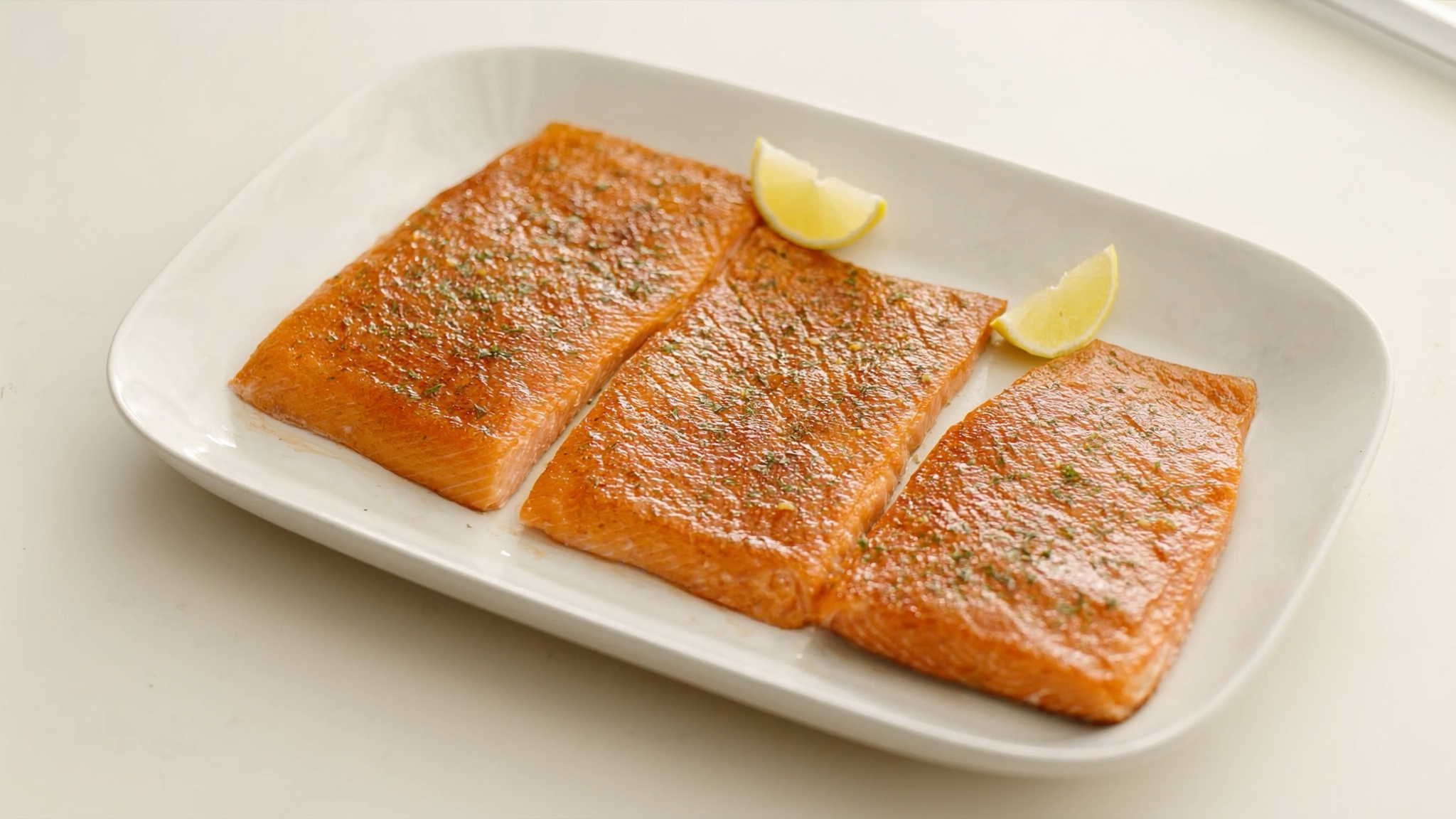
Cooked coho may retain a strong natural coral-orange color, even after it reaches the safe temperature. A gentle fork press should reveal flakes that separate instead of a translucent glassy interior. The thin maple-Dijon surface should remain lightly amber, with fine garlic flecks and a little natural variation in browning. Some pale cooked proteins can appear on top; do not conceal them beneath unmeasured syrup to create a perfectly smooth advertising image. Each salmon fillet is naturally irregular, not an identical rectangle. Photo quality matters, but an illustration cannot prove the fish actually measured 145°F. The most trustworthy instruction combines a clear internal-temperature check with practical visual cues, rather than asking readers to cook until it simply looks good.
Add Parsley Only After the Fish Cooks
Wash and thoroughly dry fresh flat-leaf parsley, then chop about two tablespoons of leaves into small pieces. Scatter it gently over the cooked fish after removing the baking sheet from the oven. This keeps the leaves fresher and makes the glaze visible. Parsley is the only green herb in the main recipe; no dill branches, rosemary, cilantro, chives or basil sprigs are required. The image should contain a few modest green flecks, not a dense green herb crust or a bouquet resting on the platter. Use clean scissors or a knife and a board separate from raw fish handling. A few parsley flecks on the plate are normal for a home dinner and need no artificial food-styling correction.
Cut Four Lemon Wedges for Serving
Rinse one medium lemon and cut it into four wedges, one for each cooked fillet. These wedges are separate from the tablespoon of juice used in the glaze. Place them alongside the salmon after cooking instead of stacking large lemon rounds over its surface during baking. Diners can squeeze additional lemon over their own portions if desired. The fresh yellow garnish is recognizable and practical, but it should not dominate a photograph of salmon. The ingredient list does not call for lime, orange slices or candied citrus peel. A plate with the cooked fillet, tiny parsley flecks and a modest lemon wedge matches the written recipe more faithfully than a crowded scene with vegetables or an elaborate citrus sculpture.
Transfer Gently With a Clean Spatula
The salmon may be delicate after cooking. Use a clean wide spatula and slide it beneath the skin so the piece stays supported as it moves from sheet pan to serving platter. Avoid lifting a thin tail section by its tip or puncturing a portion with several forks. If some skin sticks to the tray, gently separate it and continue. The sheet is hot, so handle it with dry oven mitts and set it on a stable heat-safe surface. Do not use a tool that contacted raw fish to plate cooked fillets unless it has been washed. A little separation along the natural flakes is normal and can look inviting, but no hands or serving utensils belong in the static finished-food photo for this particular release contract.
Why the Glaze Can Brown Too Quickly
Maple syrup contains sugar, which can caramelize or scorch when exposed to strong heat. A tray close to an upper element or an oven running hot can darken the surface before the fish’s center is cooked. If that happens, lower the rack position if safe or briefly shield the top using appropriate oven-safe material while continuing to cook the fish thoroughly. Do not permit foil to touch heating elements. Black burned syrup can taste bitter, and a dark surface still does not prove safe doneness. The next time, record actual oven position and fish thickness so adjustments are based on observed cooking. The desired glaze is light golden amber with a thin sheen, not a thick dark barbecue-style shell.
If the Salmon Turns Dry
Overcooking is one likely cause of dry salmon, particularly when a thin tail portion remains in the oven as long as a much thicker piece. Begin checking close to the earliest part of the estimated range and use the thermometer rather than waiting for a darker surface. If a piece is already dry, you cannot restore its original texture by pouring raw-contact glaze over it. A little lemon from the listed serving wedge may freshen the flavor, but it does not reverse moisture loss. Select similarly sized portions next time if possible and keep a record of how your own oven performs. This formulation has not been physically tested in a kitchen, so the suggested timing must be adapted to actual fish thickness.
If the Fish Center Still Looks Translucent
If the thickest part looks glossy and translucent or the thermometer reading is below 145°F, continue cooking and check again. Do not remove the fish because the clock says eighteen minutes or because maple syrup has turned amber on the surface. Fish center temperature is especially important with frozen or unusually thick portions. A longer rest on the counter is not an acceptable substitute for reaching the cooking endpoint. Continue in brief increments, protecting the surface from scorching if necessary. Once the center reaches the safe temperature, transfer with clean equipment and serve promptly. Avoid describing raw, nearly raw or sushi-style fish as the finished baked dish, since this recipe is written for a fully cooked family meal.
If the Mustard Tastes Too Sharp
Dijon mustard brands vary in saltiness and acidity, so an individual tablespoon can taste different between products. The maple syrup, lemon juice and olive oil provide a defined counterbalance. Do not automatically double the mustard or add large amounts of honey to compensate, since those changes would create a different formula. Taste only the fully cooked fish using clean utensils. If the balance feels sharper than preferred, note the product used and make a small adjustment in a future variation rather than claiming the photograph still documents an unchanged recipe. A little extra fresh lemon at the table can be offered individually. The overall intention is a mild sweet-and-savory coat that leaves the coho’s own flavor and texture prominent.
Why Skin-Side-Down Baking Is Not Pan-Searing
Some coho recipes begin in a hot skillet and focus on crisping the skin, but this version is an open oven roast. The tray holds the salmon skin-side down while a thin sweet glaze bakes on the upper flesh. There is no need to flip, shake or fry the pieces in an inch of oil. That difference matters for a home cook choosing equipment: a sheet pan is simpler to manage for four portions, and the surface will not look identical to crisp-skinned fish from a cast-iron skillet. Do not copy skillet timing into this article or assume the fish develops a hard seared crust. The final color comes from cooking and the light maple-mustard coat, not from breading or a separate pan sauce.
Safe Storage of Leftover Cooked Salmon
Cooked salmon is perishable and needs prompt refrigeration. Move leftovers to clean shallow containers within two hours after cooking, or within one hour if the surrounding temperature is above 90°F. Keep a refrigerator at 40°F or colder. The CDC’s clean, separate, cook and chill guidance explains why holding cooked seafood warm for an entire evening is unsafe. Do not treat lemon juice or mustard as preservatives that make the dish safe at room temperature. Reheat only what you plan to eat, using clean utensils, and discard food with signs of spoilage or a history of unsafe holding. The recipe has no verified storage trial establishing one exact shelf life for all homes, so make cautious decisions based on actual handling. See CDC food safety prevention recommendations for a related source.
Fin-Fish Allergy and Package Labels
Coho salmon is fin fish, a major food allergen for anyone with fish allergy. Dijon mustard can also be an allergen for some diners. The dish does not intentionally include dairy, wheat, soy or eggs, but packages and shared cooking equipment may introduce other ingredients or cross-contact. Read labels rather than promising a guaranteed allergen-free result. No reliable nutrition calculation has been performed for these exact fillets and glaze quantities, so the article does not invent protein grams, calories or omega-3 measurements for a finished serving. A salmon dinner may fit many eating patterns, but it should not be promoted as a medical treatment or guaranteed health intervention. Food safety and allergy needs should take priority over the appearance of a recipe photograph.
A Different Recipe From Whole Roasted Branzino
MySavorista publishes whole roasted branzino with lemon and herbs as another seafood dinner. That recipe uses a complete different fish, its cavity, backbone and larger cooking unit, while this one begins with four coho fillets and a light maple-Dijon surface glaze. The foods should not share the same featured photo or be presented as identical cooking procedures with a species name changed. The branzino is a good comparison when readers want a centerpiece whole-fish meal rather than individual portions. This coho article focuses on fillet handling, safe thawing, measured glaze amounts and temperature checks for multiple pieces. That distinction helps readers and search engines understand the purpose of both pages. See whole roasted branzino with lemon and herbs for a related source.
An Optional Separate Vegetable Side
A vegetable side can turn the fish into a larger meal, but the main recipe card and photographs deliberately show salmon only. MySavorista’s garlic-ginger Chinese long beans are one option to cook separately. Their soy and ginger flavors are part of their own recipe, not hidden ingredients in the salmon glaze. Adding vegetables to the sheet pan could change steam, cooking conditions and visual identity, so it is not the default method here. If a family wants rice, potatoes or a salad, prepare that side with its own instructions and serve alongside. A clear ingredient boundary makes the core coho page more useful than a vague collection of mix-and-match foods presented as one tested recipe. See garlic-ginger Chinese long beans for a related source.
What Published Recipes Do and Do Not Prove
Maple-mustard salmon is a familiar culinary pairing and not a new invention credited to MySavorista. The National Heart, Lung, and Blood Institute has published baked salmon Dijon, while other established recipe publishers describe maple-Dijon variations. Those examples offer context, not independent evidence that this particular ingredient ratio has been cooked and tasted by our editorial team. Here we define the four fillets, exact glaze, skin-down 425°F process and 145°F food-safety endpoint independently. We do not reproduce another publisher’s directions or suggest government endorsement of this recipe. When citing external information, the important supported claims are food-handling and temperature guidance rather than unverified promises about restaurant-quality results. See NIH baked salmon Dijon reference for a related source.
Original Featured and Tasty Images Must Agree
A featured image may show four baked salmon portions arranged on a plain ivory platter, while the separate Tasty card may show one or two cooked fillets from another angle. Both should have the same thin amber glaze, finely chopped parsley and simple lemon wedges, without any unlisted side foods. No person, hand, spoon, knife, fork, bottle, brand label, packaging, gibberish writing, rice, rosemary, sesame or dill belongs in either finished image. The two native 2K sources need independent food-identity reviews across the full frame and a true 100-percent pixel crop. AI-generated salmon photographs cannot prove that any real fillet was cooked to 145°F, and they are explicitly illustrations, not a kitchen-test record.
Final Serving Checklist and Editorial Transparency
Before serving, make sure the coho was properly selected and thawed, the raw fish did not contact ready-to-eat garnish, the glaze was applied before cooking, and the thickest center of each differently sized fillet reached at least 145°F. Transfer with a clean spatula, add only chopped parsley and lemon wedges, then refrigerate leftovers promptly. The cooking window is approximate, and the finished weight, exact texture and nutrition have not been independently measured in the MySavorista kitchen. This recipe is an original editorial plan with specific ingredients and safety decisions, not a claim of a physical culinary trial. Those limitations should appear openly so the reader can judge real food with a thermometer rather than relying solely on attractive generated imagery.
Frequently asked questions about coho salmon recipes
How do I bake coho salmon without drying it out?
Preheat a 425°F oven, glaze four skin-on fillets and begin checking near twelve minutes. Cook each thick center to at least 145°F rather than waiting for a black syrup crust.
How long for a six-ounce coho fillet?
A starting window is twelve to eighteen minutes for moderate fillets at 425°F. Thickness and oven temperature vary, so check with a food thermometer.
What safe internal temperature should coho reach?
FDA lists 145°F or 63°C for fin fish. Measure the thickest center without touching a pan or measuring the thin skin.
Do I need to remove the salmon skin?
No. This recipe keeps skin underneath while the fillet bakes, helping support the flesh during transfer.
Can I use frozen coho?
Yes, when thawed safely using refrigerator or other FDA-recommended methods. Fish left at room temperature overnight should not be used.
Should I use pure maple syrup?
Yes. The listed two tablespoons are pure maple syrup; imitation pancake syrups have different sweeteners and viscosity.
What mustard works best here?
Smooth Dijon mustard is specified for a thin even glaze, while whole-grain mustard creates a different seed texture.
Can cooked salmon still look pink?
Yes. Natural coral coloring can persist after cooking. Confirm 145°F and look for opaque flesh that flakes.
When do I add fresh parsley?
Sprinkle washed finely chopped parsley over fully cooked fish after baking, with lemon wedges beside the fillets.
Can I pour unused glaze onto cooked fish?
Not if the utensil or sauce contacted raw salmon. This recipe applies all measured glaze before cooking.
What if the maple glaze begins to burn?
Adjust the tray position or protect the surface safely while continuing to check the center temperature; do not rely on caramel color as doneness.
How do I store cooked salmon safely?
Refrigerate cooked fish promptly at 40°F or below, generally within two hours, or one hour in temperatures over 90°F.
Print
Coho Salmon Recipes: Maple Dijon Baked Fillets
- Prep Time: About 15 minutes of hands-on preparation, excluding variable oven preheat
- Cook Time: Around 12 to 18 minutes at 425°F, or longer until the thickest fish center is at least 145°F
- Total Time: About 30 to 40 minutes including oven warm-up; adjust for fish thickness and oven
- Yield: 4 salmon fillet servings, each approximately 6 oz before baking; cooked weights not measured 1x
- Category: Global Flavors & Street Food
- Method: Skin-side-down sheet-pan roasting at 425°F, using thermometer to verify 145°F
- Cuisine: American home-cooked oven salmon with maple and Dijon
Description
Four coho salmon fillets baked with maple-Dijon lemon garlic glaze, finished with chopped parsley and lemon wedges. Original editorial recipe not independently kitchen-tested.
Ingredients
4 skin-on coho salmon fillets, about 6 oz (170 g) each, 1½ lb (680 g) total, safely thawed and checked for bones
2 tbsp pure maple syrup
1 tbsp smooth Dijon mustard
1 tbsp olive oil
1 tbsp fresh lemon juice
2 garlic cloves, finely minced
½ tsp kosher salt
¼ tsp black pepper
2 tbsp washed, dried finely chopped fresh flat-leaf parsley
1 medium washed lemon cut into four serving wedges
Instructions
Preheat a conventional oven to 425°F (220°C), with a middle rack. Prepare a rimmed metal tray with parchment rated for the heat, or lightly oil the clean tray.
Keep salmon refrigerated until use. If frozen, thaw in the refrigerator or by another food-safe method. Check fillets for bones, pat dry without rinsing, and place four skin-side down with space between pieces. Wash hands after raw fish handling.
Whisk 2 tbsp pure maple syrup, 1 tbsp smooth Dijon mustard, 1 tbsp olive oil, 1 tbsp fresh lemon juice, 2 minced garlic cloves, ½ tsp kosher salt and ¼ tsp pepper.
Brush the entire maple-mustard mixture over the exposed fish flesh. Do not keep raw-fish-contaminated glaze or a used brush for post-bake serving.
Bake uncovered at 425°F, beginning checks after approximately 12 minutes. Total time may be roughly 12–18 minutes or longer depending on thickness. Insert a clean food thermometer into the thickest center of each different-size fillet and cook until each reaches at least 145°F (63°C).
Remove the pan with oven mitts when the fish is fully cooked, opaque and flaky, with a thin golden maple-Dijon glaze. Do not serve a translucent undercooked center or let the syrup burn black.
Use a clean wide spatula to plate salmon. Sprinkle a total of 2 tbsp freshly chopped parsley across the fish, and put four lemon wedges beside the portions. No side dishes or unlisted toppings are part of the recipe card.
Move leftovers to clean shallow containers and refrigerate at 40°F or lower within two hours of cooking, or one hour above 90°F ambient temperature. Discard fish held at unsafe temperatures.
Notes
Original editorial recipe not independently kitchen-tested. Actual cooked weight, oven time, taste and nutrition were not physically verified. FDA recommends at least 145°F for fin fish at thickest center, confirmed with food thermometer. Salmon is a FISH allergen; mustard can also be relevant. Keep seafood cold, thaw safely, prevent cross-contamination, do not reuse glaze touched by raw fish and refrigerate leftovers promptly. Generated images are illustrations and are not proof of a physical bake or a thermometer reading.
Nutrition
- Serving Size: One 6-ounce raw-weight coho fillet, chopped parsley and a lemon wedge
Keywords: coho salmon recipes, maple Dijon baked coho salmon, easy oven coho fillets