
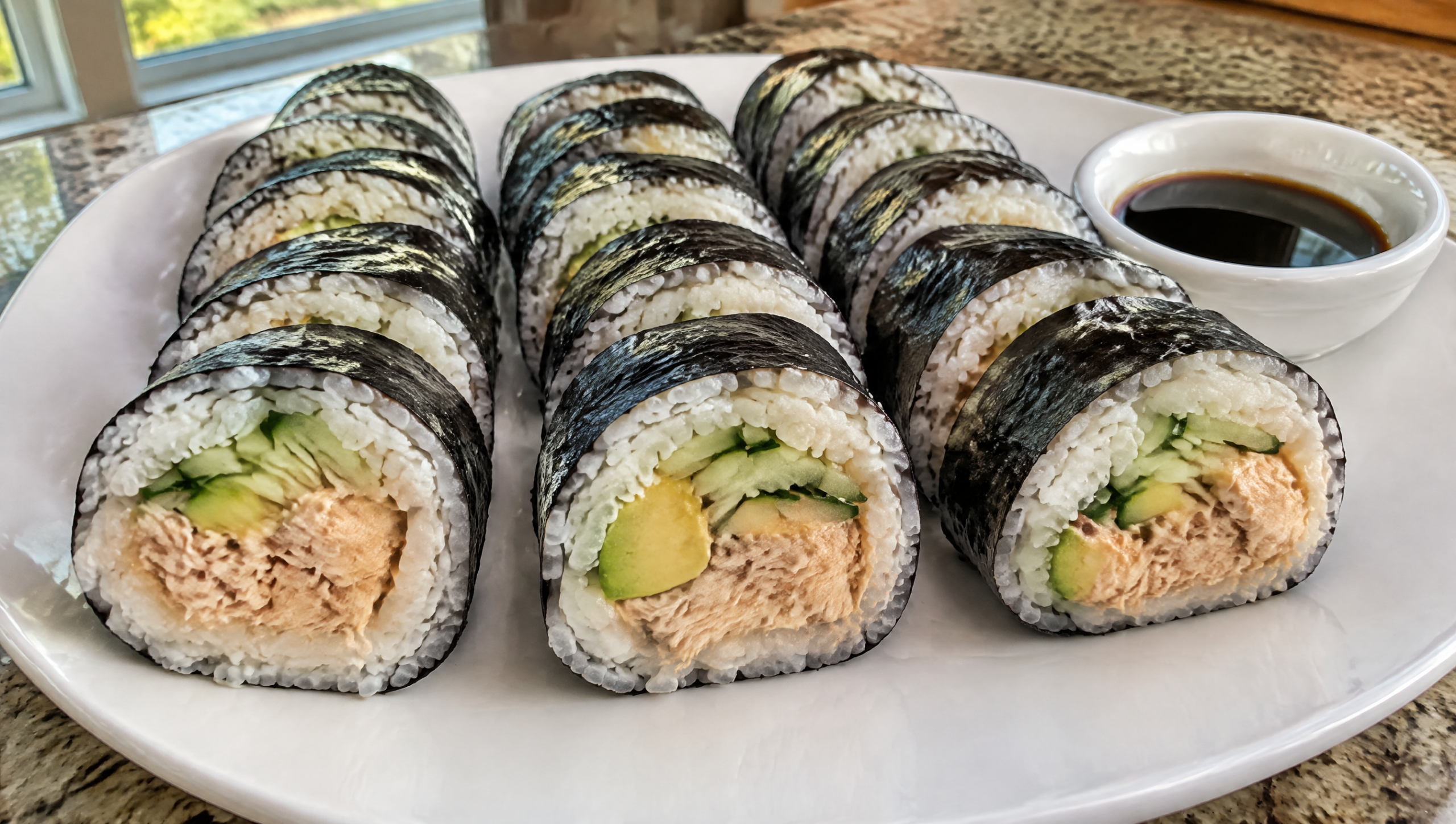
This spicy tuna roll recipe makes four easy nori rolls with seasoned short-grain sushi rice, a creamy chili-tuna filling, cucumber and avocado. Instead of restaurant-style raw tuna, this deliberately accessible U.S. home-kitchen version uses commercially canned, fully cooked light tuna. A little mayonnaise, sriracha, sliced scallion and sesame oil give the filling its familiar spicy-creamy flavor, while crisp cucumber keeps the rolls from feeling too heavy.
You will need four full-size nori sheets, one cup dry sushi rice, two five-ounce cans of light tuna, and a bamboo sushi mat or a clean flexible rolling surface. The rolls are assembled with rice on the inside of the seaweed, so there is no need to flip a delicate rice-covered sheet. Each roll can be sliced into six or eight pieces for a total of twenty-four to thirty-two bite-size pieces. They are best assembled and eaten promptly rather than left for hours at room temperature.
Traditional restaurant spicy tuna rolls often contain finely chopped raw tuna. This is a clearly labeled cooked-tuna adaptation, not a claim that canned tuna is identical to fresh sashimi. Raw fish presents different parasite and pathogen risks, and vague labels such as sushi-grade do not erase all food-safety concerns. Using commercially cooked light tuna reduces the raw-fish risk and makes the method easier to repeat at home, but fish allergy, mercury guidance and proper cooked-rice storage still matter.
Why this spicy tuna roll uses cooked tuna
Spicy tuna rolls are widely associated with Japanese-American sushi restaurants, where tuna may be served raw and mixed with a chili-based sauce. That familiar version can be excellent when prepared under specialized seafood controls, but it is not the most dependable starting point for every home cook. This editorial recipe deliberately uses properly packaged canned tuna, which has already undergone commercial heat processing, and focuses on the rice, rolling and seasoning skills.
Using cooked tuna changes texture and flavor: the fish breaks into flaky pieces instead of retaining the smooth bite of raw tuna. Rather than hiding that difference, the title and directions make it explicit. The finished roll still combines nori, seasoned rice, a spicy creamy tuna center and fresh cucumber. It is a home-style interpretation that satisfies the desire for a convenient spicy tuna roll without instructing readers to serve unidentified raw fish.
Ingredients for four medium rolls
Measure one cup (about 200 grams) dry Japanese-style short-grain sushi rice and approximately one and one-quarter cups (300 milliliters) water, adjusted to the rice package and cooker. For seasoning use three tablespoons unseasoned rice vinegar, one tablespoon granulated sugar and half a teaspoon fine salt. Prepare four full-size toasted nori sheets, two five-ounce cans of light tuna packed in water, three tablespoons commercial mayonnaise and one tablespoon sriracha or another clearly labeled chili sauce.
Add one teaspoon toasted sesame oil, two tablespoons finely sliced scallion, half a small cucumber cut into thin matchsticks and one small ripe but firm avocado cut into thin strips. Toasted sesame seeds are optional for garnish, and a little soy sauce can be offered at the table separately. The tuna weight on a can includes liquid; after draining, the two cans commonly yield roughly eight ounces or 225 grams of cooked fish. Use actual drained weight when dividing the filling.
Choosing the right tuna can
Select commercially canned light tuna, ideally labeled skipjack or light tuna in water, from an intact package within its use-by guidance. The filling needs drained flakes without a puddle of liquid, so avoid a heavily sauced product for the measured formula. If the package is swollen, leaking, damaged or improperly stored, do not taste it and discard it according to food-safety advice. Once opened, treat the contents as perishable and refrigerate promptly if you will not use them immediately.
Albacore white tuna has a different mercury profile and usually a firmer flake, so it is not an identical nutrition substitution. FDA and EPA place canned light tuna, including skipjack, in their lower-mercury Best Choices category, while albacore generally sits in Good Choices. Bigeye tuna is in the Choices to Avoid category for pregnant and breastfeeding consumers and children. Individual advice about quantities, ages and pregnancy should follow the current official guidance rather than claims made from this single recipe.
A few tools make rolling easier
A bamboo sushi mat, ideally covered with food-safe plastic wrap for cleaning, helps produce evenly shaped rolls. A clean flexible mat can also work if it does not shed or transfer materials into food. Use a sharp clean knife, a cutting board, a rice paddle or broad spoon, and a small bowl of drinking water to dampen fingers during rice spreading. A separate bowl for tuna keeps the spicy filling tidy.
The mat never touches raw fish in this cooked-tuna method, but it still requires careful cleaning, especially when wrapped in plastic. Do not use a dirty placemat or an object with unknown coatings as an improvisation. Keep hands clean between opening the tuna, cutting vegetables and shaping rice. Assemble on a clean counter with everything within reach, because the nori softens once it touches wet rice and filling.
How to wash the short-grain rice
Put the dry sushi rice in a bowl and cover with cool water. Swirl gently, drain, and repeat several times until the water becomes noticeably less cloudy, following the package’s recommendations. This removes some loose surface starch that could otherwise produce a gummy, glue-like result. Do not scrub the grains aggressively or leave the wet rice at room temperature for an extended period. Use a clean sieve that keeps the small grains from falling away.
The formula starts with Japanese-style short-grain rice because its natural stickiness helps the rolls hold together. Long-grain rice, jasmine rice or instant rice may remain too separate or become mushy under the same measurements. A rice cooker is convenient, but a heavy covered saucepan can also work. Use the manufacturer’s water ratio whenever it differs from the approximate one-and-one-quarter cups described here.
Cook the rice until tender, not mushy
Combine rinsed rice and the measured water in a rice cooker, then run the normal white-rice program. For a saucepan, bring to a gentle boil, cover tightly, reduce heat to low and cook according to the specific short-grain package, commonly around fifteen to twenty minutes. Let it rest covered for about ten minutes after heat is off so moisture distributes. Do not lift the lid repeatedly and add random water if some steam escapes.
Proper sushi rice should be fully cooked, tender and cohesive, yet each grain remains visible. A hard center is not acceptable, while a pudding-like mass will be difficult to spread thinly. If the rice is too wet, your water ratio or heat may need adjustment next time. Do not refrigerate raw undercooked rice and then assume the vinegar seasoning will complete cooking; the rice must be cooked first.
Make a simple sushi rice seasoning
Warm the three tablespoons of unseasoned rice vinegar with one tablespoon sugar and half a teaspoon salt just enough to dissolve the crystals. The mixture should not boil for a long time or become syrupy. Spread the hot cooked rice in a broad clean bowl and drizzle in the seasoning while folding gently with a rice paddle. Work around the bowl rather than mashing with a whisk. A light fan can help excess steam escape while the rice becomes glossy.
This is a culinary seasoning, not a professionally validated acidification procedure. The acidity of homemade sushi rice varies with rice quantity, vinegar strength and mixing, so the added vinegar does not make rice safe to keep at room temperature all day. The correct home approach is to assemble promptly after cooking and seasoning, or cool and refrigerate rice promptly if preparation must be delayed. Never present a pleasantly tart taste as proof of safe pH.
Cooked rice and Bacillus cereus safety
Cooked rice requires care because dry rice can contain Bacillus cereus spores, which may survive cooking. If rice sits for too long at temperatures that encourage bacterial growth, toxins can form and reheating does not necessarily solve the problem. A bowl of cooked rice left on the counter overnight is not suitable for tomorrow’s sushi, regardless of how good it smells or how much vinegar was added.
Move from cooking and seasoning to assembly without unnecessary delay. If you cannot continue, divide the rice into shallow containers and refrigerate promptly rather than holding it in a deep warm pot. General U.S. guidance calls for perishable prepared food to be refrigerated within two hours, or one hour when ambient temperature exceeds 90°F. The roll contains tuna and mayonnaise as well, so it should be treated as perishable at every stage.
Drain tuna until the filling holds its shape
Open the two intact canned-light-tuna packages and drain the fish in a fine strainer. Press gently with a fork to remove loose liquid without turning the flakes to dust. Transfer to a clean mixing bowl and separate very large pieces with the fork. You want small moist tuna flakes, not watery tuna soup or a completely smooth paste. If your brand is packed in oil, the mayonnaise amount and flavor will differ from the specified water-packed version.
Do not leave the opened cans at room temperature while you prepare the rice for an hour. Make the tuna filling close to assembly and keep it cold when waiting. If the drained tuna is very salty, taste it before adding sauces that may contain sodium. A properly mixed filling should mound on a spoon rather than running off and soaking through the nori.
Spicy mayonnaise in measured amounts
Mix three tablespoons commercially prepared mayonnaise with one tablespoon sriracha and one teaspoon toasted sesame oil, then stir in the finely sliced scallion. Start with a smaller amount of chili sauce if serving people sensitive to heat, but keep the basic proportion as a reference. Fold the seasoned mayonnaise into the drained tuna until the flakes are evenly coated. Do not add water to thin it: the roll needs a fairly compact filling.
The level of heat varies by chili sauce brand, so taste and adjust a few drops at a time. Commercial mayonnaise is the specified ingredient; homemade mayonnaise using unpasteurized raw eggs would introduce additional food-safety concerns and require a different preparation. This amount provides a light creamy coating rather than a giant puddle of sauce. You can serve extra spicy mayonnaise on the side, kept refrigerated, without making the filling unnecessarily wet.
Cucumber and avocado should be dry
Slice half a cucumber into thin matchsticks approximately the length of a nori sheet’s short edge. If it has a very watery seed center, remove a little of that portion before cutting. Pat the cucumber dry with a clean towel. Slice a firm-ripe avocado into slender strips immediately before assembly so it stays green and holds its shape rather than collapsing into soft chunks.
These vegetables balance the creamy tuna with a fresh crisp bite. Too many thick strips make the roll bulky and difficult to close, while wet cucumber can weaken the seaweed. No cream cheese, mango, tempura crumbs or sweet teriyaki glaze is included in the base formula. Such additions belong to distinct sushi-inspired recipes and would alter the intended compact classic spicy-tuna profile.
Place the nori correctly on the mat
Lay a clean bamboo mat on your work surface and cover it with food-safe plastic wrap if that is how you normally maintain the mat. Set one nori sheet on the mat with its rougher side facing upward and its longer edge running horizontally. Leave a little space at the edge closest to you. Nori is brittle when dry but softens where it touches warm moist rice, so work steadily after beginning the roll.
Do not wet the whole nori sheet in advance. Have a tiny cup of potable water ready for the final seal, and keep the remaining sheets in their original dry packaging until needed. If a sheet tears, use a fresh one rather than trying to glue it together with a large lump of sticky rice. A well-formed roll depends on an even rice layer and a modest filling.
Spread the rice without crushing it
Divide the seasoned cooked rice into four roughly equal portions. With lightly dampened fingers, spread one portion across the rough side of a nori sheet in a thin uniform layer, leaving about three-quarters of an inch of bare seaweed at the far edge. Press just enough to connect the grains; avoid compressing them into a solid rubbery slab. A thin layer leaves room for filling and helps every slice maintain balance.
If the rice sticks to your hands, dip fingers briefly in clean water rather than adding more vinegar. Too much water causes wet spots in the nori. A small rice paddle can also help spread grains across the corners. The goal is an even surface that reaches the near and side edges but leaves the far sealing strip clear.
Portion the spicy tuna down the center
Spoon one-quarter of the spicy cooked-tuna mixture in a narrow line across the lower third of the rice layer. Add a few cucumber matchsticks and avocado strips on top or immediately beside the tuna. Keep the filling away from both end edges so it does not squeeze out during rolling. The tuna should remain visibly flaky and orange-pink from the chili mayonnaise, not a smooth neon-colored purée.
Overfilling is the most common problem for beginners. A roll that barely closes while still on the mat will likely burst when you cut it. If you have a little extra tuna after portioning, refrigerate it in a separate small container and use it promptly with the meal rather than forcing it into one roll. The measured ingredients should produce balanced rolls when divided evenly, but actual sheet and avocado sizes vary.
Roll firmly but do not flatten the filling
Lift the near edge of the bamboo mat and fold the nori over the filling while holding the cucumber and avocado in place with your fingers. Tuck the edge gently under the filling, then continue rolling forward so the rice wraps around it. Use the mat to compress the roll just enough to make a cylinder, without squeezing out tuna or crushing avocado. Apply a few drops of clean water to the bare far edge and finish the seal.
Set the completed roll seam-side down for a minute while you repeat with the remaining three sheets. Do not leave a stack sitting for a long time: seaweed absorbs moisture and loses texture. A compact roll should hold its shape when lifted with clean hands. If the seam opens, use a little additional water on the bare strip and press lightly, rather than coating the entire roll in sticky mayonnaise.
How to cut neat sushi pieces
Use a sharp clean knife with a smooth cutting edge. Wet and wipe the blade lightly between cuts to prevent rice from sticking. First cut each roll in half, then cut each half into three or four pieces, yielding six or eight pieces per roll. Use a gentle forward slicing motion and avoid pressing straight down as though chopping carrots. A clean even cut shows the spicy tuna in the center with cucumber and avocado beside it.
Arrange the pieces cut-side up on a plate and serve immediately. The slices should reveal a ring of rice, dark nori and a compact center of tuna and vegetables. Do not leave cut rolls uncovered for hours, because the rice dries while the nori turns leathery and the filling remains perishable. Make the number of rolls you plan to eat promptly rather than preparing trays far in advance.
What the finished rolls should taste like
Each bite combines lightly tangy seasoned rice, a savory flaky tuna center, mild chili heat, a little sesame aroma and cool crisp vegetables. The nori adds a toasted marine flavor but should not dominate the whole roll. If the tuna tastes too salty, check whether your brand of sriracha or mayonnaise is highly seasoned. If the rice seems too sour, the vinegar may have been measured incorrectly or distributed unevenly.
A traditional raw spicy tuna roll often has a softer fish texture; this cooked version is flakier and feels closer to a sushi-style tuna salad. Presenting that difference clearly helps readers choose the meal that suits their preference. There is no need to claim it tastes indistinguishable from restaurant raw tuna. The goal is a convenient, satisfying roll that uses recognizable ingredients and a safe, realistic home workflow.
Raw tuna versus canned light tuna
Raw fish used in sushi carries risks involving parasites and bacteria even when sold with premium-sounding labels. Appropriate sourcing, freezing controls and sanitary handling are specialized considerations, and freezing does not eliminate every harmful microorganism. This article does not instruct readers to buy an ordinary supermarket tuna steak and serve it raw. It relies on commercially heat-processed canned light tuna specifically to avoid a raw-fish preparation.
Choosing cooked tuna does not mean the finished roll may sit out indefinitely. Tuna can spoil after a can is opened, mayonnaise and chopped vegetables are perishable once assembled, and cooked rice requires prompt safe cooling. The FDA also advises that pregnant people, children and others at increased risk of foodborne illness avoid raw or undercooked seafood. A cooked filling is a more accessible option, but individual medical and dietary advice still takes priority.
Tuna mercury: choose the product deliberately
The FDA and EPA guidance distinguishes canned light tuna, including skipjack, from albacore white tuna and bigeye tuna. Canned light tuna is generally categorized as a Best Choice, while albacore is listed as a Good Choice and bigeye among fish to avoid for vulnerable populations. These categories relate to typical mercury content, not to whether a particular can tastes better. Heating or cooking tuna does not remove methylmercury.
People who are pregnant, breastfeeding, planning pregnancy or feeding young children should follow the official age- and situation-specific fish advice, including portion limits and variety across fish choices. This page does not claim the recipe is safe in unlimited amounts or appropriate for every allergy or medical circumstance. The tuna choice is presented transparently so readers can make informed shopping decisions.
Soy sauce and other serving options
Offer a small dish of soy sauce for dipping if desired, but start with just a little because the tuna filling and rice already contain salt. Ordinary soy sauce often includes wheat, so do not describe the dish as gluten-free without checking every label. Pickled ginger and wasabi can also be served separately in small portions, but neither is required for the original measured recipe.
Some diners prefer less spice. Instead of changing the entire filling after it is mixed, offer a few pieces with a mild version using less sriracha, made in a clean separate bowl. Keep the rolls cold if there is a pause before serving. Avoid drizzling a thick layer of extra mayonnaise over everything just for photographs; the nori, rice and vegetables should remain recognizable.
What to serve beside these rolls
A simple crisp vegetable side can balance the creamy cooked-tuna filling. MySavorista’s garlic-ginger long beans offer a separately cooked vegetable option, although they belong to a different culinary tradition and should not be labeled a traditional Japanese sushi accompaniment. The site’s Japanese-style egg salad sandwich is another adaptation, useful for readers seeking a different handheld lunch.
For a fully cooked tuna meal without rolling, the tuna and dill pickle melt on rye uses distinct American sandwich flavors. It is not a sushi variant and needs its own cooking and allergy checks. These internal connections are alternatives for people deciding what to prepare, not attempts to claim that all Japanese-inspired and tuna dishes share one authentic origin.
Common problem: the rice will not stick
If rice falls apart when spreading, it may be the wrong variety, undercooked or too dry. Use labeled short-grain sushi rice and follow its water ratio. Let it rest after cooking, then fold in seasoning while warm. A little moisture on the hands is helpful, but pouring water onto nori will not fix rice that was never cooked to the right texture.
Long-grain rice can remain too separate for a compact roll. Do not add flour, mashed potatoes or a large amount of mayonnaise to glue it together. The structure should come from properly cooked short-grain rice and gentle handling. For the next batch, check the specific brand’s instructions rather than repeating an unsuitable generic water ratio.
Common problem: the roll bursts or looks lopsided
An overstuffed roll has too much tuna, cucumber or avocado for the available sheet. Spread a thinner rice layer, keep filling in a narrow line and leave the far bare nori edge for sealing. Use a mat to guide a tight cylinder without crushing. If filling spills from one side, reduce the amount rather than pressing the roll harder.
A sheet that splits may have been too dry, damaged or handled roughly before rolling. Let rice moisture soften the nori briefly as you shape it, but do not soak the sheet. Consistent portioning across four rolls gives a more attractive result than one giant roll plus several nearly empty ones. Practice and clean tools matter more than decorative sauces.
Common problem: rice becomes unsafe during preparation
The most serious mistake is keeping warm cooked rice at room temperature for many hours. Rice can harbor Bacillus cereus spores, and taste or smell does not reliably reveal unsafe storage. Rice vinegar seasoning in a home recipe is not a validated preservation method. Work promptly after cooking, or cool rice safely in shallow containers and refrigerate it rather than leaving it in a warm rice cooker overnight without a controlled holding process.
Once rice is combined with tuna and mayonnaise, the entire roll is perishable. Serve within a short safe window, use clean serving utensils and return leftovers to refrigeration promptly. If the rolls sat out beyond ordinary perishable food limits, discard them. Extra wasabi, soy sauce or more vinegar cannot repair poor temperature control.
Make-ahead planning without compromising texture
Rice can be measured and rinsed shortly before cooking, vegetables can be washed and kept refrigerated, and the tuna cans can remain unopened until assembly. The best texture comes from preparing the filling and rolling close to mealtime. Precut avocado may brown, nori becomes soft once wet, and cooked rice may harden when chilled. A busy cook gains more from organizing clean ingredients than from assembling four complete rolls the night before.
If you do need a short pause, place the finished rolls promptly in a clean covered container in the refrigerator and serve as soon as practical. Expect some texture change. Do not leave the rice, tuna mixture and chopped cucumber in separate bowls at room temperature all afternoon. Cold storage and prompt service matter even when the fish was originally canned.
Storage, leftovers and food safety
Spicy tuna rolls with mayonnaise, vegetables and cooked rice are perishable. Refrigerate promptly at 40°F (4°C) or colder and do not leave them out longer than two hours, or one hour when the room is above 90°F. For best eating quality, these rolls are meant for same-day service; nori and rice texture deteriorate quickly, and this recipe has not undergone laboratory shelf-life testing.
Do not rely on normal color, smell or taste to decide that improperly held sushi-style rolls are safe. If a roll is left on a party tray in a hot kitchen for a long time, discard it rather than putting it back into the refrigerator for later. Cooked canned tuna can still become unsafe after mishandling, and storing rice safely is as important as the tuna choice.
Allergens and suitable substitutions
The recipe contains fish from tuna, egg in many commercial mayonnaise products, and sesame from sesame oil and optional seeds. Nori and soy sauce bring additional ingredients to check; wheat may be present in ordinary soy sauce. Read each label carefully if serving someone with allergies. Do not call the rolls gluten-free solely because the rice itself contains no gluten, or egg-free without verifying mayonnaise.
If you remove tuna, the roll becomes a different vegetable or protein filling and should be named accordingly. If avoiding mayonnaise, a dressing of different consistency may not hold the flakes in the same way; that requires a measured separate adaptation. Guests with diagnosed food allergies need a suitable kitchen workflow and separate utensils, not a last-minute attempt to pick allergenic pieces out of a completed roll.
Accurate photos and editorial transparency
A faithful hero image should show neat slices of nori-wrapped sushi rice filled with an orange-tinted creamy cooked-tuna mixture, crisp cucumber and a little green avocado. The tuna should look flaky, not like raw translucent red sashimi blocks. The second Tasty Recipe photo needs an independently generated source, a different composition and the same ingredient identity, with no invented raw fish, giant shrimp, cream cheese or glossy fake sauces.
Any images must be produced only after explicit new spending authorization and reviewed at their original pixel dimensions, including exact source-byte SHA256, separate job IDs, full-resolution ingredient/no-text/no-watermark inspection and commercial-rights verification. These would be illustrations, not evidence that this formula was physically cooked. The editorial recipe is not independently kitchen-tested and does not invent nutrition data, customer ratings or Google search performance.
Spicy tuna roll recipe FAQs
Can I make a spicy tuna roll recipe without raw fish?
Yes. This version uses commercially canned light tuna that is already fully cooked. The filling is mixed with spicy mayonnaise and rolled in seasoned sushi rice and nori. It is a home adaptation, not identical in texture to restaurant rolls made with raw tuna.
What kind of tuna is used?
Two five-ounce cans of water-packed canned light tuna, ideally skipjack, drained to roughly eight ounces or 225 grams of cooked fish. Check the label and package condition before use.
Is canned light tuna lower in mercury than albacore?
FDA/EPA categorize canned light tuna among Best Choices and albacore white tuna among Good Choices. People who are pregnant or breastfeeding and children should follow current official serving recommendations and fish variety guidance.
Is it safe to use supermarket raw tuna instead?
This recipe does not use raw tuna. Raw sushi seafood requires careful sourcing, parasite and microbial controls that are not ensured by a casual sushi-grade label. Follow qualified fish-supplier and food-safety guidance rather than substituting ordinary raw tuna at home.
What rice makes the best roll?
Japanese-style short-grain sushi rice is naturally sticky enough to hold a compact roll. Cook it according to its package and season with unseasoned rice vinegar, sugar and salt.
Does rice vinegar make sushi rice safe at room temperature?
Not automatically. Home seasoning is not a validated commercial acidification process. Cooked rice can harbor Bacillus cereus and should be handled promptly or safely refrigerated rather than left out for hours.
How spicy is the tuna filling?
The base filling has about one tablespoon sriracha for two five-ounce cans of drained tuna, combined with three tablespoons mayonnaise. Adjust small amounts according to your chili sauce’s heat while keeping the mixture thick enough to roll.
Can I leave out avocado?
Yes, but it changes the final filling balance. Use cucumber and slightly less total filling rather than adding another watery vegetable without adjusting proportions.
How many rolls does the recipe make?
Four medium rolls, each usually cut into six to eight pieces. Yield depends on nori size, rice layer thickness and how much tuna and vegetables go inside.
Why does my nori tear?
The sheet may be damaged, excessively wet or overfilled. Spread rice thinly, place filling in a narrow strip and leave a bare edge for sealing. Do not soak the nori beforehand.
Can I make them the night before?
For texture and food-safety reasons, same-day prompt assembly and serving are preferable. If holding briefly, refrigerate promptly in a clean covered container, understanding that nori and rice texture will change.
Was this exact spicy tuna roll tested in a kitchen?
No. It is an original digitally assisted editorial recipe with measured quantities and food-safety references, not a documented independent physical kitchen trial.
Food safety and recipe background
The sources below inform fish safety, cooked rice, mercury categories and the distinction between raw and cooked tuna styles; none physically tested this exact recipe formula: FDA: risks of raw seafood, selection and safe storage; FDA/EPA: canned light tuna and mercury-choice categories; Food Standards Australia New Zealand: raw sushi seafood handling limitations; FSANZ: cooked rice and Bacillus cereus; CDC: prompt refrigeration and safe prepared-food handling; Pampered Chef: precedent for cooked canned-tuna sushi roll adaptation.
Print
Spicy Tuna Roll Recipe with Fully Cooked Tuna
- Prep Time: 30 minutes
- Cook Time: 15–20 minutes plus 10-minute rice rest
- Total Time: About 1 hour, including prompt assembly
- Yield: 4 medium rolls, cut into 24–32 pieces; 4 servings 1x
- Category: Sushi-Inspired Lunch and Dinner
- Method: Cook short-grain rice; mix cooked tuna and roll by hand
- Cuisine: Japanese-American spicy tuna roll, home-style fully cooked canned-tuna adaptation
Description
Four nori-wrapped spicy tuna rolls made with fully cooked canned-light tuna, seasoned sushi rice, sriracha mayonnaise, cucumber, avocado and scallion.
Ingredients
FOR THE RICE
1 cup (about 200 g) uncooked Japanese-style short-grain sushi rice
About 1 1/4 cups (300 ml) water, or package/cooker-specified amount
3 tbsp (45 ml) unseasoned rice vinegar
1 tbsp (about 12 g) granulated sugar
1/2 tsp (about 3 g) fine salt
FOR FOUR ROLLS
4 full-size sheets toasted nori seaweed
2 x 5 oz (142 g each before draining) cans water-packed canned light tuna (preferably skipjack), drained to around 8 oz/225 g
3 tbsp (45 g) commercial mayonnaise
1 tbsp (15 ml) sriracha, adjust to taste
1 tsp toasted sesame oil
2 tbsp finely sliced scallions
1/2 small cucumber, cut into dry thin matchsticks
1 small ripe but firm avocado, sliced into strips
1 tsp toasted sesame seeds, optional
Small amount of potable water for rolling/sealing
Soy sauce, optional on the side (check wheat and sodium labels)
Instructions
Wash hands and clean work surfaces. Choose intact cans of commercially fully cooked canned light tuna and properly labeled short-grain sushi rice; do not use raw fish in this recipe. Have four nori sheets, a clean bamboo rolling mat, sharp knife and clean plate ready.
Rinse 1 cup (about 200 g) dry Japanese short-grain rice with cool water several times, draining carefully. Cook using about 1 1/4 cups (300 ml) water or the rice-package-specific ratio in a cooker or covered pot until fully tender, commonly 15–20 minutes, then rest covered about 10 minutes.
Warm 3 tbsp unseasoned rice vinegar with 1 tbsp sugar and 1/2 tsp fine salt just enough to dissolve. Move hot cooked rice to a broad clean bowl and fold in vinegar seasoning gently. Work promptly; this home-seasoned rice is NOT commercially validated acidified rice and must not be kept for hours at room temperature.
Open and drain 2 x 5 oz cans canned light tuna. Transfer approximately 8 oz (225 g) drained flaked cooked tuna to a clean bowl. Mix with 3 tbsp commercial mayonnaise, 1 tbsp sriracha, 1 tsp toasted sesame oil and 2 tbsp sliced scallions, adjusting chili heat lightly.
Slice cucumber into dry thin matchsticks, removing excessively watery seed center. Slice a firm-ripe avocado into slender strips immediately before rolling.
Lay a full-size nori sheet rough side up on a clean bamboo mat, with the far edge clear for sealing. Divide seasoned cooked rice into four and spread one part in a thin even layer on the nori, leaving about 3/4 inch of bare seaweed along the far edge.
Arrange one-quarter of spicy cooked-tuna filling in a narrow line along the lower third of the rice. Add a few cucumber and avocado strips without overfilling.
Lift the mat, tuck nori over the filling and roll forward firmly but gently. Dampen the bare far edge with a few drops potable water and seal seam-side down. Repeat with the other three sheets.
Using a sharp clean lightly dampened knife, cut each roll into 6–8 pieces with a gentle slicing motion, wiping blade between cuts. Serve promptly with optional sesame seeds and a little soy sauce on the side.
Treat assembled rice-and-tuna rolls as perishable. Refrigerate promptly if not serving immediately, and discard if left out over 2 hours (1 hour above 90°F). For best texture, make and eat on the same day; do not leave homemade vinegar-seasoned rice sitting at room temperature overnight.
Notes
This explicitly cooked canned tuna spicy roll is a Japanese-American home variation, not a raw restaurant tuna maki. Canned light tuna is among FDA/EPA mercury Best Choices; albacore higher, bigeye avoid for vulnerable populations, follow personal official fish advice. Raw sushi fish would require distinct supplier/food-safety controls; not interchangeable here. Cooked rice may harbor Bacillus cereus; vinegar seasoning alone is NOT validated preservation or safe room-temperature holding. Fish tuna, egg mayonnaise, sesame and potentially wheat soy sauce allergens. Use intact canned tuna and commercially prepared mayonnaise. Original digitally assisted formula not independent kitchen tested; no invented nutrition, ratings or documentary food photos. Two independently produced original 2K hero and Tasty card images only on new founder-approved paid media budget, full byte SHA and rights QA.
Nutrition
- Serving Size: 1 roll, approximately 6–8 pieces
Keywords: spicy tuna roll recipe, cooked tuna spicy sushi roll, canned light tuna sushi roll, spicy mayonnaise tuna maki