
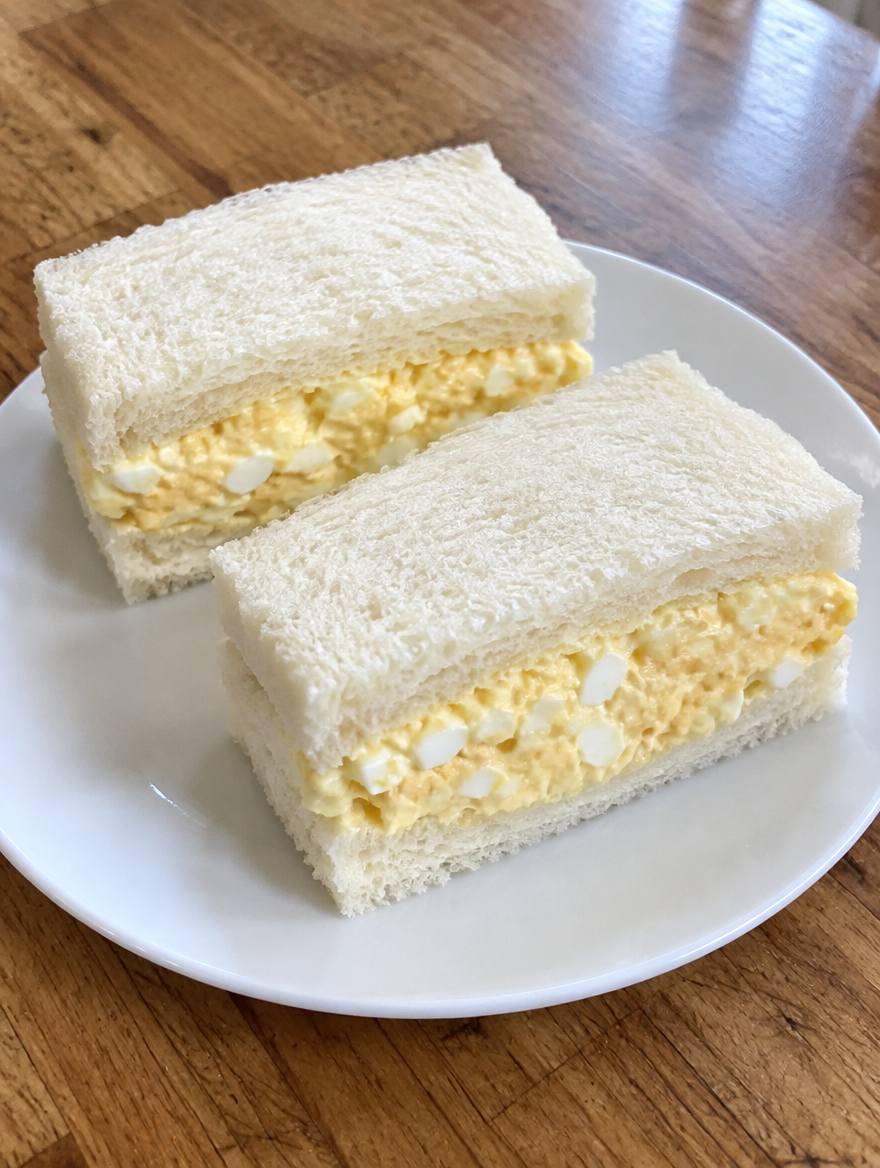
A Japanese-style egg salad sandwich combines a creamy, finely mashed hard-cooked egg filling with soft, pillowy white bread. This version is inspired by the Japanese tamago sando style often associated with soft shokupan, or Japanese milk bread. It uses everyday U.S. grocery-store ingredients and a small amount of rice vinegar, sugar and white pepper to balance the mayonnaise. There is no bacon, ham, cheese, raw onion, lettuce, tomato, mustard or spicy sauce to cover the delicate egg flavor.
Quick answer: Cook 8 large eggs until both yolks and whites are completely firm, chill promptly in an ice-water bath and peel. Mash the cooked eggs with ⅓ cup (about 80 g) commercial mayonnaise, 1 teaspoon rice vinegar, ½ teaspoon sugar, ¼ teaspoon fine salt and ⅛ teaspoon ground white pepper. Spread a thin layer of 4 teaspoons (20 g) softened unsalted butter total across the inner surfaces of 8 slices of soft white milk bread. Divide the chilled creamy egg mixture evenly across four slices, close with the remaining slices, press gently, trim crusts if desired and cut into halves. Yield: 4 sandwiches, or 8 half-sandwich pieces. Plan roughly 10 minutes preparation, 12 minutes egg cooking, 10 minutes cooling and 8 minutes assembly, or about 40 minutes total; actual cooking may take longer depending on how eggs and water are heated.
Editorial transparency: This original AI-assisted recipe has not been independently kitchen-tested. Its steps and measured proportions are an editorial formulation, not results of a physical kitchen trial. The attached food image, if published, is an AI-generated illustration, not proof that a batch was prepared or tasted. Storage guidance is based on official general food-safety recommendations, not a microbiological test of this exact sandwich.
What Makes an Egg Sandwich Japanese-Inspired?
In Japan, egg sandwiches called tamago sando commonly feature a soft square loaf of white shokupan, rich egg filling and a clean cross-section. The bread is usually soft rather than toasted, and the filling is relatively simple. The point is the contrast between tender bread and a creamy, egg-forward interior.
The familiar idea has multiple interpretations, including versions prepared by bakers and convenience stores. This MySavorista article uses a Japanese-inspired U.S. home-kitchen variation, not a claim to reproduce one store’s proprietary recipe. It avoids brand requirements; ordinary store-bought commercial mayonnaise is suitable for the measured formula, though a Japanese-style mayonnaise may have a different flavor profile.
For broader cultural context, Just One Cookbook’s explanation of tamago sando discusses soft shokupan, creamy egg filling and the characteristic simple sandwich assembly. The exact measured ingredients and editorial steps below are this page’s own separate formulation rather than a copied or kitchen-verified rendition of that recipe.
The Ingredient List for Four Sandwiches
Use a small, clearly measured set of ingredients:
- 8 large eggs, cooked until both yolks and whites are completely firm and then cooled safely.
- ⅓ cup (about 80 g) commercial mayonnaise, plain, refrigerated after opening according to its label.
- 1 teaspoon (5 ml) unseasoned rice vinegar, for a gentle tang rather than a strong acidic flavor.
- ½ teaspoon (about 2 g) granulated sugar, to soften the tang slightly.
- ¼ teaspoon (about 1.5 g) fine salt, adjusted after tasting the safe, fully cooked egg filling.
- ⅛ teaspoon ground white pepper, for subtle seasoning without large black flecks.
- 8 slices soft white Japanese milk bread (shokupan), or another very soft white sandwich loaf, ideally cut in matching square slices.
- 4 teaspoons (20 g) softened unsalted butter total, spread thinly across the inside faces of the eight bread slices.
No milk, heavy cream, raw egg in the filling, green herbs, chopped celery or mustard is required. There are eggs, wheat and dairy in the standard ingredient list because of the eggs, white wheat bread and butter. Commercial mayonnaise generally contains egg too, but always check the particular product label for allergens and ingredients.
Choose unseasoned rice vinegar, not an already sweetened sushi-rice seasoning, so the amount of sugar and salt remains controlled. If you cannot find rice vinegar, another mild vinegar would create a different flavor balance and has not been physically tested in this formulation.
Choosing the Bread
Soft Japanese milk bread is sometimes sold as shokupan. It has a fluffy, fine interior that holds the egg filling without needing toasting or a thick crust. If your local U.S. supermarket does not sell shokupan, choose a soft, fresh white sandwich loaf with slices that are not dry or brittle.
Avoid bread with large holes, a tough sourdough crust or heavy seeds if you want the simple, neatly cut appearance in the food illustration. Those loaves can still hold a filling, but their texture changes the intended result. The sandwich is meant to be pillowy rather than crunchy.
The slice thickness also matters. Very thin bread can tear if the egg filling is thick, while an extremely thick slice can overwhelm the egg flavor. Use slices that comfortably close around the portion of egg salad. Trim the crusts only after assembly if desired; that makes it easier to align the sandwich edges.
Why the Eggs Must Be Fully Cooked
This version uses hard-cooked eggs because the creamy texture comes from mayonnaise and mashed yolks, not a runny center. A fork can break down fully cooked yolks into small particles that blend with the mayonnaise, while chopped whites remain visible in the sandwich cross-section.
The FDA’s consumer egg-safety guidance recommends cooking shell eggs until both yolk and white are firm. That is especially important when the egg salad will be cooled and served without a second cooking stage. Do not assume a warm, soft or runny center will become safe merely by mixing it with mayonnaise.
Egg sizes and starting temperature affect cooking time. The suggested timing is about 11–12 minutes at a gentle simmer once the water is hot, but it is not a guarantee; inspect an egg if uncertain. If the yolk is not completely set, continue cooking the eggs properly before making the salad. Do not add raw eggs to the filling.
How to Peel Eggs Without Destroying Them
Once eggs are fully cooked, transfer them carefully to a bowl of ice water. Cooling stops further heating and makes them easier to handle. Let them cool for approximately ten minutes, then tap each shell gently and remove the shell under a little cold running water if needed.
A clean bowl and clean fingers matter because the eggs are now a ready-to-eat ingredient. Do not peel on a surface that was used for raw meat or seafood without cleaning it. Discard broken shells immediately so pieces do not become mixed into the salad.
A few small cracks or uneven whites are fine. These eggs will be chopped and mashed rather than displayed whole. The important qualities are that they are fully cooked, cleanly peeled and cooled promptly before the mayonnaise is added.
Making an Egg-Yolk-Forward Filling
Place the peeled eggs in a mixing bowl and chop or mash with a fork. To get a smooth but recognizable texture, mash the yolks thoroughly and leave some small pieces of cooked egg white. The sandwich cross-section should look like a pale yellow filling with tiny white bits, not a liquid spread or large whole egg halves.
Add 80 g mayonnaise and stir gently until evenly coated. Then add 5 ml unseasoned rice vinegar, 2 g sugar, ¼ teaspoon salt and ⅛ teaspoon white pepper. Taste the mixture only after all eggs are fully cooked and all utensils are clean. Adjust salt cautiously; some commercial mayonnaise is already seasoned.
Avoid pouring in extra milk to thin the mixture unless you are deliberately developing a different formulation. Too much added liquid can leak into the soft bread and make the assembled sandwich unstable. The mayonnaise and yolks should make the filling creamy enough without becoming runny.
What Does the Rice Vinegar Do?
Rice vinegar contributes a mild bright note that helps balance the richness of eggs and mayonnaise. This version uses just one teaspoon, so the sandwich is not supposed to taste sharply pickled. The half-teaspoon sugar supports a gentle sweetness without turning the filling into dessert.
This is not intended to imitate an exact commercial Japanese mayonnaise blend. If you use a brand with a different acidity or sweetness, you may prefer to adjust the vinegar and sugar slightly after tasting the fully prepared filling. Such adjustments are personal variations, not independent kitchen-test results.
Because the bread is soft and relatively neutral, small flavor differences in the filling become noticeable. Start with the listed quantities before adding extra seasoning. Garlic, hot sauce, onion and mustard can all overpower the simple egg-forward character.
Why Spread Butter on the Bread?
A thin butter coating adds mild richness and can help limit moisture transfer from filling to bread. Use 20 g total, not 20 g per slice. Spread it evenly across the eight inner bread faces after the butter softens enough to move without tearing the crumb.
This step does not make the sandwich water-resistant for hours in a hot environment. Egg salad is a perishable food, and the butter layer is a texture aid rather than a food-safety barrier. You must still keep the finished sandwiches appropriately refrigerated if not serving promptly.
Do not toast the bread before spreading butter. This version is meant to resemble a soft Japanese-style egg sandwich, not a crunchy American grilled egg salad sandwich. A crispy grilled version would require a separate method and more attention to heating mayonnaise filling.
Eight Steps to Make Japanese-Style Egg Salad Sandwiches
1. Cook the Eggs Until Fully Firm
Place 8 large eggs in a saucepan in a single layer and cover with clean water by about one inch. Heat to a boil, then maintain a gentle simmer and cook approximately 11–12 minutes, adjusting for egg size and starting temperature. The eggs must finish with completely firm yolks and whites. Handle hot water and steam carefully, and continue cooking if a checked egg is not fully set.
2. Cool and Peel the Eggs Safely
Transfer fully cooked eggs with a suitable spoon into a clean bowl of ice water. Cool for approximately 10 minutes or until safe to handle. Peel the shells and discard them, using clean hands and surfaces. Do not leave hard-cooked eggs at room temperature for a lengthy period after they have cooled.
3. Chop and Mash the Egg Filling
Put the peeled eggs in a clean mixing bowl. Chop with a fork, mashing the yolks thoroughly while leaving small distinct pieces of firm egg white. The filling should be relatively fine and creamy-looking but not a puree or liquid. Check for stray shell fragments.
4. Stir in Mayonnaise and Seasoning
Add ⅓ cup (80 g) commercial mayonnaise, 1 teaspoon rice vinegar, ½ teaspoon sugar, ¼ teaspoon salt and ⅛ teaspoon white pepper. Fold gently until evenly combined. Taste safely and adjust salt only after considering the seasoning in the mayonnaise. Keep the mixture cool until assembly.
5. Butter the Soft Bread
Lay out 8 slices of soft white milk bread on a clean work surface. Spread 4 teaspoons (20 g) softened butter total thinly across the sides that will face the filling. If butter is too cold and tears the bread, let it soften briefly under safe conditions rather than pressing hard.
6. Divide and Add the Filling
Spread one-quarter of the egg salad evenly on each of four buttered slices. Keep a narrow margin at the edges and distribute the filling to a consistent thickness. Top with the remaining four bread slices, buttered sides facing inward. Do not overstuff a single sandwich and leave the others nearly empty.
7. Press Lightly and Cut Cleanly
Press each sandwich gently with a flat hand or clean plate just enough to settle the filling, not crush it. Trim crusts if desired to create even square edges. Use a sharp clean knife to cut each sandwich into two rectangles or triangles. The cut face should show creamy yellow filling between soft white bread.
8. Serve Immediately or Refrigerate
Serve promptly, or wrap and refrigerate the sandwiches at 40°F (4°C) or colder until they are needed. Never leave assembled egg salad sandwiches in a warm car or on a picnic table for hours. For the best bread texture, prepare close to serving time and eat chilled or promptly after assembly.
How to Get a Clean Sandwich Cross-Section
The filling should be thick enough to spread but not run out when the bread is cut. An even amount in all four sandwiches helps produce similar-looking pieces. If the mixture is watery, check whether extra liquid was added or whether the eggs were still very hot when the mayonnaise was mixed in.
A sharp clean knife helps separate soft bread without squashing the center. Wipe the blade between cuts. For very soft loaves, a gentle downward motion and careful support can produce neater slices than forcing a dull knife back and forth.
The classic look relies on a pale yellow egg layer, small white egg pieces and soft crustless bread. There is no need to add green lettuce for contrast. The food illustration is an AI rendering of that intended appearance, not proof of a cut-and-tasted batch.
Can You Make the Egg Salad Ahead?
The filling may be prepared in advance if the eggs are fully cooked, the utensils are clean and the mixture is refrigerated promptly. Store it in a sealed food-safe container at 40°F or colder and follow safe egg-salad limits. Assemble the bread closer to eating to preserve its soft texture.
The FoodSafety.gov cold storage chart gives 3–4 days under proper refrigeration for prepared egg salad and warns that it does not freeze well. This is a general upper guidance range, not a recipe-specific laboratory guarantee. Discard the mixture if its storage or handling is doubtful.
Do not assume eggs that were boiled several days earlier and then mixed with mayonnaise gain a completely new full storage window. Use the earlier safe preparation and storage history when deciding whether leftovers are suitable.
Food Safety for Egg Sandwiches
Eggs and mayonnaise mixtures are perishable. Keep eggs in the refrigerator before cooking and cool the fully cooked eggs promptly before mixing. Use clean utensils and do not reuse bowls that touched raw eggs without washing them. An ice bath is useful for handling but does not make unsafe eggs safe if they were undercooked.
Keep the finished filling and sandwiches at 40°F (4°C) or colder. Refrigerate within two hours, or within one hour if the air is above 90°F (32°C). Serve cold at a picnic only if you have a reliable cooler that maintains safe temperatures. Do not leave these sandwiches out simply because the bread is not toasted.
The USDA egg-handling advice emphasizes firm cooked eggs, hygienic preparation and prompt cooling. For a lunch packed from home, use appropriate ice packs or insulated storage rather than assuming room-temperature bread makes the perishable filling shelf stable.
Why This Sandwich Is Not Toasted
Toasted bread has a firmer surface and a different flavor. That can work well for an American egg sandwich, but the Japanese-style profile here depends on a soft, pillow-like bread surrounding a creamy filling. Do not put the assembled mayonnaise-and-egg sandwich in a hot waffle maker or panini press and expect the same texture.
Some Japanese sandwiches are made with a rolled omelet or a softer egg center. Those are different preparations, sometimes with different safety considerations. This page intentionally uses completely cooked eggs, finely chopped and mixed with mayonnaise.
If you cannot find shokupan, ordinary fresh white sandwich bread can deliver a similar soft texture. The article calls it Japanese-inspired rather than claiming that this substitution is the only traditional form.
Related Recipes for Egg and Breakfast Lovers
For a hot breakfast in which eggs remain the focus, our cottage cheese scrambled eggs use a skillet and a different creamy egg texture. They are not a substitute for the chilled chopped-egg filling.
If you want a handheld savory meal with stronger seasonings, savory breakfast burritos with spicy sausage are a separate breakfast idea. Their sausage, tortillas and spices are not ingredients in Japanese-style egg salad sandwiches.
For a sweet morning option, our fluffy dairy-free pancakes with oat milk provide a non-dairy pancake recipe that uses completely different cooking equipment and ingredients.
These links are meant to help readers discover distinct breakfasts, not to suggest combining egg salad with unrelated sauces or meats.
Common Mistakes and Easy Fixes
Using runny or undercooked eggs. This recipe is a chilled egg salad made from fully cooked eggs. Cook until white and yolk are firm; do not use a soft center as the final ingredient.
Mixing eggs while extremely hot. Warm eggs can thin the mayonnaise and create a loose filling. Cool them properly before mixing and maintain safe temperatures.
Adding too much mayonnaise. The listed amount is 80 g for eight eggs. Extra mayo may make the sandwich ooze when cut; add only if intentionally changing the recipe.
Using bread that is dry or crusty. Thick sourdough crusts are hard to cut neatly and change the intended soft-bread texture. Use fresh soft square white bread.
Overstuffing and pressing hard. Too much filling concentrated in one place can break the bread. Spread evenly and press lightly.
Adding watery vegetables. Tomatoes, pickles or raw lettuce can alter moisture and hide the egg flavor. They are not part of the measured sandwich.
Leaving the finished sandwiches warm. Buttered bread doesn’t protect the perishable filling. Refrigerate and maintain a safe temperature until serving.
Frequently Asked Questions
Is this an authentic Japanese tamago sando recipe?
It is a Japanese-inspired home variation using the familiar soft white bread and creamy egg filling. Commercial Japanese sandwiches and home recipes vary, and this version does not claim a specific store’s exact formula.
Do you need special Japanese mayonnaise?
No. This measured version uses commercial plain mayonnaise with a little rice vinegar and sugar. A Japanese-style mayonnaise may taste different; check ingredients if you substitute it.
Why is the bread not toasted?
Soft white milk bread is part of the intended texture. Toasting would make it a different sandwich rather than the pillowy Japanese-inspired style.
Are the eggs soft-boiled or hard-boiled?
Hard-boiled, with firm whites and yolks. The creamy texture comes from mayonnaise and thoroughly mashed yolks, not liquid egg.
Can I use ordinary sandwich bread?
Yes, if it is soft and fresh. Shokupan gives a more characteristic fine crumb, but ordinary white sandwich bread is a practical U.S. alternative.
What can replace rice vinegar?
Another mild vinegar would create a different flavor and acid balance. This particular combination has not been independently kitchen-tested with other vinegars, so start with the listed unseasoned rice vinegar.
Can I add mustard or chopped celery?
Those ingredients are not in the base Japanese-inspired recipe. They would move it toward American deli-style egg salad and change texture and photo accuracy.
How many sandwiches are in the recipe?
Four whole sandwiches made from eight slices of bread, or eight halves after cutting. There are two large eggs per full sandwich in the measured formulation.
Can I pack this for school or work lunch?
Yes, with food-safe refrigeration or a cooler and ice packs. Egg salad is perishable; don’t leave it at room temperature through a long commute or warm afternoon.
How long can egg salad be refrigerated?
FoodSafety.gov lists 3–4 days at 40°F or colder for safely prepared egg salad. Follow the actual ingredients’ preparation history, and refrigerate promptly rather than treating this as a universal guarantee.
Does egg salad freeze well?
Generally no. The filling may separate or become watery. The federal cold-storage chart advises that egg salad does not freeze well.
Is this recipe dairy-free or gluten-free?
No. Standard milk bread is wheat-based and can contain dairy, and the recipe includes butter. It also contains eggs and mayonnaise. Always read the actual bread and condiment labels.
Why is the filling pale yellow?
Firm cooked yolks are mashed into mayonnaise while the white pieces remain small and recognizable. There is no mustard, turmeric or artificial yellow coloring in this formulation.
Final Sandwich Notes
Cook the eggs completely, cool and peel them cleanly, mash the yolks until creamy and keep the pieces of white small. Season with measured mayonnaise, rice vinegar, sugar, salt and white pepper. Spread softened butter on the inside faces of soft milk bread, divide the filling evenly and cut neatly. Refrigerate promptly and serve at a safe cold temperature.
The result is intended to be a straightforward Japanese-inspired egg salad sandwich for an American home kitchen, not a brand replica or a physical test result.
Final disclosure: This original AI-assisted recipe has not been independently kitchen-tested. The featured image is an AI-generated illustration, not a photograph of a physically assembled sandwich. No independent nutrient analysis, exact storage-life testing or allergy certification was carried out.
Print
Japanese-Style Egg Salad Sandwich on Soft Milk Bread
- Prep Time: Approximately 18 minutes active prep and assembly
- Cook Time: Approximately 12 minutes simmering after water boils, until egg yolks and whites fully firm
- Total Time: About 40 minutes including 10-minute ice-bath cooling, depending on water heating and eggs
- Yield: 4 whole sandwiches, or 8 half-sandwich pieces 1x
- Category: Epic Burgers & Melts
- Method: Hard-cook eggs fully, cool in ice water, fork-mash and season with mayonnaise; assemble on untoasted soft milk bread
- Cuisine: Japanese-inspired American home adaptation (tamago sando style)
Description
Japanese-inspired egg salad sandwiches with finely mashed fully cooked eggs, plain mayonnaise, mild rice vinegar and sugar, packed between pillowy white milk bread with thin buttered inner faces.
Ingredients
8 large eggs, cooked until white and yolk are completely firm
1/3 cup (about 80 g) commercial plain mayonnaise
1 teaspoon (5 ml) unseasoned rice vinegar, NOT sweetened sushi rice seasoning
1/2 teaspoon (about 2 g) granulated sugar
1/4 teaspoon (about 1.5 g) fine salt, adjust after safe taste
1/8 teaspoon ground white pepper
8 slices very soft white Japanese milk bread (shokupan) or equally soft white sandwich bread
4 teaspoons (about 20 g) softened unsalted butter TOTAL for thinly coating the bread’s eight inside faces
Instructions
Place 8 large eggs in a saucepan in a single layer under about 1 inch clean water, bring to a boil then gently simmer about 11–12 minutes or until whites and yolks are BOTH FULLY FIRM (manufacturer and egg size vary); continue appropriate cooking if a checked egg is not fully set.
Transfer cooked eggs carefully to a clean ice-water bath; cool about 10 minutes or until safely handleable, peel with clean hands and tools, discard shells and do not leave cooked eggs out for an extended time.
Chop peeled fully cooked eggs in a clean bowl, fork-mashing firm yolks until fine while leaving little firm white pieces visible. Check for shell fragments; do not add runny eggs.
Add 1/3 cup (80 g) commercial mayonnaise, 1 tsp (5 ml) unseasoned rice vinegar, 1/2 tsp sugar, 1/4 tsp salt and 1/8 tsp white pepper; fold gently to cohesive thick creamy filling and taste only after eggs are completely cooked.
Lay 8 soft white shokupan-style slices on clean surface. Spread 4 tsp (20 g) softened unsalted butter TOTAL thinly over the 8 bread faces that will be INSIDE the assembled sandwiches.
Divide egg filling evenly across 4 buttered bread slices, keeping narrow margin at edges. Close each with one of the other 4 slices, buttered side inward, making FOUR complete egg salad sandwiches.
Press each sandwich gently without crushing soft bread. Trim crusts if desired. With clean sharp knife, cut each whole sandwich into two neat rectangles or triangles: 4 sandwiches yield 8 halves with visible pale-yellow chopped egg filling.
Serve promptly while safely chilled or refrigerate assembled sandwiches at <=40°F (4°C) immediately. Keep egg salad and sandwiches cold; do not leave at ambient temperature more than 2 hours or 1 hour above 90°F (32°C). Follow 3–4-day refrigerated egg-salad guidance only if properly prepared and handled.
Notes
This original AI-assisted recipe has NOT been independently kitchen-tested and AI image is an illustrative render not proof of physical preparation. This is Japanese-INSPIRED US home adaptation, not a proprietary authentic formula. Fully cook eggs until BOTH white and yolk firm; no runny eggs or raw egg filling. Commercial ready-to-eat mayonnaise; never add unpasteurized homemade raw-egg mayo without separate safety. FoodSafety.gov prepared egg salad 3–4 days at 90°F. Contains EGG, WHEAT and MILK with standard milk bread/butter; mayonnaise label may contain egg and other allergens. No green herbs, ham, vegetables, cheese or mustard in core recipe. No independently calculated calories or physical shelf-life tests.
Nutrition
- Serving Size: 1 whole sandwich made from 2 milk bread slices and approximately 2 fully cooked eggs; 4 servings
Keywords: japanese egg salad sandwich recipe, Japanese style egg sandwich, tamago sando inspired, milk bread egg salad sandwich, soft Japanese egg sando