
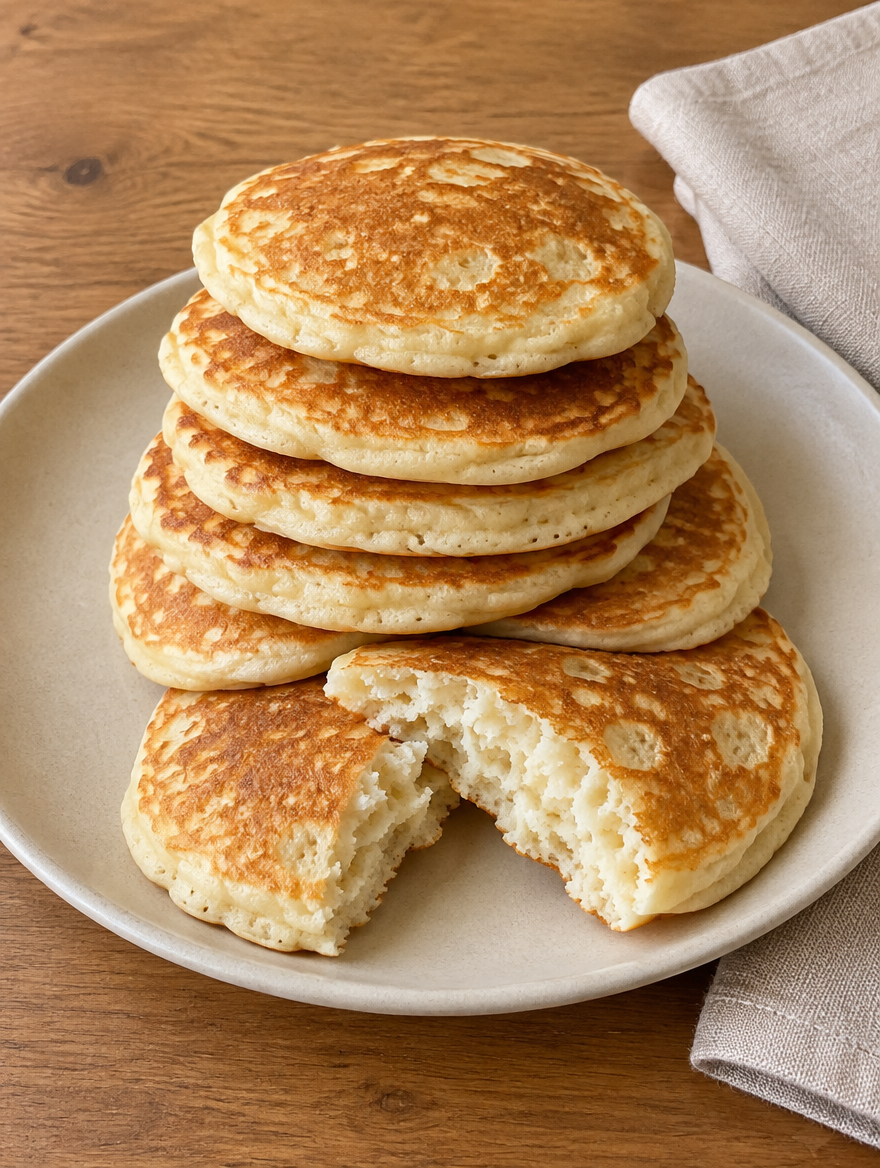
Fluffy dairy-free pancakes with oat milk make an uncomplicated, familiar American breakfast without cow’s milk, butter, yogurt, or eggs. A combination of plain unsweetened oat milk, a little neutral oil, baking powder, and a splash of vinegar creates a batter that can cook into soft, golden four-inch pancakes in an ordinary nonstick skillet. The recipe does not require commercial vegan butter or an egg-replacement mix.
Quick answer: whisk 1½ cups (190 g) all-purpose flour, 2 teaspoons (8 g) baking powder, ¼ teaspoon baking soda, 2 tablespoons (25 g) sugar, and ¼ teaspoon fine salt. In another bowl combine 1 cup plus 1 tablespoon (255 ml) plain unsweetened oat milk, 2 tablespoons (30 ml) neutral oil, 1 teaspoon (5 ml) vanilla extract, and 1 teaspoon (5 ml) apple cider vinegar. Fold the wet mixture into the dry ingredients, rest for five minutes, then cook in lightly oiled skillet portions of approximately ¼ cup (55–60 ml) over medium-low heat. Cook about 2–3 minutes on the first side and 1–2 on the second, until the centers are fully cooked. Expect roughly eight small pancakes, four modest two-pancake servings, in about 40 minutes including preparation, rest, and batch cooking.
Editorial disclosure: This is an original, AI-assisted recipe formulation, not independently tested in a physical kitchen. Oat milk brands, flour measuring methods, skillet temperature, and pancake size can change the outcome. A featured image is an AI-generated illustration, not documentation of a prepared test batch. No measured nutrition values or independent claims of allergy safety are provided.
What Does Dairy-Free Really Mean Here?
The recipe has no intentional ingredients derived from cow’s milk. Unsweetened oat milk supplies the liquid that regular pancakes often get from dairy milk, while neutral oil replaces melted butter. Because this particular formula is also made without eggs, it uses baking powder and a small amount of baking soda to help create lift instead of relying on eggs for structure.
Dairy-free and safe for a milk allergy are not automatically identical claims. Oat-milk cartons, dry baking ingredients, and utensils may involve shared manufacturing or preparation areas. Read each label, follow the needs of the person eating, and use cleaned equipment to limit cross-contact. Do not promise that any homemade batch is medically allergen-safe solely because the main recipe ingredients contain no milk.
This version also avoids eggs, but it does contain ordinary wheat flour. It is not gluten-free. Some food businesses also distinguish vegan-friendly ingredients from certified vegan sourcing; this home recipe has no intentionally animal-derived ingredients, but packaged products must still be assessed individually.
Ingredients for Eight Small Pancakes
For approximately four modest servings, prepare these measured ingredients:
- 1½ cups (190 g) all-purpose wheat flour, weighed if possible.
- 2 teaspoons (8 g) baking powder, fresh and properly stored.
- ¼ teaspoon baking soda, to react with a small amount of acid.
- 2 tablespoons (25 g) granulated sugar.
- ¼ teaspoon fine salt.
- 1 cup plus 1 tablespoon (255 ml) plain unsweetened oat milk, shaken or stirred according to carton directions.
- 2 tablespoons (30 ml) neutral oil, such as sunflower or canola oil, for the batter.
- 1 teaspoon (5 ml) vanilla extract.
- 1 teaspoon (5 ml) apple cider vinegar, or fresh lemon juice if that is what you have.
- A few drops of additional neutral oil for the skillet only if needed, according to the pan manufacturer’s guidance.
The sugar helps balance the flour and vanilla but does not turn the pancakes into a dessert. You do not need a large dose of sweetener in the batter. Keep the oat milk unsweetened and unflavored when following these exact amounts; flavored versions can alter both sweetness and browning.
The acid is a measured teaspoon, not a large pour. Combining it with baking soda supports a small amount of leavening, while the baking powder supplies most of the recipe’s lift. Do not substitute an arbitrary amount of baking soda for all the baking powder: the resulting flavor and structure could be poor.
Why Choose Oat Milk for Pancakes?
Oat milk is sold at many American supermarkets and can be an easy plant-based replacement in a breakfast batter. Its job here is to hydrate the wheat flour. It is not oat flour, and the recipe does not ask you to grind oats or prepare oatmeal. Finished pancakes should taste like lightly vanilla-scented flour pancakes, not a bowl of oats.
Oat milk brands vary widely. One carton may be thin and another creamy, sometimes because of added ingredients or processing methods. For the most reproducible result, start with 255 ml and check the batter after a brief rest rather than repeatedly pouring in liquid while you mix.
If your oat milk has been opened, follow the refrigeration and use-by instructions on that actual carton. An unopened shelf-stable product and an opened product are not stored the same way. For milk allergies, read the allergen and manufacturing information rather than relying solely on the words plant-based.
How Can Pancakes Be Fluffy Without Eggs?
Traditional recipes frequently use eggs, but pancakes can also rely on baking powder for lift. In this formulation, baking powder and baking soda react with moisture and acid, producing gas bubbles while the batter heats. The wheat flour then helps the small pancakes hold their shape as their centers cook. This is a practical explanation of the proposed method, not a claim that this precise mixture has undergone laboratory testing.
Avoid overmixing. Stirring wheat flour aggressively for several minutes encourages more gluten development, which can make the finished bite tougher than you want. A few small lumps are acceptable; they do not require a high-speed mixer to eliminate.
Portion size also matters. A modest four-inch pancake is easier to flip and cook through than a very large thick one. A broad, low-heat griddle gives each portion time to rise and set before the exterior becomes too dark.
Equipment and Skillet Setup
Use two medium bowls, a whisk, a flexible spatula, measuring spoons, a cup or food scale, a ladle, and a 10–12-inch nonstick skillet or well-seasoned griddle. A thin wide turning spatula is useful for sliding under a pancake without pulling it apart.
Set the burner to medium-low to start. If you use a nonstick skillet, follow its manufacturer’s limits on preheating and oil. There is no need to heat the empty pan until it smokes. Very high heat can brown the surface quickly but leave the center wet.
Have a clean serving plate ready before the batter enters the pan. Do not use the same unwashed bowl that held the raw flour mixture. Because uncooked flour can carry harmful microbes, the raw batter is not safe to taste.
How to Make Dairy-Free Pancakes Step by Step
1. Whisk the Dry Ingredients
In a bowl combine 190 g all-purpose flour, 8 g baking powder, ¼ teaspoon baking soda, 25 g sugar, and ¼ teaspoon fine salt. Whisk carefully until the small amounts of leavening are distributed throughout the flour. If your flour contains large lumps, break them up before moving to the next stage.
Accurate measurements make the first batch easier to assess. Scooping flour directly from a tightly packed bag can add too much, resulting in a stiff batter. A kitchen scale is helpful when available.
2. Mix the Oat Milk and Flavorings
In another bowl or jug mix 255 ml unsweetened oat milk, 30 ml neutral oil, 5 ml vanilla extract, and 5 ml apple cider vinegar. Stir until the ingredients look reasonably even. You may still see tiny oil droplets, and that is normal.
Do not replace the oil with melted dairy butter and still call the recipe dairy-free. If you choose fresh lemon juice instead of apple cider vinegar, keep the same small measured quantity.
3. Combine Gently
Pour the wet mixture into the dry ingredients. Use a spatula to fold from the bottom and turn only until the last obvious patches of dry flour disappear. Tiny lumps are acceptable. The mixture should be thick and spoonable, flowing slowly rather than running around the bowl like milk.
If it looks very thin, verify the measurements before adding more flour. If it is noticeably too stiff to drop from a spoon, evaluate it after the rest and add oat milk only a teaspoon at a time if truly needed. Large unmeasured adjustments will change the recipe.
4. Rest for Five Minutes
Let the mixture stand for about five minutes while the skillet warms moderately. This allows flour to hydrate, making it easier to judge the final thickness. It is not overnight fermentation. Baking powder begins working when wet, so this batter is designed to be cooked shortly after mixing.
Keep the kitchen surface clean and do not allow children to taste the uncooked mixture. Even without eggs, raw flour presents a food-safety concern.
5. Heat the Skillet and Portion the Batter
Warm the skillet on medium-low heat and apply just a few drops of neutral oil if the surface requires it. Wipe excess carefully using utensils safe for the hot pan. Scoop about 55–60 ml batter onto the skillet to form a circle about four inches across. Do not press the center flat.
Leave enough room to turn each pancake. A wide skillet may hold two portions; a small pan may only hold one. Keep sizes similar so they cook in comparable time.
6. Watch for Set Edges and Bubbles
Let each pancake cook for about two to three minutes on its first side. Small bubbles may appear on the top, and the edges should begin looking less wet. Lift one gently to check the underside; it should be lightly golden, not blackened.
If it browns quickly before the top begins to set, lower the burner. If it takes much longer, the heat may be too low or the portion too thick. Use the first pancake to learn your skillet’s actual behavior.
7. Flip and Finish Cooking
Slide a wide spatula under the pancake and flip it once. Cook approximately one to two more minutes, or longer if the center needs it. Test the first pancake by cutting it open after it is safe to handle: its center should look fully cooked, tender, and not glossy or raw.
Never treat a dark exterior alone as proof that the center is done. If necessary, reduce heat and extend cooking to avoid an underdone interior.
8. Repeat and Serve Promptly
Transfer finished pancakes to a clean plate, adjust the heat, and cook the remaining portions. Reapply only a little oil when necessary; the main measured oil is already in the batter. Serve while warm and tender.
There is no need to add butter, cream, cheese, syrup, berries, or other garnishes to the base dish. Optional toppings can be offered separately after checking their ingredients for the intended eater.
How Thick Should the Batter Be?
It should fall from a spoon in a slow ribbon and form a small mound before gently spreading. It will be thicker than crepe batter and thinner than cookie dough. Very thin batter can form large, flat pancakes; batter that does not flow at all can cook unevenly.
Oat milk thickness differs from carton to carton, so the feel of the batter matters alongside the measured recipe. A five-minute rest helps establish its consistency. If adjustment is necessary, make it one measured teaspoon at a time rather than guessing.
A few small lumps do not mean the batter is ruined. Trying to whisk every speck away can make the texture less tender. Cook a test pancake and inspect the center before changing ingredients.
What If the Pancakes Spread Too Much?
Check the liquid measurement first. If the oat milk was added by eye rather than measured, too much could create a thin batter. Also check that the flour was weighed correctly. The recipe uses 190 g; a lightly filled cup and a packed cup are not interchangeable.
A skillet that is cool can allow batter to spread before the outside begins setting. Let the pan reach an appropriate moderate heat, but do not overheat it. If your pancake still flows extremely wide, make a smaller test portion while you reassess the ratios.
Do not add large scoops of flour in an attempt to correct a poor first pancake. That could change the balance of baking powder and make the entire batch heavy.
Common Mistakes and Their Fixes
Mixing too hard. A batter that is whisked for a long time may yield less tender pancakes. Fold just until the dry flour disappears.
Using stale baking powder. Check the date and storage instructions. Leavening that has lost effectiveness cannot give the intended lift.
Overheating the skillet. Dark outsides and wet centers usually call for lower heat and a longer cook, not more oil.
Making pancakes too large. A huge thick portion is hard to flip and cook through evenly. Begin with four-inch portions.
Using sweetened oat milk. Flavored cartons change sweetness and color. Plain unsweetened oat milk gives a more reliable starting point.
Assuming dairy-free means allergen-free. Oat milk and other ingredients can have cross-contact warnings; flour contains wheat. Read every label.
Adding dairy toppings. Butter pats, whipped cream, and some chocolate spreads contain milk, changing the suitability of the final serving even if the pancake batter itself has none.
Can I Substitute Almond or Soy Milk?
Possibly, but this exact formulation has not been physically tested with either. Plant milks differ in thickness, flavor, and ingredients. An unsweetened almond milk may produce a different browning pattern, while soy milk can have a different taste and protein content.
Almond milk also creates an additional tree-nut concern for anyone with that allergy, and soy is another major allergen. Avoid promising that substitutions are interchangeable for every household. If you want the results described here, use plain unsweetened oat milk and record the brand for future batches.
For a person with a medically diagnosed milk allergy, cross-contact during manufacture and preparation matters too. Check the individual brand, clean utensils, and avoid shared toppings that contain dairy.
Are These Pancakes Vegan and Gluten-Free?
The measured ingredient list contains no intentional animal products, including no eggs, milk, yogurt, or butter. Depending on how your packaged ingredients are sourced, this may suit a plant-based diet. However, do not equate that with certification or guaranteed freedom from traces of animal ingredients.
The recipe is not gluten-free because it uses all-purpose wheat flour. Some oat-milk products can also have oat/gluten cross-contact considerations. A person with celiac disease needs a specifically formulated gluten-free batter and appropriate product and kitchen checks rather than a simple label change.
Because neither physical kitchen testing nor laboratory allergen testing was performed, this article avoids definitive medical safety guarantees.
Serving Ideas Without Changing the Recipe
Plain warm pancakes are the core recipe and the most useful way to evaluate their flavor and fluffy structure. For people who want a topping, offer a separate bowl of sliced fruit or a small amount of pure maple syrup after checking ingredient labels and dietary needs. These serving choices are optional and not included in the measured formula.
Some sauces or commercial spreads that look like harmless sweet toppings contain milk. If your household is avoiding dairy because of an allergy, treat toppings and shared utensils as part of the food-safety check.
For a different pancake idea, our fluffy pumpkin-spice pancakes with maple drizzle
Make-Ahead Tips for a Busy Morning
You can measure the dry ingredients into a clean covered bowl in advance. Store oat milk according to its carton and keep any opened product refrigerated if directed. When you are ready to cook, mix the liquids separately, combine, and cook promptly.
Because the batter relies on baking powder and baking soda, leaving it mixed overnight is not the approach described here. A long rest can change both consistency and rise. For a simpler morning, pre-measure the dry mix and set out the pan and utensils the evening before instead.
For another completely different breakfast format, our savory sweet-potato and bacon hash
Storage and Food Safety
Once fully cooked, serve the pancakes promptly. Put leftovers into clean, shallow containers and refrigerate within two hours of cooking at 40°F (4°C) or below. If the surroundings are unusually hot, above 90°F, follow the shorter one-hour rule for perishable foods.
As a conservative editorial estimate for this untested formulation, plan to use properly refrigerated pancakes within two to three days. It is not a microbiologically validated shelf-life claim. Reheat a portion thoroughly until the middle is hot and avoid repeated cycles of warming and cooling.
The CDC’s raw dough safety guidancenot taste or eat the uncooked pancake mixture. Follow the FoodSafety.gov clean, separate, cook, and chill principles
You may freeze fully cooked pancakes if handled safely, but this exact recipe has not been assessed for quality after freezing. Wrap cooled portions well, date the package, and thaw or reheat safely. Texture can change.
Other Breakfast Choices on MySavorista
These dairy-free pancakes give you a classic breakfast shape with no intended milk or egg ingredients. If you need something portable rather than skillet-fresh, the homemade chewy granola bars
The strongest reason to make this pancake is straightforward: you have a carton of plain oat milk and want fluffy breakfast pancakes without using milk or butter. You do not have to describe them as a miracle health food or promise precise calories. Cooking technique and ingredient labeling matter more than marketing language.
Frequently Asked Questions
Can I make pancakes without milk or eggs?
Yes, this formulation omits both. It uses oat milk, baking powder, baking soda, a teaspoon of acid, and neutral oil to make a cooked pancake batter. It has not been independently kitchen-tested, so exact rise and tenderness can vary.
Is oat milk always dairy-free?
Oat milk usually does not have intentionally added cow’s milk, but brands and shared manufacturing facilities differ. Read the carton and any allergen or cross-contact warnings, particularly when preparing for someone with a milk allergy.
Will these pancakes taste like oatmeal?
Not necessarily. They use wheat flour, not blended oats, and a small amount of plain oat milk. The intended flavor is lightly sweet with vanilla rather than strongly oat-flavored.
Why are my pancakes flat?
Possible causes include old baking powder, a batter that is too thin, overmixing, or a pan temperature that causes the batter to spread before setting. Measure carefully, rest briefly, and cook a test portion.
Should I add butter to the skillet?
No. A few drops of neutral oil may be used if appropriate for the skillet. Adding real dairy butter would change the recipe’s dairy-free character.
How many pancakes will the recipe make?
About eight small four-inch pancakes, or four modest servings of two. The actual yield varies with scoop size and how thickly the batter spreads.
Can I use almond milk instead of oat milk?
It may work as an adaptation, but it was not independently tested for this formulation and adds different allergen concerns. For the core recipe, use the measured unsweetened oat milk.
Can I leave out the vinegar?
You would change the acid balance that the formula uses alongside a small amount of baking soda. For this version, keep the measured teaspoon of apple cider vinegar or the specified lemon-juice alternative.
Is this recipe gluten-free?
No. It contains 190 g ordinary wheat flour. Replacing that with gluten-free flour calls for a separate tested formulation and verified ingredient labels.
How do I know when to flip the pancakes?
Wait until bubbles begin appearing, the edges look less wet, and the underside is golden. Flip once, then continue cooking until the middle is fully cooked and no longer raw or glossy.
Can I prepare the batter the night before?
The recommended method is to measure the dry ingredients ahead and combine everything shortly before cooking. A fully mixed batter left overnight may lose some leavening activity and requires safe storage.
Can I freeze finished pancakes?
You can try freezing fully cooked portions that have been promptly cooled and safely packaged, but freezing quality is not independently tested for this exact recipe. Reheat thoroughly and allow for possible texture differences.
Final Tips for Tender, Dairy-Free Pancakes
Measure 190 g flour and 255 ml plain oat milk, use the designated leavening, and mix only until combined. Let the batter rest briefly and cook small pancakes on a moderately heated skillet. Check the first pancake’s center instead of trusting color alone, and keep milk-containing toppings off any servings intended to remain dairy-free.
These are practical, familiar dairy-free oat milk pancakes without eggs or butter, based on an original editorial formula. Product labels, kitchen cleanliness, and actual cooking results always take priority over a promised perfect outcome.
Editorial transparency: Recipe developed with AI assistance; not independently cooked or tested. A featured image, if present, is AI-generated illustration, not documentation of a kitchen trial. No nutrition calculations, laboratory findings, or guaranteed allergen-safety claims have been invented.
Print
Fluffy Dairy-Free Pancakes With Oat Milk
- Prep Time: 15 minutes
- Cook Time: 20 minutes
- Total Time: 40 minutes including 5-minute batter rest
- Yield: Approximately 8 small 4-inch pancakes (4 servings) 1x
- Category: Breakfast & Brunch Upgrades
- Method: Skillet/griddle, gently mixed batter and medium-low heat
- Cuisine: American home breakfast
Description
Fluffy plain dairy-free and egg-free pancakes with unsweetened oat milk, all-purpose flour, baking powder, a splash of vinegar, vanilla and neutral oil, made in a skillet without butter.
Ingredients
1½ cups (190 g) all-purpose wheat flour
2 teaspoons (8 g) baking powder
¼ teaspoon baking soda
2 tablespoons (25 g) granulated sugar
¼ teaspoon fine salt
1 cup plus 1 tablespoon (255 ml) plain unsweetened oat milk
2 tablespoons (30 ml) neutral oil such as sunflower or canola, for batter
1 teaspoon (5 ml) vanilla extract
1 teaspoon (5 ml) apple cider vinegar or fresh lemon juice
A few drops additional neutral oil for skillet only if necessary
Instructions
In a medium bowl whisk 190 g all-purpose flour, 8 g baking powder, ¼ teaspoon baking soda, 25 g sugar, and ¼ teaspoon salt until leavening is evenly dispersed.
In a separate bowl or jug mix 255 ml plain unsweetened oat milk, 30 ml neutral oil, 5 ml vanilla and 5 ml apple cider vinegar (or lemon juice) until combined.
Pour the wet mixture into the dry ingredients; fold gently until no large dry flour pockets remain, allowing small lumps. Batter should be thick and spoonable, not watery; do not beat hard.
Rest the mixed batter about five minutes while a clean nonstick skillet or griddle warms on medium-low heat. Do not taste uncooked flour batter.
Apply only a few drops neutral oil to the skillet if needed. Spoon around 55–60 ml batter per pancake, making approximately 4-inch circles and leaving space to flip.
Cook about 2–3 minutes on the first side until small bubbles appear, edges begin setting and underside becomes lightly golden. Reduce heat if browning too fast.
Flip once with a broad spatula and cook roughly 1–2 minutes more or until each pancake is fully cooked in the center, not wet or raw. Adjust time to actual thickness and heat.
Transfer to a clean plate, repeat with remaining batter and serve promptly as plain pancakes, without dairy butter or milk toppings. Refrigerate leftovers promptly in shallow containers at or below 40°F (4°C).
Notes
Original AI-assisted editorial formula NOT independently kitchen-tested. Featured image is an AI-generated illustration, not a photo of a physical test. Core batter contains NO milk, butter, yogurt or eggs, but it contains wheat gluten, and safe allergy suitability cannot be guaranteed without ingredient-label and cross-contact review. Read oat milk packaging, including milk and other allergen cross-contact warnings. Do not taste raw flour batter (CDC food safety guidance). Use small pancake portions and cook fully, not raw inside. Refrigerate cooked leftovers promptly within 2 hours (within 1 hour above 90°F ambient), at 40°F or less; prefer use within 2–3 days as a conservative nonvalidated estimate. No nutrition calculation, no guaranteed gluten-free or allergen-free claim.
Nutrition
- Serving Size: 2 small pancakes per serving
Keywords: dairy free pancake recipe, oat milk pancakes, pancakes without milk, egg-free dairy-free pancakes, fluffy oat milk pancakes
2 thoughts on “Fluffy Dairy-Free Pancakes With Oat Milk”