
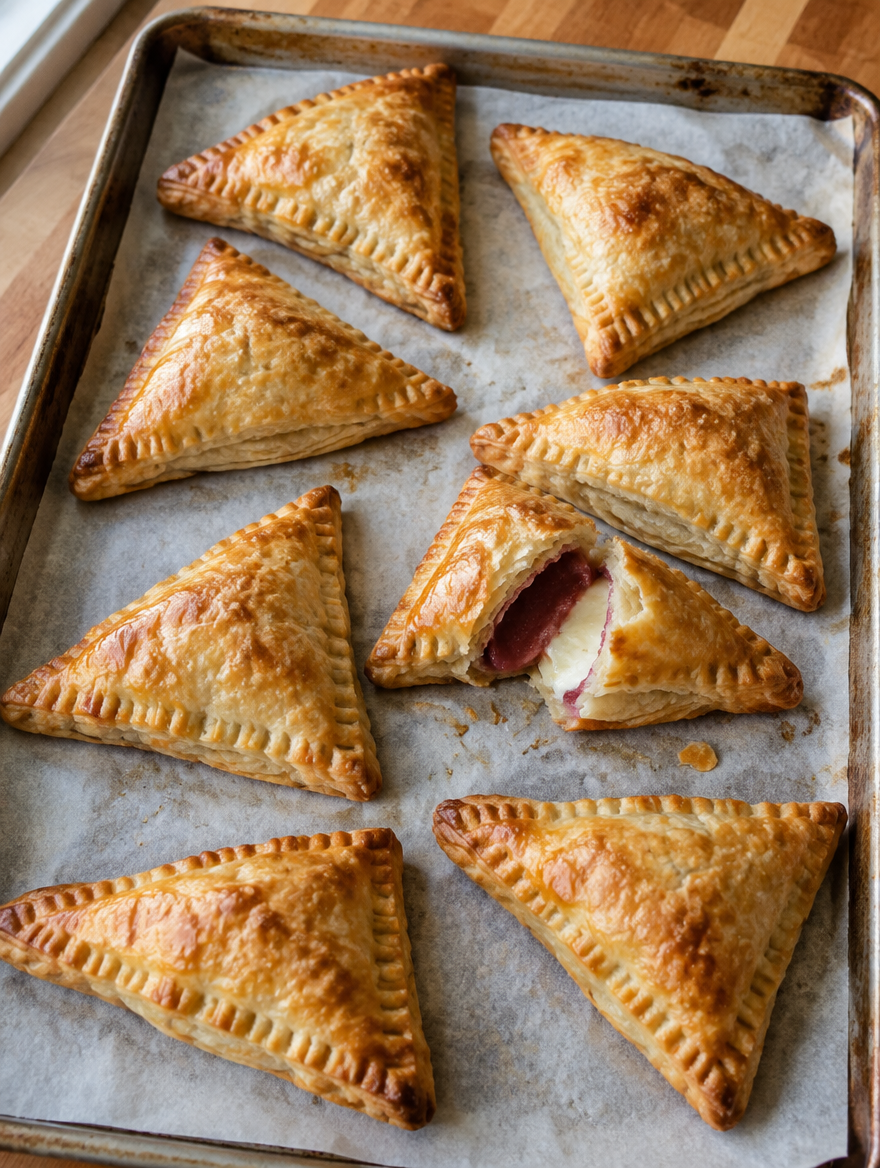
Guava cream cheese puff pastry turnovers bring a simple Latin bakery-inspired flavor combination into an American home kitchen: sweet-tart guava paste, a little tangy cream cheese, and a crisp golden pastry shell. These triangular hand pies use store-bought frozen puff pastry, so there’s no need to laminate dough or cook down fresh guavas before you can bake.
If you have been searching for guava recipes that use an easily available grocery-store or Latin-market ingredient, this is a practical starting point. Choose guava paste rather than a watery juice or ordinary guava nectar; the firm paste helps the filling stay inside the pastry as it heats. The recipe makes eight generous triangular turnovers from two puff pastry sheets and intentionally uses no extra glaze, fruit chunks, or complicated toppings.
Quick answer: thaw two 8½-ounce (roughly 240–245 g each) frozen puff pastry sheets in the refrigerator as directed by the package. Cut each sheet into four equal squares. Divide 6 ounces (170 g) guava paste and 4 ounces (115 g) plain full-fat cream cheese into eight portions each. Fill one corner-half of each square, fold to triangles, crimp with a fork and brush with one egg mixed with 1 tablespoon water. Chill the formed pastries 15 minutes, then bake at 400°F (205°C) for approximately 20–25 minutes, or until puffed, golden, and fully baked through. Cool briefly on a rack before serving. Allow about 25 minutes hands-on preparation, 15 minutes chilling and 20–25 minutes baking, not including the brand-specific time needed to thaw frozen pastry.
Editorial transparency: This original AI-assisted recipe has not been independently kitchen-tested. Exact puff-pastry dimensions, guava paste firmness, cream cheese brands, baking time, and final yield can vary. Any accompanying food photograph is an AI-generated illustration, not documentation of a real kitchen test. No independently calculated nutrition facts or guaranteed allergen-free claims are provided.
What Are Guava and Cream Cheese Turnovers?
A turnover is a portion of pastry folded around filling, frequently into a triangle or half-moon. This version uses rectangular or square frozen puff pastry, folds each portion over guava paste and cream cheese, and seals the edges before baking. Once cooked, the outside should be crisp and layered while the inside remains a little sweet and creamy.
Guava-filled pastries are popular in multiple Latin American bakery traditions, notably Cuban pastelitos. However, those traditions also include different shapes, doughs and filling proportions. The eight large triangular pastries here are our own home-kitchen interpretation, not a claim that every Cuban bakery uses this exact method. The James Beard Foundation’s guava and cream cheese turnover recipe provides additional culinary context for pairing guava paste with pastry and cream cheese.
A common confusion is between fresh guava and guava paste. Fresh guava contains flesh, peel and seeds and behaves differently from a dense, sweetened fruit paste during baking. We specifically use commercial guava paste in measured slices, because it can be portioned and sealed inside a small pastry more predictably than free-flowing guava juice or thin jam.
Ingredients for Eight Turnovers
The ingredient list is intentionally short, with no need to make pastry dough from scratch:
- Two frozen puff pastry sheets, about 8½ ounces each (approximately 480–490 g total), thawed in the refrigerator according to the package directions.
- 6 ounces (170 g) firm guava paste, cut into eight roughly equal slices or small blocks.
- 4 ounces (115 g) plain full-fat cream cheese, chilled until portioning and then divided into eight portions.
- 1 large egg, for the pastry wash.
- 1 tablespoon (15 ml) water, mixed with the egg for brushing.
- A little all-purpose flour for the work surface if the pastry package recommends it, used only as needed to prevent sticking.
The measured recipe does not include powdered sugar, a milk glaze, syrup, berries, fresh guava wedges, or additional cream sauce. Guava paste is usually already sweet, and plain cream cheese provides contrast. Adding more sugar is a personal variation rather than part of this tested-by-the-editorial-process formulation.
Check the package sizes before starting: puff pastry brands do not all supply two identical sheets. A package with one large sheet can still be divided, but the number and size of squares may change; the version on this page assumes two separate approximately 8½-ounce sheets, each cut into four.
Because the pastry contains wheat, the filling contains milk, and the glaze contains egg, these are not gluten-free, dairy-free, egg-free or vegan. Store-bought puff pastry may list additional allergens such as soy. Check each package and any cross-contact warnings when cooking for someone with allergies.
Where to Find Guava Paste in the United States
Guava paste is sometimes sold in the international-food aisle, in Latin American markets, or by stores that carry Caribbean pantry ingredients. It may appear as a firm rectangular block or in a can. Look for ingredient labels that explicitly say guava paste or pasta de guayaba, rather than guava nectar, guava juice, a thin jelly, or a beverage concentrate.
The most useful visual clue is consistency: you should be able to cut the paste into portions that hold their shape at room temperature. It can soften during baking, but it should not run out of your hand like fruit syrup when you assemble the turnovers.
If the package contains a much softer guava spread, the measured pieces in this recipe may not behave the same. A very loose filling can leak onto the baking sheet, burn at the edges and leave less fruit in the turnover. For the core recipe, use the firm product called for rather than promising that every fruit jam or jelly will be an exact substitute.
Can You Use Fresh Guava Instead of Paste?
Fresh guava is delicious in its own right but not a direct one-for-one replacement for firm paste in these turnovers. Depending on variety and ripeness, the fruit may contain firm seeds, watery flesh and a different degree of sweetness. It would need a separate preparation and moisture-control process.
Similarly, guava nectar is a drink, not a pastry filling. Pouring nectar onto puff pastry would undermine the sealed layers and create a soggy center. Use fruit paste designed to hold its shape, then portion it with a knife or spoon according to its firmness.
If you are interested in a lighter breakfast format instead of a fruit pastry, our fluffy dairy-free pancakes with oat milk are a different recipe with different ingredients and dietary characteristics. This pastry, by contrast, intentionally contains cream cheese and egg wash.
Choosing and Thawing Frozen Puff Pastry
Puff pastry consists of dough and fat arranged in layers that separate in the heat of the oven. Frozen ready-made sheets are a significant time-saver, but they still require careful thawing. Follow the package directions for thawing in the refrigerator, not an improvised warm spot near the stove.
You want pastry that is pliable enough to unfold without cracking, yet still cool and easy to handle. If it becomes very sticky or starts stretching as you work, return it to the refrigerator briefly before continuing. Warm, soft pastry can smear the layers and make crisp flakiness harder to achieve.
A faint dusting of flour can prevent sticking if the package permits it. Avoid using handfuls of extra flour; you are forming pre-made dough, not kneading bread. Handle the sheet just enough to divide it into four manageable squares.
Do not use ordinary pie crust or crescent-roll dough and expect the same result. Those are different products with different baking behavior, sealing requirements and finished textures.
Why Cream Cheese Is a Good Match for Guava
Guava paste tastes fruity, concentrated and sweet. Plain cream cheese supplies a tangy, mild counterpoint that can make the overall pastry feel more balanced. A small amount in each turnover is enough to create a distinct pale stripe beside the ruby-colored guava.
Use full-fat brick-style cream cheese for the most predictable portioning in this formulation. A thin whipped tub product or cream-cheese sauce can be harder to keep in place. This recipe has not been physically tested with reduced-fat or plant-based alternatives, so their exact melting and leaking behavior cannot be guaranteed.
Cream cheese is a perishable soft dairy product. Keep it refrigerated until needed and promptly refrigerate any leftovers; the USDA FSIS advice about soft cheese notes that cream cheese needs refrigeration for safety. This matters even when the other filling component, guava paste, has a long unopened pantry shelf life.
Equipment to Prepare Before Starting
You need two parchment-lined baking sheets, a cutting board or clean pastry work surface, a sharp knife or pizza cutter, a fork, a small bowl for egg wash, a pastry brush, and a cooling rack. If you only own one baking sheet, bake in batches rather than crowding the turnovers.
Set out a clean ruler if you want evenly sized pastry squares. Precise geometry is less important than keeping enough unfilled dough around each edge to seal the pastry closed. A measuring spoon also helps make the filling portions consistent.
The recipe uses an oven preheated to 400°F (205°C). Check that your baking sheets and parchment are rated for this temperature, and place the oven rack so the pastries can rise without touching a heating element.
How to Make Guava Cream Cheese Turnovers
1. Thaw the Puff Pastry Safely
Move the package of frozen puff pastry to the refrigerator and thaw it according to the manufacturer. Do not assume every brand uses the same thawing interval. While it thaws, portion 170 g guava paste into eight similar pieces and 115 g cream cheese into eight portions.
Keep the cream cheese cold until assembly. If the guava paste is especially firm, cut it carefully on a stable board rather than forcing the knife toward your hand. Prepare the parchment-lined trays before unfolding the pastry.
2. Preheat the Oven and Prepare the Egg Wash
Set the oven to 400°F (205°C). Beat one large egg with 15 ml water in a small bowl until fluid enough to brush. Use a dedicated brush and keep raw egg away from ready-to-eat surfaces. The wash helps the pastry become golden; it is not used as a filling ingredient.
Do not leave the oven door open during preheating. The pastry needs a properly heated environment to rise into crisp layers.
3. Cut the Pastry Into Eight Squares
Unfold each of the two chilled pastry sheets onto a clean, lightly floured surface if needed. Cut each sheet into four approximately equal squares, giving eight squares altogether. Minor variations in dimensions are fine as long as each square will fold diagonally around its filling.
Avoid rolling the pastry very thin. Keeping an intact layered sheet helps the finished hand pies puff. If the dough starts becoming sticky, place the squares back in the refrigerator while you work with the filling.
4. Add Guava Paste and Cream Cheese
Place one-eighth of the guava paste and one-eighth of the cream cheese on one triangular half of a dough square, leaving a clear border of about ½ inch around the two edges you will seal. The filling should sit in a compact mound rather than being spread across the entire piece.
Repeat on the remaining seven squares. Be careful not to overstuff; extra guava paste at the seam can escape and burn. You want a pastry with a visible guava-and-cheese center after baking, not one whose filling has all leaked out.
5. Fold and Crimp the Triangles
Brush the empty dough border lightly with egg wash, then fold the opposite corner over the filling to make a triangle. Press the two open sides gently together, then crimp along both edges with a fork to create a seal. Keep the filling away from the sealed border.
Transfer the triangles to the parchment-lined sheets with a little space between them. Do not pile raw turnovers on top of one another. If your dough becomes warm during assembly, refrigerate the filled pastries before brushing their tops.
6. Chill Briefly and Vent the Tops
Refrigerate the eight assembled pastries for 15 minutes so the puff pastry becomes cool and firm again. Use a sharp small knife to make one short vent slit on top of each triangle, without cutting so deeply that the filling is exposed along the edge.
Lightly brush the upper pastry surface with the remaining egg wash, avoiding puddles along the seams. Excessive egg wash on cut edges can glue layers together. The pastries should remain recognizable triangles, not strips or lattices.
7. Bake Until Golden and Fully Cooked
Bake at 400°F (205°C) for approximately 20–25 minutes, rotating the sheets as needed if your oven browns unevenly. Look for a deeply golden, well-risen laminated crust and no wet, raw dough at the center seam. Timing depends on dough thickness, oven calibration and brand; color alone is a guide, not a universal timer.
If guava paste oozes slightly at one seam, it may caramelize on the parchment. Do not try to push hot filling back into the pastry with your fingers. If a turnover starts browning too fast, adjust the sheet position or heat according to safe oven practices.
8. Cool Briefly and Serve
Remove the sheets with dry oven mitts and move the pastries carefully to a cooling rack. Let the turnovers rest for about 10–15 minutes before serving: guava paste and cream cheese filling can stay hotter than the outside looks. Keep the pan out of reach of small children during cooling.
Serve the turnovers as they are, without powdered sugar or added glaze. Once fully cooled and not being eaten promptly, refrigerate them because of the cream-cheese filling.
How to Keep Guava Filling Inside the Pastry
The most common mistake is putting too much paste close to a seam. The guava needs room to soften while the puff pastry expands. Use the measured 170 g divided eight ways and leave a substantial clean border for crimping.
Another risk is working with dough that has become warm and greasy. Warm pastry may stretch out of shape and fail to seal neatly. A short 15-minute refrigeration step before baking helps the folded triangles hold their form, though the exact result has not been physically tested for this specific version.
Finally, do not spread cream cheese across the outer half-inch of the pastry. A clean dough edge with a little egg wash provides a better seal than a slippery one. A fork’s crimp marks should be visible all the way along the open edges, with no large gaps.
What Should the Finished Turnovers Look Like?
Each pastry should be a distinct golden triangular hand pie with crisp layered edges. When carefully opened after cooling, the inside should show a contrasting ruby-to-pink guava filling and a light creamy cheese filling. Minor spreading of the filling can occur, but the center should not be a completely empty cavity.
Puff pastry layers may rise unevenly. An imperfectly browned corner does not make a pastry a failure as long as the dough has baked through. However, do not serve pieces with visibly raw wet dough in the center.
The photographs in this article, if included, are illustrative. They are not evidence that MySavorista independently baked a specific batch or measured internal temperatures in a test kitchen.
Common Mistakes to Avoid
Using guava juice instead of paste. Juice has far too much free liquid for this method and can soak the dough. Use firm guava paste that can be sliced.
Overfilling the squares. Filling that touches the borders prevents a reliable seal. Divide the guava and cheese into eight portions and leave about ½ inch clear.
Letting the pastry get too warm. Puffy laminated pastry works best when handled cool. Return sticky pieces to the refrigerator rather than kneading them heavily.
Skipping the fork crimp. A gentle press alone may not hold when the filling heats and steam builds. Seal and crimp both open sides.
Crowding the baking sheet. Turnovers need room to expand. Bake on two sheets or in separate batches if you have limited space.
Serving immediately from the oven. Concentrated fruit filling can retain heat. Allow a short cooling period to reduce the risk of burns.
Leaving cream-cheese pastries unrefrigerated for hours. These contain a perishable dairy filling and should be refrigerated promptly when not being served.
How This Recipe Differs From Guava Jam Pastries
A pastry filled with a thin fruit jam may require thickening, chilling or another moisture-control strategy. Here, the dense guava paste is a deliberate choice. A solid fruit block is easy to measure, portion and place inside a square before folding.
Cream cheese changes the contrast as well: the pastry contains both concentrated fruit and tangy dairy rather than just a sweet guava center. The proportions in this version are 170 g paste to 115 g cream cheese, divided across eight pastries.
If you want to explore a different classic bakery approach, the King Arthur Baking guide to guava cream cheese pastries discusses the importance of firm guava paste and careful pastry handling. This recipe uses a simpler store-bought-sheet, triangular turnover process rather than that guide’s particular dough and assembly.
Are These the Same as Cuban Pastelitos?
They belong to a related family of guava-and-cheese pastries, but it would be inaccurate to claim that the exact eight-triangle method is the single authentic Cuban standard. Bakeries and home cooks use different sizes, layered pastry shapes and fillings.
The ingredient pairing of guava paste and cream cheese is a recognizable Latin bakery favorite. Our version honors that pairing while using an American grocery-store convenience ingredient, frozen puff pastry, and a simple fork-crimped triangle.
You can serve the turnovers for breakfast, brunch or dessert. They are sweet pastries regardless of the time of day, so don’t treat their fruit filling as a nutritional substitute for whole fruit.
Can You Make the Turnovers Ahead?
The easiest time-saver is to portion the guava paste before baking day and keep the cream cheese refrigerated. Puff pastry can be thawed according to the package’s directions before assembly; do not leave frozen pastry beside a heater to speed it up.
You can also assemble the triangles and refrigerate them briefly before baking, provided you maintain food-safe temperatures and do not store the raw egg-washed pastries for extended periods without suitable guidance. The recipe has only been editorially formulated around a 15-minute chill, so longer storage affects texture and requires judgment.
For a busy gathering, bake in two batches if necessary. Clean the counter and utensils after handling raw egg wash, and keep cooked pastries on a fresh rack or plate.
Storage and Reheating
Because these turnovers contain cream cheese, refrigerate leftovers promptly, even if a commercial package of plain shelf-stable guava paste can be stored differently before opening. Use shallow, clean covered containers and a refrigerator maintained at 40°F (4°C) or below. Refrigerate within two hours of cooking or sooner in hot surroundings.
For this kitchen-untested recipe, a conservative editorial plan is to use well-refrigerated leftovers within two to three days; this is not an experimentally established shelf-life. If a pastry has been left out at unsafe temperatures or you cannot tell how it was handled, discard it rather than relying on reheating.
To reheat, place a portion in a suitable oven or toaster oven according to the appliance’s directions and heat it until the center is hot. The puff pastry may lose crispness after refrigeration. Avoid repeatedly warming and cooling the same turnover, and let hot guava filling cool enough to eat safely.
Freezing after baking may change the texture of cream cheese and pastry; this exact formulation has not been evaluated for that purpose. If you choose to freeze, follow safe packaging, thawing and reheating practices instead of assuming a guaranteed texture or shelf life.
Other Easy Breakfast and Brunch Ideas
Guava pastries are sweet, buttery-style baked goods and can be a special occasion treat. For something made in a skillet rather than the oven, browse our fluffy pumpkin-spice pancakes with maple drizzle. They have a different seasonal flavor profile and are not presented as a guava recipe.
If you want a portable snack rather than filled pastry, our homemade chewy granola bars are a separate recipe that includes peanuts and honey. Read their ingredient list separately if any dietary or allergen concerns apply.
For an egg-free dairy-free batter option, the oat-milk pancakes are intentionally different from these cream-cheese, egg-washed guava pastries.
Frequently Asked Questions
What do guava cream cheese turnovers taste like?
They are sweet-tart and creamy: concentrated guava paste supplies fruity flavor, plain cream cheese provides tang, and puff pastry adds a crisp golden shell.
Can I use fresh guava instead of guava paste?
Not without creating a different filling. Fresh fruit can be wetter and contain seeds; the measured recipe requires 170 g firm guava paste.
What is guava paste called at the grocery store?
Look for guava paste or pasta de guayaba, often in a Latin or international aisle. Guava nectar, juice and thin guava jelly are not the same texture.
How many turnovers does this recipe make?
Eight large triangular turnovers from two sheets of frozen puff pastry, each cut into four squares.
Can I use cream cheese from a tub?
A firm brick-style cream cheese is easier to portion and keep centered. Whipped or very soft tub varieties have not been physically tested in this recipe and may behave differently.
Should the filling be sweetened?
The measured version uses guava paste’s existing sweetness with plain cream cheese. There is no additional sugar mixed into the filling.
Do I need to chill them before baking?
This recipe includes a 15-minute refrigerator rest after assembly to help keep the puff pastry cool and shaped. Follow safe storage practices during that interval.
How do I seal guava turnovers?
Leave approximately ½ inch clear around the dough edges, fold each square into a triangle, press gently and crimp both open sides with a fork.
What oven temperature should I use?
The recipe uses 400°F (205°C) and an estimated 20–25 minutes, but follow visual baking cues and your pastry package’s guidance when applicable.
Why did my guava filling leak?
The triangle may have been overfilled, the filling touched the seam, or the edges were not sealed well. Leave a border, crimp thoroughly and work with cool pastry.
Are guava cream cheese turnovers dairy-free?
No. The filling intentionally contains plain cream cheese, and some puff pastry brands also contain dairy.
Can I keep the baked pastries on the counter overnight?
No. With a perishable cream-cheese filling, refrigerate leftovers promptly; do not treat them like a shelf-stable unopened jar of guava paste.
Is this a traditional Cuban recipe?
It is a Latin bakery-inspired home interpretation of the familiar guava-and-cheese pastry pairing. It does not claim one universal authentic bakery shape or technique.
The Best Way to Enjoy These Guava Pastries
For a straightforward guava dessert or sweet brunch item, start with firm guava paste, chilled full-fat cream cheese and two sheets of ready-made puff pastry. Divide everything evenly into eight triangular packages, crimp carefully, chill briefly and bake until the layers are golden and cooked through.
Serve after the filling has cooled enough to eat safely. No sugar glaze, fruit garnish or special equipment is required to enjoy the contrast between guava and cream cheese.
Editorial and image disclosure: This original AI-assisted recipe has not been independently kitchen-tested. Any featured photo is AI-generated illustration and does not document a real test batch. Nutrition, allergy safety and storage outcomes have not been independently laboratory-validated.
Print
Guava Cream Cheese Puff Pastry Turnovers
- Prep Time: 25 minutes hands-on
- Cook Time: 20–25 minutes
- Total Time: About 60–65 minutes plus package-directed refrigerator thawing of frozen puff pastry (25 minutes prep, 15 minutes chill, 20–25 minutes bake)
- Yield: 8 large triangular turnovers 1x
- Category: Global Flavors & Street Food
- Method: Store-bought puff pastry triangles, fork-crimped, briefly chilled and oven baked at 400°F
- Cuisine: Latin bakery-inspired, Cuban guava-and-cheese pairing
Description
Golden Latin bakery-inspired guava and cream cheese triangle turnovers made with two sheets of store-bought puff pastry, firm guava paste, full-fat cream cheese and egg wash.
Ingredients
2 frozen puff pastry sheets, approximately 8½ oz (240–245 g) each / 480–490 g total, refrigerator-thawed according to package
6 oz (170 g) firm guava paste, cut into eight equal pieces
4 oz (115 g) plain full-fat brick-style cream cheese, divided into eight portions
1 large egg, beaten for egg wash
1 tablespoon (15 ml) water, mixed with the egg
A small amount of all-purpose flour for the pastry work surface, only if needed
Instructions
Thaw both frozen pastry sheets in refrigerator as instructed on package; prepare 170 g firm guava paste in eight portions and 115 g cream cheese in eight portions. Keep cream cheese cold.
Preheat oven to 400°F (205°C), line two baking sheets with parchment rated for the oven. Beat 1 egg with 15 ml water to make egg wash.
Unfold two cool pastry sheets on a lightly floured work surface if needed. Cut each sheet into four roughly equal squares, eight in total; avoid stretching or kneading.
Place 1/8 guava paste and 1/8 cream cheese on one triangular half of each square, leaving about a ½-inch empty border for sealing. Do not overfill.
Brush edges very lightly with egg wash, fold corner to corner into a triangle, press and crimp both exposed edges firmly with a fork. Arrange triangles separated on parchment-lined sheets.
Refrigerate assembled triangles for 15 minutes, cut one small steam vent in each pastry top and brush exposed top lightly with egg wash without pooling in seams.
Bake at 400°F (205°C) about 20–25 minutes until deeply golden, well puffed and pastry cooked through, checking for any wet raw dough near seams; rotate sheet position if needed. Hot fruit filling can leak and burn; never touch it barehanded.
Cool on baking rack about 10–15 minutes before serving. Refrigerate uneaten cream-cheese-filled pastries promptly at 40°F (4°C) or less within two hours; reheat portions thoroughly and cautiously because filling retains heat.
Notes
This original AI-assisted recipe has not been independently kitchen-tested. Featured food image is an AI-generated illustration, not documentation of a real test batch. Ingredients intentionally contain WHEAT, MILK and EGG; packaged pastry may have other allergens, review labels/cross-contact. Use firm guava PASTE, not guava nectar/juice or thin jam. Cream cheese requires refrigeration per USDA FSIS; do not leave pastries with dairy filling unrefrigerated overnight. Approx 8 large pastries, one triangle per square. Recipe is Latin bakery-inspired, not a definitive claim to all Cuban or Latin American traditional formats. Prompt refrigeration within two hours, 40°F or below; conservative use of refrigerated leftovers within 2–3 days is not microbiologically validated for this recipe. Frozen pastry thawing times vary by manufacturer and are not included in prep total. No invented nutrient facts, lab results, or guaranteed dietary safety.
Nutrition
- Serving Size: 1 large turnover (1 of 8)
Keywords: guava recipes, guava cream cheese turnovers, guava puff pastry, easy guava pastelitos, guava paste recipe