
If you are looking for round eye round steak recipes, begin by understanding what this lean cut needs: controlled heat, accurate doneness checks, and thin slices across the grain. Unlike a fatty ribeye, eye of round can taste dry if it stays in a hot skillet for too long. This guide gives three distinct methods while keeping one featured, fully described dinner recipe as the primary focus.
The main method serves four people with garlic-pepper eye-of-round steaks and a simple golden onion pan gravy. A separate tomato-onion braise and a pepper-lime strip skillet provide alternatives for different meal plans. The Tasty card and both featured images represent the first method only; they do not claim all three dishes were photographed or kitchen-tested.
Food safety comes first: for intact whole-muscle beef steaks, follow the USDA minimum of 145°F using a meat thermometer, followed by at least a three-minute rest. Exact minutes depend on steak thickness and pan heat. All times, yields and amounts below are editorial estimates until a real cooking test confirms them.
Three useful ways to cook lean eye of round steak
Searching for round eye round steak recipes often leads to a mix of oven roasts, Swiss steak and quick skillet dinners. The names can be confusing, because eye of round is a particular lean muscle from the beef round, while a whole eye-of-round roast is not identical in size to several packaged steaks cut from that muscle. This guide focuses on actual eye of round steaks, not a several-pound whole roast.
The featured recipe is thin eye of round steaks with caramelized onion and a simple pepper-garlic pan gravy. Two additional separately measured options—a slow tomato-onion braise and a quick pepper-lime strip skillet—give cooks useful alternatives. Only the main pan-gravy preparation has the Tasty recipe card and the recipe photographs. The alternatives are clearly labeled so the reader does not accidentally use one method’s cooking time or ingredient list for another.
Understand the cut before heating the pan
The Beef. It’s What’s For Dinner eye-of-round cut guide describes a very lean muscle that is shaped somewhat like a tenderloin but is less tender. It may be sold as a roast, steaks, stew meat or cubed steak. That explains why a beautiful package of round steak can become chewy if treated like a highly marbled ribeye.
When asking a butcher for eye of round steak, specify that you want slices approximately three-quarters of an inch thick and preferably from the eye-of-round muscle. Top round, bottom round, round tip and cube steak are related retail categories but not guaranteed to behave identically. The distinction matters for both a useful cooking guide and for honest recipe photography.
Why quick searing needs careful timing
Eye of round has relatively little intramuscular fat. Searing can create a flavorful surface, but keeping this cut over high heat for too long will not make it buttery. Use steaks of similar thickness, give them enough pan contact to brown, and rely on a thermometer rather than a fixed minute count. The meat can then rest while the onion gravy finishes.
The beef industry’s skillet guidance explicitly lists eye-of-round steak, and recommends suitable thickness and doneness control for this lean cut. The USDA’s food-safety minimum for intact beef steak is 145°F with at least a three-minute rest. We follow that safety standard here, even if some restaurant-style steak tips elsewhere discuss lower culinary preference temperatures.
Recipe one: garlic-pepper steaks with onion pan gravy
The first and featured version serves four people. It uses four boneless eye-of-round steaks weighing about six ounces apiece, one large sliced yellow onion, two garlic cloves, a cup of low-sodium beef broth, a teaspoon of Dijon mustard and a teaspoon of apple cider vinegar. Olive oil, salt, black pepper and a little thyme bring the ingredients together.
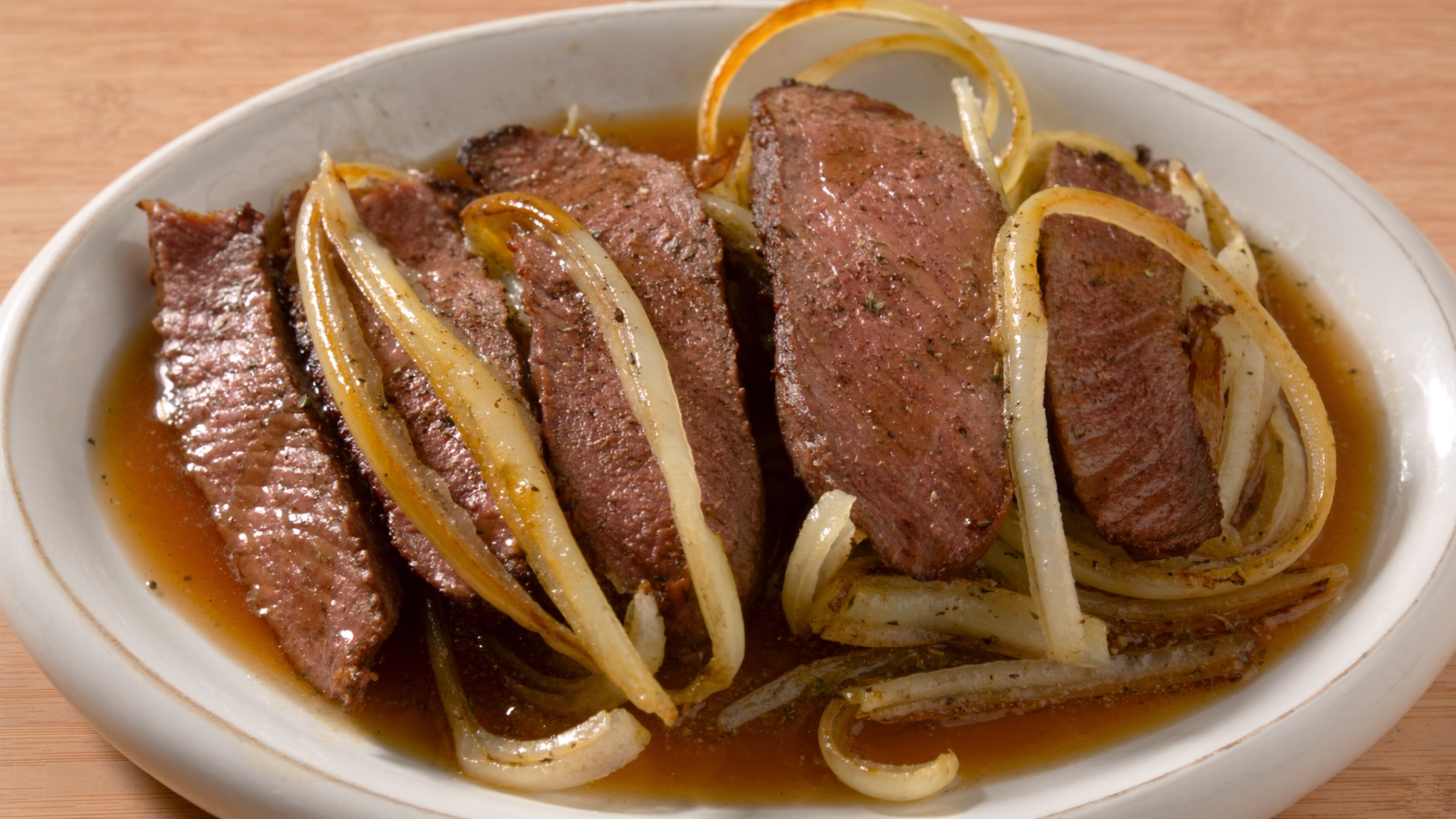
The onion sauce is designed to coat thin slices of beef, not bury them beneath a thick white gravy. It should be glossy and light brown with clearly visible soft golden onion ribbons. The steak stays recognizable, browned on the exterior and sliced thin across the grain to reduce the length of its firm muscle fibers. That anatomy is the source of truth for both independent recipe images.
A complete ingredient list for the main recipe
For the four portions measure 1½ pounds eye-of-round steaks, preferably four even steaks ½ to ¾ inch thick; two tablespoons olive oil divided; one large yellow onion, thinly sliced; two garlic cloves, finely minced; one cup low-sodium beef broth; one teaspoon Dijon mustard; one teaspoon apple cider vinegar; half a teaspoon dried thyme; three-quarters teaspoon kosher salt to begin; and half a teaspoon coarse-ground black pepper.
These amounts produce four steak portions with an aromatic onion sauce. Dijon mustard can include mustard allergens, and beef broth varies in sodium; check product labels for dietary restrictions. There is no cheese, cream, mushroom, bacon, wine or hidden flour in the principal preparation. The pan gravy thickens slightly by reducing broth and cooking onions, not by adding a roux.
How to prepare the steaks evenly
Unwrap cold steaks on a clean board dedicated to raw meat and pat the surfaces dry with paper towels. If any edge has a thick external silverskin, trim it carefully without removing all the lean muscle. Lightly score or gently tap thick sections using a meat mallet, but avoid pounding them into paper-thin cutlets. Uniform thickness is more important than extreme tenderization.
Season with the measured kosher salt and black pepper. Let the seasoned steaks rest covered in the refrigerator while the onion is sliced and the other ingredients are measured, rather than leaving raw beef at room temperature for an extended period. Wash hands and clean utensils after raw-meat contact, and keep vegetables and ready-to-eat foods on a separate surface.
Choose a pan with enough cooking space
A 12-inch heavy skillet, preferably stainless steel or cast iron, gives the meat room to brown. If all four steaks cannot lie flat with a little space between them, sear in two batches and keep the first batch on a clean warm plate. Crowding the skillet traps steam and prevents the browned surface that makes a simple pan sauce taste savory.
Warm one tablespoon of olive oil over medium-high heat until it shimmers. The oil should not smoke violently or darken. Add the steaks without dragging them around, so each piece makes good contact. Use tongs rather than a fork that pierces the surface repeatedly, and avoid splashing hot oil when turning the meat.
Sear to a thermometer reading, not a stopwatch
For steaks roughly ½ to ¾ inch thick, start checking after a few minutes per side; actual time depends on skillet, starting temperature and thickness. Turn the steaks when the first surface is browned. Insert an instant-read food thermometer from the side into the thickest part and ensure intact beef steak reaches at least 145°F before removing it from the heat.
The USDA FSIS safety guidance requires at least a three-minute rest for steaks after reaching 145°F. Place the cooked steaks on a clean plate and rest them while preparing the sauce, without returning raw-beef utensils to the finished food. A thermometer reading, not pink color or accumulated pan juices, determines the safe minimum.
Build golden onion flavor in the same skillet
Reduce the heat to medium and add the remaining tablespoon of olive oil. Scatter the sliced onion into the skillet and stir gently, scraping up loose browned bits that have not burned. Allow around eight to ten minutes for the onion to soften and develop light golden edges, adding a teaspoon of water if the bottom becomes too dry.
Onions should feel soft but still retain some shape. Very dark or charred onion will make the finished broth harsh, so turn down the heat if necessary. When the onion is softened, add minced garlic and dried thyme for about thirty seconds. The garlic should become fragrant, not brown to the point of bitterness.
Create the quick beef broth pan gravy
Pour in one cup of low-sodium beef broth, add the Dijon mustard and stir in a teaspoon of cider vinegar. Scrape the browned beef fond from the bottom of the skillet with a wooden spoon. Simmer around five to seven minutes until the sauce reduces slightly and the onions are coated; it should still pour easily off a spoon.
Taste before adding more salt, because the volume of liquid has decreased and the mustard contains some seasoning. A small splash of hot broth can loosen a sauce that has reduced too far. Do not add heavy cream or white cheese for visual richness: the specified sauce is a clear light-brown onion jus with savory body, not an Alfredo-style sauce.
Slice against the grain for more tender bites
After the USDA three-minute rest has elapsed, find the direction of the long muscle fibers in each steak. Hold a sharp knife perpendicular to those fibers and cut thin slices, roughly one-eighth to one-quarter inch thick. Slicing with the grain leaves each bite with long, resistant fibers; crossing them makes lean beef noticeably easier to chew.
Arrange the slices over a small amount of the cooked onion gravy and spoon more onion broth across the top. Keep the dish simple: browned thin steak strips with soft onion ribbons and a modest glaze. The plate should not resemble shredded pot roast, a cheesesteak sandwich or thick filet medallions. The result is a practical weeknight steak dinner, not a steakhouse illusion.
Why we make the gravy after cooking the meat
Separating the two stages prevents steaks from overcooking while onions slowly soften. Lean eye of round has a narrower margin for pleasant texture than a fatty cut. Once a steak reaches its safe doneness, hold it on a clean plate during the short sauce stage rather than boiling it inside the onion broth for another fifteen minutes.
The rested juices that collect on the clean plate can be stirred into the simmering gravy and brought back to a simmer if you choose. This makes sensible use of the meat flavor. However, the sauce is not dependent on those juices to succeed, and it is important not to mix any uncooked marinade or raw-meat drippings into a finished sauce without proper cooking.
The finished plate and what it should look like
The featured meal should show lean, finely sliced, browned eye-of-round steak with a light sheen and distinct golden-brown onion strands. A few small flecks of thyme or black pepper are appropriate. The gravy can pool lightly at the edge of a plain plate but should not completely submerge the meat or look like a thick cream sauce.
A useful photograph must show the real recipe, including its minimal ingredient list. Avoid adding mushrooms, green bell peppers, cheese, mashed potatoes, carrots or a large parsley garnish that appear nowhere in the Tasty card. Side dishes can be shown separately if described honestly, but the two original images planned here focus on the steak and onion gravy alone.
Recipe two: slow tomato-onion eye-of-round braise
For an alternative moist-heat dinner, start with 1½ pounds eye-of-round steaks cut about ¾ inch thick, one tablespoon olive oil, one sliced onion, one 14-ounce can crushed tomatoes, three-quarters cup unsalted beef broth, two garlic cloves, one teaspoon dried oregano and half a teaspoon smoked paprika. Season with salt and black pepper to taste. This is a separate recipe, not an ingredient variation inside the featured Tasty card.
Brown the steaks quickly in an oven-safe Dutch oven, remove them, then soften the onion and garlic. Stir in tomatoes, broth and spices. Nestle the meat in a shallow layer of sauce, cover tightly and cook in an oven preheated to 300°F. Begin checking after about 75 minutes, then continue until the meat is tender enough to slice and the sauce is cooked; the beef must exceed the safe 145°F minimum and braised tenderness may take significantly longer.
When braising makes more sense than searing
Choose the tomato-onion braise if your eye-of-round steaks are thicker, your family wants a saucier comfort-food dinner, or you have time for a longer oven session. Moist heat lets the sauce coat the meat as it cooks. It does not magically transform an extremely lean cut into a well-marbled chuck roast, so do not promise the same shreddable result.
If the braise seems dry before the meat is tender, add more hot broth and re-cover. If the sauce is thin once the beef has softened, transfer the steaks to a clean platter, reduce the sauce briefly, and return them only long enough to coat. Slice the meat across the grain, especially if the texture remains firmer than expected.
Recipe three: pepper-lime steak strips
A second alternative emphasizes small strips rather than whole steaks with gravy. For four lighter servings, use one pound thin eye-of-round steak, one tablespoon olive oil, one tablespoon lime juice, two minced garlic cloves, half a teaspoon ground cumin, half a teaspoon black pepper, three-quarters teaspoon kosher salt and one thinly sliced yellow bell pepper. Keep the lime as a brief flavor addition rather than a prolonged room-temperature soak.
Place the cold steak on a clean board and cut into thin strips perpendicular to the muscle grain. Toss with oil, garlic, cumin and salt; refrigerate covered for up to 30 minutes if preparing ahead. Heat a wide skillet and cook strips in small batches, adding the bell pepper near the end, until the beef is cooked thoroughly. A thermometer on the largest, thickest strip should reach the appropriate safe beef temperature; thin strips must not be served undercooked because they browned quickly.
A thin steak seared in a hot skillet, a steak braised beneath a lid and narrow strips tossed in a pan have different heat-transfer patterns. Their cooking time, moisture and final texture will vary even though they originate from the same muscle. The featured recipe assumes intact small steaks, while the braise and strip skillet have their own measured ingredient sets.
Keep the three methods separate when planning groceries. The photographic media and Tasty schema represent recipe one only, and the two alternatives are text-only options clearly described within the article. This prevents a reader from trying to use a four-minute searing estimate for a thick braise or from mistaking a tomato sauce for onion gravy.
Marinade options for lean steaks
Eye-of-round steak often benefits from flavorful marinating before a hot skillet or grill, especially if the slices are not very thin. The University of Minnesota Extension beef-cuts guide discusses inexpensive lean cuts and how oil, acidic liquid and seasonings can work together in a marinade.
For a separate marinated variation, combine two tablespoons olive oil, one tablespoon cider vinegar, two minced garlic cloves and a half teaspoon black pepper per pound of steak, then refrigerate in a covered nonreactive container for 30 minutes to two hours. Discard the raw-meat marinade after use unless it is subsequently boiled according to safe handling guidance; never drizzle it raw over the cooked steaks.
Should eye of round steak be tenderized?
Gentle mechanical tenderizing can shorten tough fibers in a lean steak, but pounding forcefully may shred the surface and create uneven thickness. Use the flat side of a meat mallet for a few passes on thicker areas, then restore an even shape before cooking. Tenderizing is a texture aid, not a substitute for choosing the correct cut and the proper internal temperature.
Be aware that commercially mechanically tenderized beef may have different labeling and food-safety directions than an intact steak. Follow the package instructions if the product is labeled mechanically tenderized or injected. Do not assume a safe minimum meant for intact whole-muscle steak automatically overrides the label’s preparation requirements.
Best sides for onion gravy steak
The garlic-pepper steaks pair well with roast potatoes, plain rice, steamed green beans or a crisp salad. Since the sauce is savory but not overly thick, something starchy on the plate can catch the onion broth. A simple vegetable side adds contrast without changing the recipe’s centerpiece or creating an overly crowded presentation.
For a larger comfort-food dinner, you could cook the one-pot Parmesan garlic orzo separately. It contains dairy and has its own ingredients; do not put cheese into the steak gravy simply because the side uses Parmesan. Distinct preparation helps with both flavor balance and clearer allergen communication.
How this differs from tri-tip steak
Tri-tip and eye of round are different parts of beef and can behave very differently under heat. If you have a triangular tri-tip roast rather than small eye-of-round steaks, the thin-skillet recipe is not an appropriate one-to-one cooking method. The size, fat distribution and desired slice direction matter enough to require a separate method.
Readers interested in that alternative can explore our garlic herb oven-roasted tri-tip. Use it for tri-tip, and use this page for actual eye-of-round steaks. Cross-linking the two helps visitors make a confident choice without treating all steaks as interchangeable search keywords.
How does it compare with beef stew?
A classic beef stew depends on cubes simmered over time with vegetables and a substantial broth or gravy. The featured pan-seared steaks here cook individually and are served as slices under a light onion sauce. The tomato braise is a closer relative to stew, yet it still begins with recognizable steak portions rather than bite-size cubes.
If you prefer a spoonable meat-and-potato supper, our classic beef stew with carrots and potatoes has a different structure. Keeping that link as a related option—not inserting its carrots into the featured steak image—makes the current page more useful for people choosing a cut and cooking method.
Food safety: 145°F and a rest for intact steaks
The USDA’s published minimum for intact raw beef steaks is 145°F as measured with a food thermometer, followed by a minimum three-minute rest before carving or eating. That rule applies to the featured pan-seared steak and is the safety baseline for the alternative methods. A medium-rare color description on a food website is not an adequate replacement for an actual thermometer reading.
When checking thinner steaks, insert a suitable probe horizontally from the edge so the sensor sits near the center. Avoid touching the hot pan with the tip. If the steak is too thin to get a reliable reading, use equipment and methods appropriate to its thickness and do not rely on surface browning as proof of safety. USDA FSIS beef-temperature FAQ explains the threshold.
Handling raw beef and cutting boards safely
Set raw steaks on a board that will not then be used for salad or ready-to-eat side dishes until cleaned and sanitized. Pat dry with disposable paper towels rather than washing beef under the kitchen faucet. Keep the raw package and used utensils away from the clean plate where cooked steaks will rest.
After cooking, wash your hands, tongs, counters and any board that touched raw meat with hot soapy water, and sanitize as appropriate. Do not reuse a plate that held raw steak unless it has been thoroughly cleaned. These basic separation steps are important when a recipe involves both raw meat and sliced onions that will eventually become a ready-to-eat sauce.
What to do when the steak is chewy
If cooked eye of round tastes tougher than expected, look first at the thickness and slice direction. The lean muscle responds well to very thin cross-grain slicing, while thicker slices can feel resistant. A too-long sear or pan that stayed over high heat after the center reached the desired safe temperature can also produce a dry bite.
You cannot completely undo an overcooked lean steak, but serving thin slices under warm onion broth improves ease of eating. For the next attempt, choose even thinner cut steaks, use a thermometer earlier and stop cooking the main beef before working on a sauce. If you want fall-apart meat rather than slices, choose a more suitable braising cut or use the separate moist-heat version with realistic expectations.
Preventing watery pan gravy
A watery onion sauce usually means the broth has not reduced enough or the onions have not softened. Simmer uncovered for another few minutes while stirring, watching that the sauce does not become excessively salty. You may mash a few cooked onion pieces against the pan side to add body naturally without flour.
The sauce should coat a spoon lightly and leave a shiny trail across the steak slices, not resemble a thick brown paste. If you have reduced too much, loosen with a tablespoon or two of hot water. Dijon and vinegar are small supporting notes; they should not dominate over beef, onion and garlic.
Fixing burnt onion or garlic
Dark browned bits from seared beef often taste good, but scorched garlic and blackened onion may taste bitter. If the pan bottom is genuinely charred, discard the burnt fragments, wipe the skillet carefully, add a little fresh oil and restart the onion stage. Deglazing a layer of black burnt garlic into the sauce will not make it delicious.
Avoid overly high heat after the meat has been removed. Medium heat gives onion time to soften while releasing moisture, and minced garlic needs only a brief final stir before broth is added. Good pan management is more dependable than adding sugar to mask a bitter sauce.
Making the main recipe ahead
Steaks are usually most pleasant sliced and served shortly after their required rest. You can slice onions, measure broth and prepare clean side dishes earlier, storing perishables in the refrigerator. Raw steak should remain refrigerated until you are ready to cook, rather than sitting on a counter while a long onion sauce cooks.
For guests, sear the steaks close to serving and make the gravy while they rest. If you must cook the steak in advance, cool and refrigerate safely, then rewarm gently with a little broth to minimize additional drying. It is better to accept a reheated texture difference than claim the meat will be identical to freshly cooked steak.
Storing, freezing and reheating leftovers
The FoodSafety.gov cold-storage chart lists three to four refrigerated days for cooked meat leftovers at 40°F or below. Refrigerate cooked beef and gravy promptly in shallow covered containers; do not leave a deep pan of warm sauce at room temperature all evening. When freezing, portion with a little gravy so sliced lean beef is less exposed to drying.
Reheat gently until the entire portion is thoroughly hot, stirring the sauce and turning the slices as necessary. Cooked eye-of-round steak can become firmer with each reheating, so use a moderate burner rather than a hard boil. Frozen and thawed portions should be handled under standard safe thawing guidance, preferably in the refrigerator.
When eye of round is not the best choice
If you want thick steakhouse medallions that stay richly juicy with minimal attention, eye of round may not be your ideal cut. It is generally leaner and less tender than ribeye or tenderloin. Buying the correct cut for the intended dish is part of good recipe advice, not a failure of cooking technique.
For a slow-cooked shredded beef dish, a collagen-rich chuck roast often behaves differently under prolonged heat. For quick everyday sliced steaks, thin eye-of-round can still be economical and enjoyable when treated as lean beef: seasoned, cooked safely, rested and sliced across the grain.
Scaling the onion gravy recipe
For two portions, use about three-quarters of a pound steak, half a large onion and half a cup of broth; reduce oil and spices accordingly. For six portions, begin with roughly two and one-quarter pounds of eye-of-round steaks, one and a half onions and a cup and a half of broth. The exact number of steaks depends on how your butcher portions the meat.
Do not put six steaks in one tight skillet and expect the original sear time to stay unchanged. Cook in batches and keep the finished portions on a clean plate. The sauce can be prepared in one batch after all the beef has browned, and a wider skillet will reduce broth differently than a small pan, so taste and adjust at the end.
Common recipe mistakes at a glance
The first mistake is treating eye-of-round steaks like a thick, fatty ribeye. The second is cooking by time alone without checking 145°F and the required rest. The third is slicing with the grain into thick chewy portions. The fourth is piling meat in a pan and steaming the surface instead of allowing proper browning.
Other mistakes include letting garlic burn, salting a reduced broth without tasting and putting raw-meat utensils back onto the cooked plate. Each can be prevented with straightforward habits: buy even steaks, keep a thermometer nearby, prepare a clean resting plate and finish the sauce only after the meat has been safely cooked.
A quick preparation timeline
While the steaks remain refrigerated, slice the onion and mince the garlic. Pat the beef dry, season, then heat the skillet and sear in batches to the thermometer-confirmed safe minimum. Transfer steak to a clean plate for at least three minutes. Add onion to the pan and let it turn soft and golden; follow with garlic and thyme.
Deglaze with broth, mustard and vinegar, reduce until lightly glossy, then cut steaks thin across the grain and spoon gravy over them. This is a planning order rather than a guarantee that all steaks are ready after an exact minute count. Thickness and actual food temperature remain the controlling variables.
Sources and transparency about testing
The description of eye-of-round as a lean beef cut follows the beef industry cut guide, while skillet suitability and proper food-temperature guidance are supported by industry materials and the USDA. The alternative recipes are original editorial formulations for comparison and do not claim independent physical kitchen tests. Exact ingredient brands, pan dimensions and home ovens can change timing.
The featured onion-gravy recipe and the two text-only alternatives have not been independently kitchen-tested, physically cooked or tasted by the MySavorista editorial team. Any AI-generated photos are illustrative and must depict the main recipe rather than inventing an undocumented preparation. Nutrition numbers are not calculated; they depend on the cut’s true weight, broth, seasoning and serving size.
Frequently asked questions about eye of round steak
Is eye of round the same as top round steak?
No. Both come from the beef round, but the eye-of-round muscle is a specific lean cut. Check the package or ask the butcher rather than assuming every product labeled round steak is equivalent.
What is the best way to cook eye of round steak?
For thin, even steaks, a brief skillet sear followed by a rest and thin cross-grain slicing works well. For a saucier dinner, use a separate moist braise with an appropriately longer cooking period.
What is the USDA safe internal temperature for intact beef steak?
USDA guidance specifies at least 145°F measured in the thickest part with a food thermometer and at least three minutes of rest before carving or eating.
How do you make eye of round steak less tough?
Use reasonably thin, even steaks, avoid extended overcooking, let them rest, then slice thinly across the visible muscle grain. A gentle mallet treatment or a refrigerated marinade can help but does not add marbling.
Can I cook eye of round steak in a cast-iron skillet?
Yes. Preheat a properly maintained cast-iron skillet, add a little oil and leave space between steaks. Monitor the core temperature with a food thermometer instead of relying on a fixed time.
How long should eye of round steaks cook?
Thickness and pan heat determine time. Some thin steaks brown in a few minutes per side, but the correct endpoint is a measured 145°F minimum with a three-minute rest for intact beef steaks.
Can I use a whole eye-of-round roast here?
Not directly. A whole roast is much thicker than the individual steaks specified in this recipe and needs its own validated roasting or braising instructions and thermometer checks.
Is eye of round steak good for slow braising?
It can be braised in covered sauce, especially when slices are tough, but its low fat means the result differs from chuck roast. Keep sufficient liquid and cook until appropriately tender without promising shredded pot roast.
Does the featured onion gravy contain dairy?
No. The main recipe uses olive oil, beef broth, onion, garlic, thyme, mustard and cider vinegar. Check packaged broth and Dijon mustard for allergens and label details.
Can I add mushrooms or bell pepper to onion gravy?
You can create a variation, but those ingredients are not in this main recipe and should not appear in photos intended to illustrate it. They also change the sauce’s flavor and cooking time.
How should I store cooked eye of round steak?
Transfer leftovers promptly into shallow containers and refrigerate at 40°F or below. FoodSafety.gov lists three to four days for properly refrigerated cooked meat leftovers.
Why does eye of round steak look dry when reheated?
Because it is a lean cut, reheating can tighten the muscle fibers and push out juices. Warm slices gently with a little onion gravy instead of boiling them hard or repeatedly reheating the same portion.
Print
Round Eye Round Steak Recipes: Onion Gravy and 2 More Ways
- Prep Time: 15 minutes
- Cook Time: 20–35 minutes, depending on steak thickness, batches and onions
- Total Time: About 35–50 minutes including the required rest
- Yield: 4 servings 1x
- Category: BBQ, Grilling & Smokehouse
- Method: Skillet sear and onion pan-gravy reduction
- Cuisine: American home cooking
Description
Garlic-pepper eye-of-round steaks seared in a skillet, rested to USDA minimum, sliced thin across the grain and served with golden onion pan gravy.
Ingredients
1½ lb boneless beef eye-of-round steaks, four similar steaks about ½ to ¾ inch thick
2 tbsp olive oil, divided
1 large yellow onion, thinly sliced
2 garlic cloves, minced
1 cup low-sodium beef broth
1 tsp Dijon mustard
1 tsp apple cider vinegar
½ tsp dried thyme
¾ tsp kosher salt to start, plus more to taste
½ tsp coarse-ground black pepper
Instructions
1. Keep raw steaks refrigerated while preparing ingredients. Use a clean raw-meat board to pat four eye-of-round steaks dry; trim tough exterior silverskin if necessary, and season with kosher salt and black pepper.
2. Heat 1 tablespoon olive oil in a large heavy skillet over medium-high heat. Place steaks flat in uncrowded batches and brown, turning once as needed. Begin checking the center with a food thermometer after a few minutes per side.
3. Continue cooking until the thickest intact steaks reach at least 145°F. Transfer to a clean plate and rest for at least three minutes before slicing, as directed by USDA food-safety guidance.
4. Reduce skillet heat to medium and add remaining 1 tablespoon olive oil and the thinly sliced onion. Cook about 8–10 minutes, stirring and scraping browned bits, until onions are soft and lightly golden.
5. Add minced garlic and dried thyme to the onions. Stir for about 30 seconds, taking care not to burn the garlic.
6. Pour in 1 cup low-sodium beef broth, 1 tsp Dijon mustard and 1 tsp apple cider vinegar; scrape the pan and simmer uncovered about 5–7 minutes, stirring until the sauce lightly coats a spoon. Taste and adjust salt carefully.
7. After the required rest, cut steaks into very thin slices across the muscle grain. Arrange the cooked meat on a platter and spoon the hot golden onion gravy over the slices.
8. Serve immediately with any separately prepared sides. Cool and refrigerate cooked-beef leftovers promptly, and use within 3–4 days when properly stored.
Notes
Tasty card documents the MAIN onion-gravy skillet method only, not the two alternative recipes in article. Raw intact beef steak requires 145°F core and minimum 3-minute rest per USDA; follow distinct package instructions for mechanically tenderized beef. Cook-time is a planning range; thermometer controls endpoint. Mustard may be allergenic. No physical kitchen test, no measured nutritional values. AI-generated images are illustrative, not photos of an actual kitchen test.
Nutrition
- Serving Size: 1 steak portion (about 6 oz raw beef) and onion broth
Keywords: round eye round steak recipes, eye of round steak, onion gravy steak, garlic pepper round steak