
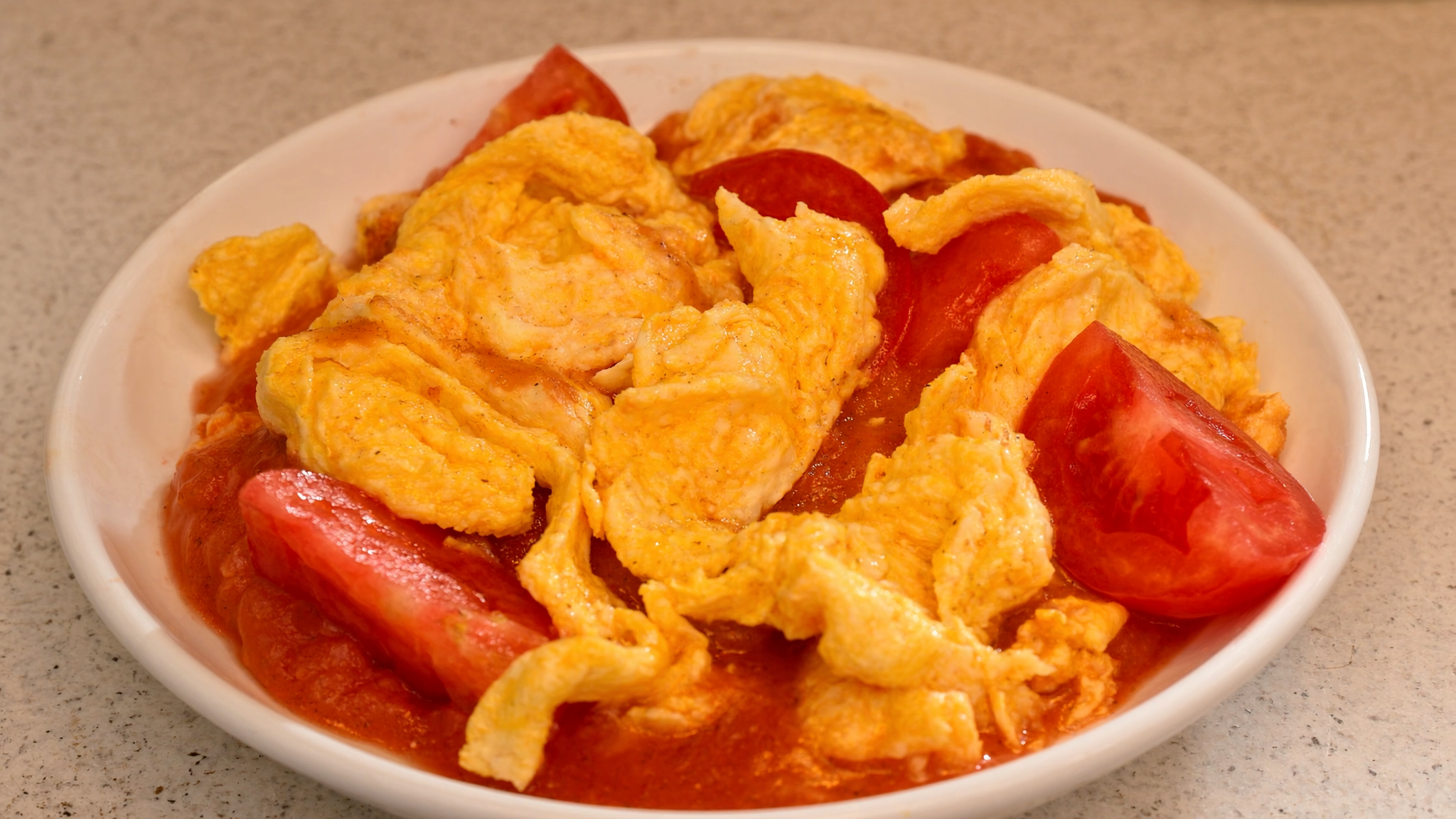
Tomato egg recipe with ripe red tomatoes and tender golden scrambled eggs in a light sweet-savory skillet sauce. Inspired by Chinese home-style tomato-and-egg stir-fry, the method uses two short cooking stages to keep the tomato wedges and egg curds distinct. This version includes four eggs, three medium tomatoes, neutral oil, salt, a touch of sugar and water—no rice, ketchup, cornstarch or dairy in the base recipe. The editorial formulation is not independently kitchen-tested.
Tomato egg recipe: the quick version
This tomato egg recipe combines four large eggs with three ripe medium tomatoes, about 1 pound (450 g) total, cooked in a skillet with 1½ tablespoons neutral oil, ½ teaspoon salt, ½ teaspoon sugar and 2 tablespoons water. Beat the eggs, cook them briefly into large soft curds, and transfer them to a clean plate. In the same skillet soften the tomato wedges with the remaining oil, salt, sugar and water until their juices form a light sauce, then fold the eggs back in and heat until fully set. The result is a Chinese-style home-cooking dish of tender golden egg curds and clearly visible bright red tomato pieces, not a tomato soup or shakshuka.
What makes Chinese-style tomato and egg distinctive
In many Chinese home kitchens, stir-fried tomatoes and eggs are a familiar everyday dish, often called fanqie chao dan. The balance can vary from savory to softly sweet depending on the tomatoes and household preferences. This recipe chooses one simple version instead of claiming there is one universal or original family formula. The eggs are cooked separately first to keep recognizable soft yellow curds; the tomatoes release juice in the hot pan and become a light coating rather than a thick bottled sauce. The Woks of Life offers cultural and culinary context for the dish. Our ingredient quantities and writing are independently developed.
Why this is not a Western tomato omelet
A folded omelet encloses a filling inside a continuous sheet of egg. This tomato-and-egg stir-fry leaves egg as large irregular curds distributed among soft red tomato wedges and their juices. It is cooked in two stages and reunited in the pan rather than served folded or browned into a pancake. There is no cheese, milk, breakfast sausage or toast built into the dish. Some people eat tomato egg at breakfast, others with lunch or dinner; the site places the recipe in Breakfast & Brunch Upgrades for readers who want a savory egg option. That category choice does not change the Chinese home-cooking context of the preparation.
Choose ripe but not collapsing tomatoes
Use three medium ripe red tomatoes, roughly 450 grams altogether, with intact skin and no mold or leaking spoiled patches. Slightly soft ripe tomatoes release enough juice to make a thin sauce, whereas very hard underripe tomatoes may stay sharp and dry. Wash the fruit under running water and dry it before slicing. The overall quantity matters more than having three identical sizes, since one large beefsteak tomato can weigh as much as several smaller ones. Do not swap the measured fresh tomatoes for a whole jar of tomato sauce and expect the same large pieces in the finished dish. The red wedges should remain visible beside the scrambled eggs.
Cutting tomato wedges rather than tiny dice
Slice each tomato into six to eight bite-size wedges, removing only the tough stem core. Medium wedges keep some shape during the brief stir-fry while their cut faces release juices. Minced tomato would collapse very quickly and could obscure the eggs in a smooth red sauce. Extremely thick half-tomatoes might stay too firm while the surface cooks. A roughly even cut lets the pan soften the pieces predictably. Save any clean juices on the cutting board and add them with the tomatoes; they belong to the weighed ingredients. Do not peel the tomatoes unless the skins are unusually tough and you choose a separately tested variant.
Four large eggs provide the main yellow curds
Crack four large eggs into a clean bowl, checking each one as you go. Whisk with a fork until the yolks and whites are evenly mixed, but there is no need to whip them into a foam like meringue. The eggs should be fresh and handled according to package refrigeration instructions. Because raw eggs can carry harmful bacteria, wash hands and clean any surfaces that come into contact with spills. The cooked curds should be yellow and soft but completely set, without a translucent layer of runny egg. This is a two-portion main dish or about four smaller side servings; the exact cooked weight has not been measured in a physical test.
Use a neutral oil rather than lots of butter
One and a half tablespoons of plain neutral cooking oil provide the fat for both stages. Use one tablespoon for scrambling the eggs and the remaining half tablespoon to soften the tomatoes. A light canola or other neutral vegetable oil works because it does not overwhelm the mild egg and tomato flavor. This dish is not deep-fried, and there is no reason to fill a wok with several inches of oil. Butter would introduce a different creamy richness that is not part of the specified ingredient list. The finished mixture should look gently glossy from tomato juices and oil, not float in a pool of orange fat.
Why a small amount of sugar helps
Half a teaspoon of granulated sugar balances the tomato acidity. It should not make the dish dessert-sweet or transform the juices into a sticky glaze. Some families use more sugar and some omit it, so the chosen amount is one restrained starting point rather than a rule for every Chinese kitchen. A particularly sweet summer tomato may need less sweetness to taste balanced, while tart out-of-season fruit may feel sharper. Since this exact formula has not been physically tested, we do not claim to have measured its pH, sweetness or final flavor strength. The sugar belongs in the tomato stage, where it dissolves in released juices.
The salt is divided across two stages
Use a total of half a teaspoon of fine salt, with one-quarter teaspoon mixed into the beaten eggs and the remaining one-quarter teaspoon added to the tomatoes. Dividing it this way seasons both principal ingredients rather than leaving one bland. Salt flakes and coarse kosher salt have different volume densities, so the exact amount is specified as fine salt for reproducibility. A home cook may adjust after the eggs are fully cooked and tasted safely, but adding soy sauce, fish sauce or stock powder would change the original ingredient contract. The recipe should taste simply of eggs and ripe tomatoes, with a slight sweet-savory balance.
Two tablespoons of water are enough
The tomato pan receives two tablespoons of clean drinking water, which helps the wedges soften without requiring prepared broth or a thick sauce product. Ripe tomatoes already contain considerable water, so this small measured amount is deliberately limited. If you pour in a full cup, you will be making a thin tomato broth with floating egg pieces rather than a skillet stir-fry. The water should simmer and combine with the tomatoes’ natural juices for a short, light coating. The mixture remains moist but not soupy. The final image must show glossy tomato wedges and egg curds with only a modest amount of red sauce around them.
No ketchup or cornstarch in this formulation
Many versions of tomato egg include a little ketchup, cornstarch slurry or other savory additions. They can be appropriate in their own recipes, but they are not used here. We choose fresh tomato juices thickened only by short cooking, so readers can understand how the dish works without a bottled condiment. The absence of cornstarch also means the sauce may be thinner than restaurant versions that use a starch glaze. Do not describe the result as thick and shiny as syrup if the actual process has no starch. No rice wine or alcohol is added, making the ingredient list straightforward and visually easy to verify.
A nonstick or well-seasoned skillet helps
Use a 10- to 12-inch nonstick or well-seasoned skillet with a suitable cooking spatula. Eggs can stick firmly to bare metal if the temperature and oil are not controlled, so a familiar pan is helpful for everyday cooks. A flat skillet works even without a traditional wok, although it does not recreate every cooking characteristic of wok heat. Keep a clean plate beside the stove to hold the first-cooked egg curds. Prepare the tomatoes and measure seasonings before turning on the burner because the actual skillet time is relatively short. Never leave a heated empty nonstick pan over high heat for an extended period.
Prepare everything before heating the pan
Wash the tomatoes, cut the wedges, beat the eggs with their quarter teaspoon of fine salt, and place the remaining salt, sugar, water and oil within reach. Have a spatula and clean plate ready. This short preparation stage prevents overcooked eggs while you stop to search a cupboard for sugar. Raw egg utensils should not be used on finished food without washing. If cooking for more than two people, consider whether a single skillet can comfortably hold a doubled batch; crowding makes it harder to maintain distinct large curds. The approach is organized home cooking rather than a complicated multi-sauce restaurant technique.
Step one: beat the eggs lightly
In a clean medium bowl crack the four eggs and add one-quarter teaspoon fine salt. Mix until yolks and whites are combined and the surface looks mostly uniform yellow. You do not need to add milk or cream, which could change the texture and introduce an unlisted allergen. A few small bubbles are natural, but an enormous foamy top is not the goal. Keep the bowl away from raw chicken or other foods that could cross-contaminate it. If any shell falls into the mixture, remove it with a clean tool. Once the pan is heated, the eggs will set quickly, so complete this preparation before adding them to the oil.
Step two: create soft but cooked curds
Warm one tablespoon of neutral oil in the skillet over medium heat. Pour in the beaten eggs and let the bottom start setting, then push them gently from the edges toward the middle with the spatula. Fold rather than stir rapidly into tiny dry crumbs. When the eggs have formed large soft curds and are almost fully set, transfer to the clean plate; they will return to the pan for a final brief finish. Do not taste or serve them at this partially cooked stage. The aim is golden irregular folds with no browned leathery patches, which will continue to cook until fully set after they are combined with tomatoes.
Step three: soften the red tomato wedges
Add the remaining half tablespoon oil to the skillet over medium heat and tip in the fresh tomato wedges with any juice collected during cutting. Stir briefly to coat, then add the remaining quarter teaspoon fine salt and half teaspoon sugar. Cook around two to three minutes, turning gently so the red pieces soften while still retaining some wedge shape. The skillet should begin to collect light red juices, not a dark caramel glaze. Avoid crushing every piece with the spatula or the dish will look like tomato soup. The scent should be fresh tomato rather than charred sugar. Adjust the heat if the pan begins to smoke.
Step four: add measured water
Pour two tablespoons of clean water into the tomatoes, stir and let the liquid bubble gently for roughly another minute or two. The released tomato juices combine with the water, salt and sugar into a simple thin coating. Do not allow the pan to become completely dry and scorch at the edges. Equally, do not add a large amount of liquid to make a broth. The tomatoes should be tender enough to release juices but still be recognizable red chunks when you look down into the skillet. The exact cooking minute depends on their ripeness and the pan’s heat, so use their texture as the practical guide.
Step five: return the eggs and finish safely
Slide the soft egg curds back into the tomato pan, including any safe cooked juices on the clean plate. Use the spatula to fold the yellow eggs gently around the red wedges, not mash everything into a uniform pink paste. Continue heating until the egg curds are fully set and the mixture is hot throughout. For a cautious egg-dish temperature reference, FoodSafety.gov lists 160°F (71°C) for egg dishes; use a suitable food thermometer when practical and never serve visibly runny or uncooked egg to vulnerable diners. A little moist tomato sauce around the pieces is expected.
Step six: serve soon after cooking
Transfer the fully cooked tomato-and-egg mixture onto a clean shallow white or neutral plate. Let the pieces fall naturally so the soft yellow folds and red tomato wedges remain obvious. This version can be a light savory breakfast, brunch plate or simple lunch component. If you like rice or noodles alongside it, prepare and serve those separately following their own instructions; they are not ingredients in this recipe or its designated photos. The immediate presentation is the best way to appreciate the distinct texture. Do not bury the dish under green onion garnish, sesame seeds, chili oil or additional sauces that were not included in the recipe card.
How to recognize the finished texture
The eggs should look like soft, thick golden curds with gently rounded folds; the tomatoes should appear bright red, tender and slightly collapsed, with visible pieces of skin and flesh. A little light orange-red juice may coat the eggs and collect in a thin film on the plate. The mixture is not watery broth and not dry, browned scrambled eggs mixed with raw cold tomatoes. No large puddle of ketchup should surround the dish. This recognizable red-and-yellow contrast is the strongest visual signal for the keyword. A photo depicting an omelet filled with red sauce or whole fried eggs on tomato slices would misrepresent the steps.
Why you should cook eggs and tomatoes separately
Eggs set at a different rate from tomatoes, which need time to soften and release liquid. Cooking them in separate passes makes it easier to preserve curds without stirring them constantly while waiting for raw tomatoes. Once reunited, the ingredients can warm together briefly without turning the eggs into minuscule pieces. This two-stage approach is familiar in various home versions of Chinese tomato egg stir-fry, although methods differ by household. It is not necessary to label every other variation incorrect. Our goal is a predictable editorial sequence and a final plate that shows the identity of the two primary foods clearly.
If your eggs turn rubbery
Rubbery eggs may have spent too long over high heat or been chopped into small dry fragments while the tomatoes cooked. The improvement is procedural: remove them as soon as they form large almost-set folds, then complete the cooking only after tomato juices are ready. Do not solve the problem by adding a cup of heavy cream or cheese, which would transform the dish. If the eggs are still visibly wet at the final stage, continue heating rather than serving undercooked food. The exact timing differs with pan thickness and burner strength. A medium heat with deliberate folding gives more control than the highest possible setting on every stove.
If the tomatoes seem too sour
Tomato acidity varies with ripeness, season and variety. The half teaspoon of sugar in this formula provides a subtle balance, but it cannot make every underripe tomato sweet. For the best result, start with ripe flavorful red tomatoes rather than trying to compensate with tablespoons of sugar. Avoid introducing sweet ketchup during the photographed method, since it is not on the ingredient list. If you want to experiment after a first batch, document the variation separately. A slight tang is a normal part of tomato-and-egg cooking and helps keep the eggs from tasting heavy. There is no added vinegar in the published recipe.
If the pan fills with too much liquid
Very ripe tomatoes can release a generous amount of juice. Before adding eggs back in, give the tomato mixture a short additional uncovered simmer so the liquid concentrates slightly, but do not cook all the tomato flesh into paste. The recipe already uses only two tablespoons of added water, so adding more without a reason is unnecessary. An overly watery plate may make the scrambled eggs look as if they are floating in soup. Do not sprinkle dry cornstarch directly into hot juices to correct it; that would be an unmeasured new ingredient and could create clumps. The aim is a light sauce coating the curds, not thick restaurant gravy.
If the tomatoes are undercooked
Very firm tomato wedges need a little more time before the eggs return to the pan. Stir and let the cut sides soften until the pieces release recognizable juices, then add the water and briefly simmer. Do not crank the stove so high that the bottoms burn while the interiors remain raw. If the tomato variety has thick skin, the skin may curl and become more noticeable; the dish can still be pleasant, but choose ripe tomatoes for a softer result. The final mixture should not taste like raw tomato salad dressed with egg. It is a warm, fully cooked skillet recipe with visible soft red pieces.
How to use the eggs safely
Eggs should remain refrigerated as directed until used. Crack them into a clean bowl rather than directly onto the counter, and wash hands after contact with raw egg. Utensils that stirred raw mixture should not serve finished food until washed properly. The final brief heating stage is necessary to ensure the eggs are fully cooked, even though they were lifted from the skillet when nearly set earlier. The FDA’s egg safety guidance emphasizes safe handling and thorough cooking. The tomato juices can make the plate look moist even when the egg curds themselves are fully set.
Does the dish need soy sauce?
Soy sauce is used in some savory adaptations of tomato-and-egg cooking, but it is not required here. This recipe relies on salt, a hint of sugar and tomato juices for its simple flavor. Adding soy sauce would change color and sodium content, and it can introduce wheat or other allergens depending on the product. Since the primary keyword is broad, a clear small ingredient list makes the recipe approachable to readers without specialized pantry sauces. We are not declaring soy sauce inauthentic or wrong; it simply belongs to a different version. The images must not show a bottle or dark sauce pooled around the finished eggs.
What about scallions or cilantro?
Many cooks garnish tomato egg stir-fry with scallions; others add ginger, garlic or cilantro. The source formula presented here does not include any of those items, so the images and card omit them. A small green garnish can look attractive but would be a misleading addition if it appears without corresponding quantities in the list. The goal is to illustrate the natural red and yellow of the tomatoes and eggs, not to decorate the plate like a restaurant tasting menu. If readers prefer scallions, they can create an optional personal version after preparing the basic method. Do not call that adaptation the exact five-ingredient formula documented here.
What type of rice could go alongside it?
Steamed rice is a common way to enjoy Chinese tomato-and-egg stir-fry, but no rice is cooked in this recipe card. Keeping the plate focused on eggs and tomatoes makes the method more suitable for both a savory breakfast and a flexible family meal. If you serve rice separately, follow the rice package’s preparation and safe storage instructions. Do not place a mound of rice underneath the tomato egg in either of the two website images, because that would imply an ingredient and an additional recipe step. This article answers the tomato egg intent first, leaving accompaniments as suggestions rather than invisible ingredients.
Other egg dishes on the same site
Our bitter melon garlic egg stir-fry is a different savory egg preparation, with its own bitter vegetable and separate ingredient ratios. It can help a reader explore other stir-fried egg textures without copying or confusing this tomato-based dish. Here the defining combination is ripe red tomato wedges and golden eggs; there is no bitter melon or garlic. The link offers a related method while preserving distinct recipe intent and avoiding content cannibalization. The two photos should show different colors and ingredient shapes, reflecting the actual ingredient lists.
A different soft egg preparation for lunch
The published Japanese-style egg salad sandwich on soft milk bread is another way to serve eggs, but it is made with a creamy filling on bread rather than a hot tomato stir-fry. Readers comparing quick meals can choose between a cold sandwich and a warm skillet plate. This tomato egg article does not contain mayonnaise, milk bread or hard-boiled egg chunks. Both have their own search intents and must use their own faithful images. Linking related egg content should help navigation, not be an excuse to repeat the same introductory paragraphs across multiple pages.
Tomatoes can also be used without eggs
Our fresh tomato salsa with lime and cilantro starts from a similar produce aisle ingredient but remains a cold condiment with completely different seasonings. A reader who wants uncooked tomatoes with lime can explore that page; a reader who wants a warm red-and-yellow egg dish can follow this skillet method. The salsa should not be spooned onto the finished tomato egg to make the photograph more colorful. The original recipe includes neither lime nor cilantro and relies on cooking, not raw preparation, to develop its tomato juices. Distinct internal links reinforce the differences in method.
A familiar Western scrambled egg variation
The site’s cottage cheese scrambled eggs illustrate a very different creamy breakfast scramble. The tomato egg version does not use cottage cheese, dairy or a Western-style omelet technique; its moistness comes from tomato juices. A reader searching for higher-protein or dairy-based eggs may prefer the existing page, while the present recipe focuses on a Chinese home-style combination. This is an editorial cross-link, not permission to add cottage cheese to the pan or show white curds in the images. Any nutritional comparison would require verified ingredient data that we have not calculated.
How much does this recipe yield?
Four large eggs and approximately one pound of ripe tomatoes can serve about two people as a light main plate or four people in smaller side portions. Exact cooked yield depends on tomato moisture and how much liquid evaporates during cooking. We have not weighed a finished batch, so the recipe card labels the portion size as approximate instead of printing fictitious grams. For a larger group, you can double ingredients, but a crowded pan may require two rounds to preserve the separate soft curds and tomato pieces. The goal is not to build a giant casserole; it is a short skillet method that remains manageable.
A breakfast, brunch or dinner option
Because eggs are a flexible ingredient, some U.S. readers will want this for a savory breakfast or brunch, while many Chinese home cooks enjoy the combination as part of lunch or dinner with other dishes. Both uses are reasonable, and the recipe does not claim the dish originated as a U.S. breakfast. The site’s category makes it discoverable to readers looking for egg meals, while the text acknowledges the Chinese home-cooking inspiration. Do not add bacon or hash browns merely to make the photograph fit American breakfast expectations. The recipe should remain true to tomatoes, eggs, oil, salt, sugar and water.
Handling leftovers correctly
Because the dish contains eggs and cooked vegetables, refrigerate leftovers promptly in a clean shallow covered container at 40°F (4°C) or below. Follow the two-hour refrigeration guideline, or one hour when the environment is hotter than 90°F (32°C). For a conservative household plan, use properly refrigerated leftovers within roughly three to four days as general food-safety guidance allows for many cooked dishes, without claiming this formula has a lab-tested shelf life. Reheat thoroughly, stirring gently to warm the egg curds and tomatoes evenly. The texture may become firmer after a second heating; do not promise that leftovers will feel exactly like fresh soft scramble.
Reheating without turning the eggs rubbery
Warm a small serving in a clean skillet over low to medium-low heat, stirring only enough to heat the tomato juices and eggs all the way through. If the pan is very dry, a tiny splash of water may help loosen the tomato coating, although that changes the original amount of liquid. Avoid blasting the eggs at very high heat for several minutes, which can make them tough. Reheat food thoroughly using appropriate guidance for leftovers, and never attempt to rescue food that sat out too long. If the tomato curds are too dry after storage, they will not return perfectly to their just-cooked texture, but careful heating can reduce further damage.
Could you make it spicy?
A chili-forward adaptation might include chili crisp, fresh hot peppers or pepper flakes, but those ingredients do not belong to the exact recipe here. Some households enjoy the dish mildly sweet and savory with no heat at all. If you experiment with spice later, record the change rather than silently adding chili oil to the photo. Red tomato already supplies the warm color; a layer of bright crimson chili sauce would obscure the intended tender yellow egg folds. The named recipe and Tasty fields must remain consistent. Readers who need an intentionally spicy tomato egg variation deserve a separate tested formulation and ingredient list.
What the featured image must communicate
The featured image should show one humble white or cream ceramic shallow plate of glossy cooked red tomato wedges interwoven with generous yellow scrambled egg curds. The two ingredients must remain distinguishable and occupy roughly balanced areas of the dish. A small amount of reddish tomato juice can glisten between them, but no soup, rice, bread, noodles or garnishes are permitted. The lighting should look like a warm home kitchen snapshot, not a hyperreal studio advertisement. No hands, chopsticks, bowls of raw ingredients, branded bottles or printed words should appear. If an image instead shows a fried egg on top of tomato slices, it fails the recipe identity requirement.
The Tasty recipe-card image must be independent
The recipe-card photo is a second independent original source, with a different angle and arrangement rather than a crop of the featured plate. It can show an overhead bowl of the same red tomato wedges and soft golden egg curds, with a small amount of natural sauce. The eggs must be visibly cooked and the tomatoes softened, not a raw salad. Source-native 2K dimensions, unchanged original file hashes, full-frame inspection and actual 100% pixel crops are all required before publication. An image with fake writing, extra green onion, white rice or a ketchup bottle will be held regardless of how appetizing it looks. Two sources must be visibly distinct but identical in dish identity.
Editorial testing and nutrition disclosure
This is an original MySavorista editorial formula not independently kitchen-tested in a physical kitchen. Times, pan behavior, final portions and tomato moisture are reasoned planning estimates, not measurements from a completed documented cook. Photography produced with generative tools is illustrative and does not prove food was prepared or eggs reached a safe temperature. No nutrition data, calorie estimate or verified protein total is invented without actual product labels and cooked yields. The method is designed to be clear and safely actionable while giving appropriate credit to the broader Chinese home-cooking tradition and avoiding claims that one version is definitive.
Tomato egg recipe: 12 common questions
What is a tomato egg recipe?
A Chinese-style skillet dish that combines tender scrambled egg curds with ripe tomatoes softened into a light sweet-savory sauce. The eggs and tomatoes are cooked separately and folded together at the end.
What ingredients do you need for tomato egg stir-fry?
This version uses four large eggs, three medium ripe red tomatoes (about 1 pound), 1½ tablespoons neutral oil, ½ teaspoon fine salt, ½ teaspoon sugar and 2 tablespoons water.
Do you cook eggs or tomatoes first?
Cook the beaten eggs briefly into large almost-set curds and remove them to a clean plate, then soften the tomatoes, add the water and return the eggs for a final thorough cooking.
Why add sugar to tomato and egg?
A small amount balances the natural acidity of ripe tomatoes. It is not intended to make the dish dessert-sweet; this recipe uses half a teaspoon.
Does Chinese tomato egg need soy sauce?
No, not in this exact version. Some households add soy sauce, but the listed formula gets seasoning from fine salt, light sugar and the juices of fresh tomatoes.
What temperature should the eggs reach?
Cook until fully set. For egg dishes, FoodSafety.gov gives 160°F (71°C) as a safe minimum reference, and especially vulnerable people should avoid undercooked egg.
Can you serve tomato egg for breakfast?
Yes. It can be a savory breakfast or brunch plate, although it is also widely eaten for lunch or dinner in Chinese home cooking.
Do you need ketchup or cornstarch?
No. The light sauce comes from fresh tomato juices and two tablespoons of water. Ketchup or cornstarch would create a different recipe variation.
How do you keep the eggs soft?
Scramble over moderate heat into larger folds, remove before they dry out, and only finish them after the tomato wedges have softened. Make sure they are fully cooked before serving.
How many servings does this recipe make?
Approximately two light main servings or four smaller sides. Exact cooked yield is not measured and depends on tomato size and evaporation.
Can you cook it ahead?
It is best freshly made for tender eggs. Cool and refrigerate cooked leftovers promptly at or below 40°F, then reheat thoroughly, recognizing the eggs may firm up.
Has the MySavorista version been tested in a kitchen?
No. This is an original editorial formulation not physically kitchen-tested; cooking times and finished quantities are estimates, and generated images are illustrative.
Print
Tomato Egg Recipe: Chinese-Style Soft Scramble
- Prep Time: About 10 minutes to clean and cut tomatoes, beat eggs and measure seasoning; editorial estimate
- Cook Time: About 8–12 minutes skillet cooking, depending on tomato ripeness and pan heat; cook eggs until fully set
- Total Time: Approximately 18–22 minutes from setup to serving; editorial estimate not independently timed
- Yield: About 2 light main servings or 4 smaller sides; finished weight not physically measured 1x
- Category: Breakfast & Brunch Upgrades
- Method: Scramble salted beaten eggs into large soft curds and set aside; soften ripe tomato wedges in oil with salt, sugar and water; return eggs and cook fully while folding gently
- Cuisine: Chinese home-style tomato-and-egg stir-fry, adapted for American home kitchen
Description
Chinese-style tomato egg recipe with soft scrambled eggs and red ripe tomato wedges in their own juices. Four eggs, three medium tomatoes, neutral oil, salt, a hint of sugar and water. Original editorial recipe not physically tested.
Ingredients
4 LARGE EGGS, refrigerated and fresh
3 MEDIUM RIPE RED TOMATOES, about 1 lb (450 g) total, washed, cored and cut in 6–8 wedges each (not canned sauce)
1 1/2 TABLESPOONS NEUTRAL VEGETABLE OIL, divided: 1 tablespoon for eggs and 1/2 tablespoon for tomatoes
1/2 TEASPOON FINE SALT, divided: 1/4 teaspoon eggs and 1/4 teaspoon tomatoes
1/2 TEASPOON GRANULATED SUGAR, added to tomatoes
2 TABLESPOONS CLEAN DRINKING WATER, added to tomatoes
NO rice, noodles, ketchup, soy sauce, scallions, cilantro, ginger, garlic, sesame seeds, chili oil, cornstarch, cheese, milk, cream, toast or optional garnish in exact recipe
Instructions
1. Gather a 10–12-inch clean nonstick or well-seasoned skillet, clean spatula, clean plate and medium bowl. Wash and core THREE RIPE RED TOMATOES (about 450 g total) and cut each into 6–8 medium wedges, saving their clean juices. Crack FOUR LARGE EGGS into a clean bowl and whisk with 1/4 tsp FINE SALT until yolks and whites combine.
2. Warm 1 TABLESPOON of the TOTAL 1 1/2 tbsp neutral oil in the skillet over MEDIUM heat, not smoking. Pour in beaten eggs, let bottom set, and gently push/fold into LARGE SOFT YELLOW CURDS with a spatula. Transfer almost-set curds to a clean plate; they are NOT ready to eat yet because they will finish in the tomato stage.
3. Add remaining 1/2 TABLESPOON oil to the same skillet over medium heat. Add the THREE sliced tomatoes with any juice, remaining 1/4 tsp fine salt and 1/2 tsp granulated sugar. Toss gently and heat about 2–3 minutes until red wedges soften and begin releasing juices but remain recognizable.
4. Pour in 2 TABLESPOONS CLEAN WATER and gently simmer roughly 1–2 minutes more so a modest thin red tomato coating develops. Do not add ketchup or cornstarch and do not turn the mixture into soup. Avoid scorching.
5. Return the large scrambled egg curds to the skillet. Fold gently through softened tomato wedges, heating thoroughly until egg curds are FULLY SET, not translucent or runny. FoodSafety.gov recommends egg dishes reach at least 160°F (71°C); use a food thermometer where practical and never serve undercooked egg to vulnerable diners. Do not overcook until eggs become dry rubbery crumbs.
6. Transfer cooked eggs and tomatoes to one clean shallow serving plate. The finished dish must show DISTINCT LARGE YELLOW EGG CURDS and TENDER RED TOMATO WEDGES, lightly glazed in natural tomato juices; no rice, bread, green scallion garnish, dairy, thick bottled sauce or other additions.
7. Serve promptly as approximately TWO light main servings or FOUR smaller sides. Use fresh clean plates and utensils rather than items that touched raw egg.
8. Refrigerate cooked leftovers promptly within 2 hours (1 hour above 90°F/32°C) in shallow clean covered containers at 40°F/4°C or below. Reheat leftovers thoroughly and discard food stored unsafely. Finished yield and storage life have not been independently tested.
Notes
ORIGINAL MY SAVORISTA EDITORIAL FORMULA NOT INDEPENDENTLY KITCHEN-TESTED. Cultural reference: Chinese home-style fanqie chao dan, one of many household versions, not definitive authentic recipe claim. RAW EGG and thorough cooking safety: eggs must be fully set; FoodSafety.gov reference 160°F (71°C) for egg dishes. No physically measured yield or invented nutrition. ALLERGEN: EGG; commercial ingredient labels and any cross-contact need independent checks. Images must be independent original native 2K, full-frame and 100%-native-pixel reviewed: only red juicy tender TOMATO WEDGES and large opaque GOLDEN YELLOW SCRAMBLED EGG CURDS lightly coated with natural juices, no wet uncooked egg, no white rice, noodles, toast, green herb garnishes, scallions, chopsticks, soy, ketchup, commercial wrappers, hands, labels, words, logo or watermark. Images AI illustrative, not documentary kitchen tests.
Nutrition
- Serving Size: Half the skillet recipe as one of approximately two main servings, or one-quarter as side
Keywords: tomato egg recipe, chinese tomato egg stir fry, tomato scrambled eggs, soft scrambled eggs with tomatoes