
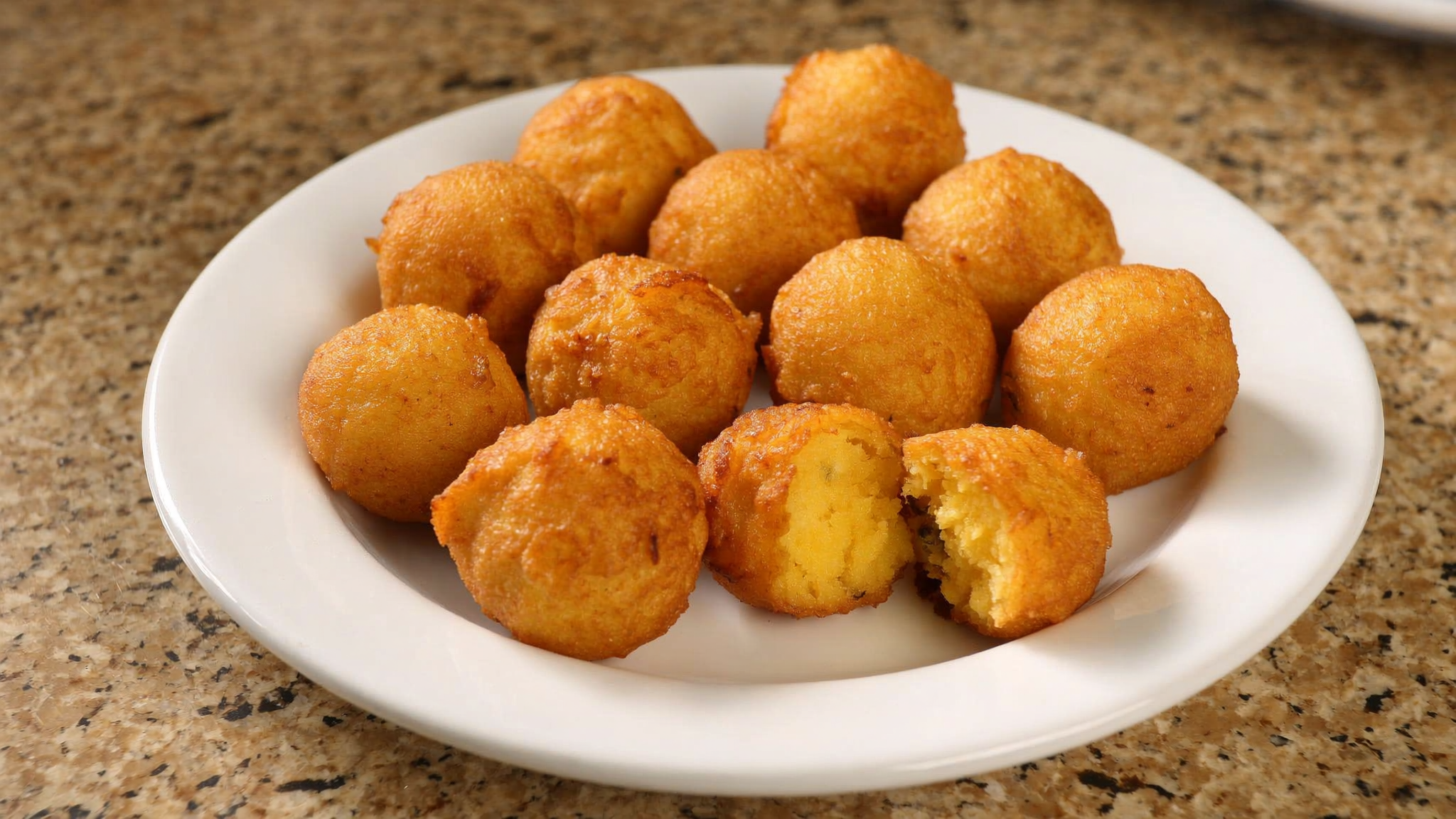
Cornmeal balls recipe for crispy Southern-style hush puppies: small golden fried fritters made from yellow cornmeal, flour, buttermilk, egg and chopped sweet onion. The center should be soft, tender and fully cooked, not doughy or cheese-filled. This is a distinct Southern American cornmeal snack rather than Jamaican festival or polenta croquettes. Learn how to mix and rest the batter, fry manageable batches, check the centers and handle hot oil safely. This original editorial formula has not been independently kitchen-tested.
Cornmeal balls recipe: the short answer
This cornmeal balls recipe makes golden Southern-style hush puppies from yellow cornmeal, all-purpose flour, buttermilk, egg, finely chopped onion, baking powder, a little sugar, salt and pepper. Mix the dry ingredients, fold in the wet ingredients, let the batter rest briefly, and drop rounded spoonfuls carefully into oil around 350°F (175°C). Fry small batches until uniformly golden and cooked through, then drain briefly on a rack. These are savory, lightly sweet round fritters, not cheese-filled polenta croquettes or Jamaican festival dumplings. The proposed ratios and timing are editorial estimates, not results from a documented physical kitchen test.
What kind of cornmeal balls are these?
In American Southern cooking, small fried cornmeal batter balls are widely called hush puppies. The batter often includes flour for structure and onion for flavor. The Food Network explanation of hush puppies identifies their round or oblong shapes and typical serving role alongside fried seafood and barbecue. Our recipe aims for rounded bite-size pieces with a rough, lightly crisp golden surface and a tender yellow cornmeal interior. The phrase cornmeal balls is broad enough to describe other foods, so we name the specific Southern-style preparation rather than claiming every culture’s cornmeal dumpling is identical.
A Southern fish-fry snack, not a universal name
Hush puppies have a strong association with Southern American fish fries and informal shared meals. They may be served as an appetizer or side and are familiar at many seafood establishments. The James Beard Foundation recipe archive provides a Southern cornmeal-fritter reference. Our version is independently proportioned and does not copy a restaurant’s or author’s specific formula. We also avoid unsupported claims about exactly who invented the name: origin stories differ and are not necessary for cooking them well. A reader seeking Jamaican festival or a Brazilian cornmeal snack should follow an appropriately named recipe for that dish rather than treating these fritters as the same food.
Choose fine or medium yellow cornmeal
Use one cup of plain yellow cornmeal, approximately 150 grams depending on grind and packing. Fine or medium grind is practical for small fritters because it hydrates in the short rest and produces a tender interior without very hard gritty particles. Coarse polenta-style grinds may need different liquid and resting time. Quaker’s cornmeal hush puppies reference confirms the basic role of cornmeal in the dish, while our exact ratio is editorial. Check that the package contains plain cornmeal, not a seasoned cornbread mix that already includes leavening, sugar or salt. The ingredient identity matters as much as the measurement.
Why some all-purpose flour helps
Half a cup of all-purpose wheat flour, approximately 60 grams, supports a batter that can be dropped into rounded pieces. Cornmeal alone lacks the gluten network of wheat flour and may make fragile fritters with a different texture. Mix flour and cornmeal well before adding liquids so no dry pockets remain. A batter made with more wheat flour will resemble a plain doughnut more than a cornmeal hush puppy; one made with far less flour may spread or crack. This is a practical starting ratio rather than a measured guarantee of perfect shape with every brand. All-purpose wheat flour contains gluten and cannot be described as a gluten-free ingredient.
Buttermilk adds moisture and gentle tang
Three-quarters of a cup of cultured buttermilk, about 180 milliliters, supplies the main liquid. Its gentle acidity complements the sweet corn flavor and onion, and its texture helps the dry ingredients come together without a large amount of water. Use food-safe store-bought cultured buttermilk and keep it refrigerated until you begin cooking. Plain milk with added acid is sometimes offered as a substitute in other recipes, but it is not the exact ingredient in this source formula and may produce a different batter. The mixture should be thick enough to hold a rounded spoonful, not pour like pancake batter. Do not judge its final consistency before the cornmeal hydrates briefly.
One egg helps bind the batter
A large egg combines with buttermilk to bind the dry ingredients and support the tender interior. Crack it into a separate clean bowl to check the shell, then whisk lightly with the buttermilk before adding the liquid to the cornmeal mixture. Do not taste uncooked batter: it contains raw egg and raw flour. The egg contributes to browning and structure but doesn’t mean the fritters are guaranteed cooked when they look golden outside. The centers must cook thoroughly before serving. Keep egg-contact tools separate from any rack or plate used for cooked fritters, and wash hands after spills. This recipe intentionally contains egg and is not vegan.
Chopped sweet onion belongs inside, not on top
A quarter cup of very finely chopped sweet onion, about 35 grams, adds savory flavor and tiny moist pieces without making the fritters chunky. Chop finely enough that the batter can form cohesive spoonfuls. Large raw onion pieces may protrude into the oil and darken faster than the rest of the fritter. Don’t replace the measured onion with a cup of chopped scallions and call it the same formula. The final surface can show a few tiny browned onion flecks, but it shouldn’t look like a green-herb croquette. No onion rings or loose onion garnish should be staged in the photographs. If a diner strongly dislikes onion, that requires a separate variation.
Baking powder keeps the centers lighter
Use one and a half teaspoons of regular baking powder. It helps the batter expand as heat reaches the interior, preventing a dense little ball of wet cornmeal. Make sure your baking powder is within its stated use period, because an old product may have reduced activity. Do not confuse it with baking soda and make a direct equal-volume substitution; these leaveners work differently. The mixture only needs a brief rest before frying, not a multi-hour yeast rise. It should create a tender crumb with small irregular air spaces once cooked. A completely hollow shell or a tough solid plug is not the texture intended by this editorial recipe.
Sugar is present, but this is not a dessert
One tablespoon of granulated sugar provides a gentle sweet counterpoint to onion and salt. These cornmeal balls remain a savory side or snack rather than candy-coated pastries. The exterior should turn natural golden brown during frying without honey glaze or powdered sugar. Some hush puppy recipes are sweeter and others less sweet; the formula here chooses a moderate amount. Sugar contributes to browning, so maintaining steady oil temperature is especially important. Don’t add vanilla, frosting, cinnamon sugar or jam and still call the dish the same Southern hush puppies. The photographed pieces must be plain golden fritters, with no sweet icing or extra garnishes.
Salt and pepper are intentionally restrained
Half a teaspoon fine salt and a quarter teaspoon black pepper season the batter. The small amount of sweet onion and the cornmeal flavor should remain noticeable. If a cook uses a self-rising flour blend containing salt, the balance will change and the formula no longer matches the ingredient list. Commercial sauces offered alongside hush puppies may also carry salt, so this is a straightforward base. Don’t taste the raw batter to assess seasoning because of the egg and flour. If you need to check, fully cook a small trial fritter and let it cool enough to eat safely before making a future adjustment. The images need no visible piles of salt or pepper.
Paprika for a subtle warm note
A quarter teaspoon of sweet paprika is an optional-sounding flavor in many hush puppy variations, but it is measured as a required ingredient in this exact recipe. It adds a faint warm note without making the batter red or spicy. The finished fritters should appear predominantly cornmeal-golden, not orange-red or coated in pepper flakes. Use sweet paprika rather than hot paprika or smoked paprika if you want the specified mild flavor. Paprika can form dry clumps, so mix it with flour and cornmeal before adding the wet ingredients. There are no jalapeño pieces, hot sauce drops or fresh parsley flakes in the base formula.
Oil is the cooking medium, not a measured serving
Use enough neutral frying oil to create roughly two inches of depth in a heavy, suitable deep pot; the amount depends on vessel diameter and is not a precise quantity absorbed by the food. Canola or another appropriate neutral frying oil may work. Never claim all the oil in the pot becomes part of the finished recipe’s nutritional calculation. Heat to approximately 350°F (175°C), using a suitable clip-on or probe thermometer designed for hot oil. Keep the pot well below its maximum fill, dry and away from children or loose sleeves. The recipe is genuinely fried; an air-fryer adaptation would require a separate method and should not be presented as identical.
Why the frying temperature matters
Oil that is much too cool can make batter absorb more oil and spread before it sets; oil that is too hot may darken the exterior while the center remains wet. A starting point of 350°F (175°C) is common for small fried cornmeal batter pieces. Monitor the temperature between batches, because dropping chilled batter can lower it and a strong stove can push it back up quickly. Never add water to hot oil or attempt to control it by splashing. The exact cooking time will vary with fritter size and oil recovery. Do not use surface color alone as proof that raw egg and flour have cooked through.
A heavy, appropriately sized pot is safer
Choose a heavy pot with high sides that is stable on the burner and designed to handle deep frying. Fill with oil to a safe depth without approaching the rim, allowing room for bubbling and displaced liquid. Keep a correctly rated lid nearby if recommended by your local fire-safety guidance, but don’t cover the pot during ordinary active frying because trapped moisture can cause splattering. An oil thermometer helps you avoid guessing. Never leave frying oil unattended; turn the handles away from walkways and make sure the stovetop is dry. If hot oil catches fire, turn off the heat if safe, use an appropriate kitchen fire extinguisher, and never pour water onto the flames.
Prepare a clean draining rack before you fry
Set a wire rack over a lined tray to receive cooked hush puppies. This allows excess surface oil to drain without trapping steam under the crust. A paper towel-lined plate is often used, but fritters left piled in a dense mound may soften. Arrange a slotted metal spoon or spider nearby and prepare a small dish for the first fully cooked trial piece. Do not put uncooked batter bowls on the same surface as ready-to-eat food. Keep cloth towels and packaging away from open flame and hot oil. Organizing the workspace first reduces the temptation to reach across the pot while holding hot utensils.
Mix all the dry ingredients first
In a clean medium bowl combine the cup of yellow cornmeal, half cup all-purpose flour, baking powder, sugar, salt, black pepper and sweet paprika. Stir for at least several turns until the color and texture look uniform. Breaking small dry lumps now is easier than trying to correct pockets of flour after the buttermilk has been added. Do not substitute a premade hush puppy mix unless you are deliberately following that manufacturer’s formula. Each ingredient serves a defined role in this source recipe, and adding a commercial mix would change leavening and salt. Use dry measuring utensils to avoid accidental moisture in the pantry containers.
Whisk the egg into the buttermilk
In a separate bowl whisk one large egg into three-quarters cup cultured buttermilk until there are no obvious streaks of raw egg white. The mixture need not be foamy. Add this liquid to the dry ingredients, followed by the finely chopped sweet onion. Fold with a sturdy spoon or spatula until no large dry patches remain. The batter may seem thick and slightly granular from cornmeal, which is expected. Do not beat vigorously for several minutes: the wheat flour can toughen and the onion may release extra liquid. Use the same liquid quantity described on the card rather than adding milk until the mixture pours like pancake batter.
Rest the thick batter briefly
Let the covered batter sit approximately ten minutes while you carefully bring the oil toward its temperature. This gives the cornmeal time to absorb some liquid and may make the rounded portions easier to form. The rest is brief and does not replace safe refrigeration for long delays. Don’t leave raw egg batter beside a hot stove for hours. After resting, a rounded tablespoonful should mound gently rather than spread instantly into a puddle. If it is very firm, the particular cornmeal grind may be absorbing more liquid; such variation has not been physically evaluated with every brand. The published ratio remains a starting point, not an infallible measurement.
Portion the mixture into small rounded mounds
Use two spoons or a small spring scoop to gather portions about one tablespoon each. You can lightly shape the batter between spoons without compressing it into an extremely smooth marble. Hush puppies usually have an irregular homemade surface, and that roughness crisps nicely. Very large balls are risky because the outsides may brown before the centers cook. A roughly consistent portion size helps the batch finish more evenly. Do not use bare wet hands over hot oil, and do not toss spoonfuls from a height. The intention is small golden bites, each with a lightly uneven exterior and a tender cornmeal center.
Carefully lower the batter into hot oil
When the oil is near 350°F, lower two or three spoonfuls carefully near its surface using appropriate utensils. Avoid splashing and do not crowd the pot; an overloaded batch can drop the temperature and make pieces stick together. Some fritters may turn on their own while frying, but gently rotate with a suitable slotted spoon if one side browns faster. Maintain a steady temperature rather than increasing the burner to maximum after every drop. The surface will bubble as moisture escapes. Do not put a lid tightly on the pot while cooking, and do not reach across hot oil with long loose sleeves.
Check the first fritter before frying the rest
The first small batch helps establish practical timing for your particular stove, oil depth and scoop size. A ball may take roughly two to four minutes to become evenly golden, but this is a planning range, not a verified guarantee. Remove a fully browned first piece, let it cool briefly and cut through its center. The crumb should look set, warm and tender, not shiny or raw, with small air pockets. Since the batter contains raw egg and flour, ensure it is thoroughly cooked; a thermometer can be used for confirmation when the piece is large enough to probe reliably. Adjust portion size and oil heat if necessary rather than relying only on the timer.
Cook in small batches to protect the crust
Continue frying only a few tablespoon-sized mounds at a time, allowing the oil temperature to recover between batches. Use a metal slotted spoon or spider to lift them onto the rack after their exteriors are deep golden and centers are confirmed cooked. A crowded pot makes fritters collide and can give irregular pale spots. Do not turn the oil too hot to speed up service; crust may burn while the middle stays damp. Keep children and pets away from the station, and never leave hot oil unattended while serving the first batch. If you plan to fry many pieces, arrange a safe sequence before starting rather than improvising with a full pot.
The center should resemble tender cornbread
A properly cooked small cornmeal ball should show a soft yellow interior with small irregular pores, some fine onion specks and a moist but non-sticky crumb. It must not look like liquid pancake batter, melted cheese or a stuffed meatball. The exterior should be naturally golden and slightly craggy, not covered in breadcrumbs. Cut a sample open to verify that the center has cooked through before placing the whole batch on a serving platter. With raw egg-containing batters, food safety matters more than obtaining a photogenic dark crust. No source photograph can prove actual safe cooking temperature; it only illustrates the intended final appearance.
Serve promptly while the outside is crisp
Arrange the cooked and drained fritters in a simple shallow serving bowl or on an unadorned plate. They are best shortly after frying, when the outside remains crisp and the interior is warm. The base recipe includes no dipping sauce, lemon wedge, herb topping or honey glaze, even though diners might enjoy condiments separately. An honest featured image should therefore show only a small pile of golden hush puppies, with one split open to demonstrate its tender yellow cornmeal crumb. A shiny plastic-looking surface or a cheese filling would misrepresent these ingredients. Use clean serving utensils that never touched raw batter.
Why hush puppies sometimes break apart
A batter that is too thin or dropped into oil before it reaches the right heat can spread or fragment. Cornmeal grind, flour measurement and the proportion of liquid all influence cohesion. Using consistent spoonfuls and allowing a short rest can make handling easier. If the first piece breaks up, stop and reassess before sacrificing the entire batch. It may be useful to check the flour and buttermilk measurements rather than blindly adding dry ingredients until the batter becomes bread dough. The published formula has not been physically tested, so it cannot guarantee identical behavior in every kitchen. Do not treat a failed piece as evidence that the rest are safe to eat.
Why the exterior can brown before the middle cooks
The oil may be too hot, the scoops may be much larger than one tablespoon, or the batter may contain more sugar than intended. Lower the heat toward the recommended range and form smaller uniform portions. A dark exterior is not proof of safe internal cooking. Break open a trial fritter to assess whether the center is set; if it looks wet and doughy, continue the next batch longer at an appropriate temperature. Don’t just cover raw centers with ketchup or dip. If pieces have cooled after undercooking, safely discard or recook according to reliable food-safety guidance rather than assuming a second brief fry always corrects the issue.
If the cornmeal balls are oily
Oiliness can come from overcrowding and reduced frying temperature, as well as from resting finished fritters in a solid pile where steam softens their crust. Keep the oil near 350°F using a thermometer and fry in small batches. Drain cooked pieces on a rack and serve soon. Do not mash the fritters in paper towels to squeeze oil out, as that would destroy their structure. The amount of cooking oil placed in the pot cannot be equated with the amount absorbed by the food. We therefore do not invent calorie totals or fat grams for the finished dish without measuring oil loss and the cooked yield.
Why we don’t call these Jamaican festival dumplings
Jamaican festival is a related but distinct cornmeal-and-flour fried dough, often shaped into elongated fingers and mildly sweetened. Jamaicans.com describes festival in its own culinary context. Our recipe is rounded Southern-style hush puppies with minced onion and a different stated ingredient balance. Borrowing the festival name without matching its typical preparation would mislead readers who know the dish. The larger category Global Flavors & Street Food can contain international street foods and regional American snack traditions, but individual pages should identify culinary identity accurately. A reader who wants Jamaican festival should use an appropriately labeled recipe rather than reshape this one.
Other regional cornmeal preparations differ
Italian polenta, Caribbean cornmeal fritters and Southern hush puppies share corn as an ingredient but differ in hydration, shaping, seasonings and cooking technique. The present batter is dropped into hot oil in small spoonfuls and immediately forms a crisp outer shell. It is not pre-cooked polenta shaped around melted cheese, nor a steamed cornmeal ball served with stew. When discussing search intent, such distinctions matter more than squeezing every possible phrase into one article. We use the founder’s broad phrase in the introduction and immediately clarify the exact dish, allowing readers to decide whether this is what they intended to make.
Make the fritters part of a snack platter
For a party, serve a modest portion of cornmeal balls with other cooked snacks on separate dishes. MySavorista’s loaded cheesy bacon potato skins are an entirely separate party-food recipe with their own ingredients and cooking method. The cornmeal batter does not contain potatoes, bacon, cheddar cubes or sour cream. Linking the two pages helps visitors plan a snack table without making the photo imply that such fillings belong inside the hush puppies. Keep the fried cornmeal bites on a clean serving tray and avoid mixing them with raw ingredients or sauces used for raw meat.
A creamy dipping sauce is a separate choice
The site’s Greek yogurt ranch dressing could be offered in a separate small bowl for people who enjoy creamy dips. It is not mixed into the hush puppy batter or poured over the finished fritters in this exact recipe. The ranch article contains yogurt and fresh herbs; the cornmeal balls contain buttermilk and small pieces of onion but no dill or chives. Use a clean spoon for each dish and keep refrigerated dips properly chilled. A linked condiment is a serving idea, not a license to add unlisted sauce, packaging or garnish to the featured and Tasty images.
For a spicy contrast, offer something different
If diners want heat, the jalapeño hot sauce with fresh green peppers is a separate spicy condiment. Its bright green color and sharper flavor contrast with the mild, gently sweet cornmeal fritter, but it is not part of the base ingredients. Do not add hot sauce, green pepper rings or fresh jalapeño slices to the hush puppy photo. The reader who chooses a spicy side can follow the linked recipe independently. An effective recipe page presents the main dish precisely, then clearly labels any optional serving context instead of hiding extra components in the instructions.
A complete dinner option with chicken
For readers seeking a heartier meal, crispy garlic herb chicken thighs with roasted vegetables are another published dish that could be served separately. The chicken recipe has its own cooking time and temperature safety requirements; the hush puppies remain small cornmeal snacks. Do not cook raw chicken in the same oil or workspace as finished fritters without designing and validating an appropriate food-safety procedure. This internal connection is about assembling a menu, not combining recipes or misleading Google with a page that targets every comfort-food term. Keep the culinary identity of the fried cornmeal ball intact.
How much batter does the recipe make?
The planned quantity may yield about sixteen to twenty tablespoon-size fritters, depending on how tightly each scoop is packed and how much batter remains on the utensils. This is an editorial estimate and has not been measured after a physical trial. For a side dish, three or four small pieces per person might be a starting serving idea, but appetite and the rest of the menu differ. Avoid reporting a precise finished gram weight without weighing actual cooked pieces. Frying also changes moisture and oil content unpredictably across pots. The card should state the estimate openly rather than pretending a fixed number of identical restaurant-size balls was produced.
Can the batter be made far in advance?
Because the mixture contains raw egg, buttermilk and leavening, it is best mixed relatively close to frying. A very long rest may affect batter thickness and baking powder activity while creating unnecessary food-safety concerns if held at room temperature. For efficient preparation, measure the dry ingredients in advance and refrigerate the wet ingredients until you are ready. Then combine, allow the brief planned rest and fry. Do not leave a bowl of raw batter on the counter during an all-day party. If scheduling is important, prepare a small controlled batch rather than promising identical performance after many hours.
How to store leftovers safely
Let cooked pieces cool briefly, then move them into clean, shallow covered containers and refrigerate promptly at 40°F (4°C) or below within two hours, or one hour when ambient temperature exceeds 90°F (32°C). FoodSafety.gov describes the clean, separate, cook and chill principles. This particular recipe has no tested storage life, so use a short refrigerated window and discard food with uncertain handling. The crust is likely to soften in a closed container as moisture redistributes. Do not claim that a crispy exterior will remain unchanged after cooling; reheating can improve texture but cannot make mishandled food safe.
Reheat without pretending they’re newly fried
A moderate oven or air fryer can warm properly refrigerated cooked fritters and help dry the outside, provided the pieces are heated thoroughly according to safe leftover guidance. Spread them rather than stacking a dense heap. Avoid extremely high heat that burns the crust before warming the centers. The result may be somewhat drier than freshly fried hush puppies, and the small onion pieces may change texture. Reheating should not be used to rescue fritters left at room temperature overnight. Because this exact formula has not been physically tested, we do not print a universal reheating minute as a guaranteed outcome for every appliance.
Allergens and dietary considerations
All-purpose wheat flour contributes gluten, buttermilk contributes milk, and the egg is a major allergen. Some commercial cornmeal products are processed near wheat, so label checks matter even in an alternative recipe. This exact formulation is not vegan, dairy-free or gluten-free. Switching to plant milk, gluten-free flour or egg substitute would alter structure, hydration and possibly frying behavior, requiring a separate testing process. Don’t infer calories or fat content from the quantity of cooking oil in the pot because most is not necessarily absorbed. For diet restrictions, use actual ingredient information and professional advice rather than invented nutrient calculations.
The featured image contract
The hero photograph must depict a plain white ceramic plate with perhaps twelve to fifteen naturally irregular small deep-golden hush puppies, roughly round and no larger than golf balls, on an ordinary warm American kitchen counter. One fritter can be cut open to reveal its pale yellow, tender, porous cornmeal crumb with a few fine onion flecks. There must be no cheesy filling, cornbread slices, skewers, lemon wedge, green parsley sprigs, sauce ramekins or meat. The crust is dry and crisp with tiny rustic bumps, not covered in breadcrumbs or glossy syrup. No readable packaging, fake labels, watermarks or hands should appear. A credible home photo is more useful than a polished but misleading image.
A separate original image for the Tasty card
The Tasty photo must be a fully independent second native-2K source, not a crop of the hero. An overhead view of a small shallow ivory bowl containing a different arrangement of the same golden irregular balls would distinguish the two images. One piece could show a small tender yellow cornmeal interior without raw shiny dough or cheese. Both must be inspected at full original frame and true 100% original source pixels, with byte-level SHA256 evidence, before publishing. Reject any image that substitutes round fried cheese croquettes, falafel with green centers, sugary doughnuts or cubed polenta. Branding, food props and fake writing are also prohibited. Illustrative AI images cannot prove a real frying test.
Transparency: editorial formula, not a kitchen trial
This is an original MySavorista editorial formulation not independently kitchen-tested in a physical kitchen. Ingredient ratios, yield, frying time, batter texture and recommended rest are reasoned estimates, not measured results of a documented cook. Food safety still requires thoroughly cooked centers, careful management of raw egg and flour, and safe handling of hot oil. A digitally generated image is only an illustration of the intended appearance, not proof that the recipe was actually prepared. The article does not claim to be the only authentic Southern method, invent exact nutrition figures, or guarantee identical results across cornmeal grinds, buttermilk brands, pots and frying equipment.
Cornmeal balls recipe: frequently asked questions
What are cornmeal balls called in Southern cooking?
Small savory fried cornmeal batter balls are commonly called hush puppies. This recipe uses yellow cornmeal, flour, buttermilk, egg, onion and a little sugar.
How do you make a cornmeal balls recipe?
Whisk together the dry ingredients, fold in egg and buttermilk with finely chopped onion, rest briefly, and carefully drop small rounded spoonfuls into oil around 350°F. Fry in batches until golden and fully cooked inside.
Are cornmeal balls the same as polenta balls?
Not here. These are drop-fried hush puppies made with uncooked cornmeal batter. Polenta croquettes typically begin with already cooked and cooled polenta and have a different structure.
Can hush puppies be made without all-purpose flour?
Changing or removing the measured wheat flour would alter batter cohesion and requires a separate formula. This exact recipe includes half a cup of all-purpose flour.
What oil temperature should I use?
Start near 350°F (175°C) with an appropriate frying thermometer, adjusting heat between small batches. Too-hot oil can brown the exterior before the center cooks.
Why are my cornmeal balls greasy?
The oil may have cooled too far from crowding, or the fritters may have been stacked while draining. Cook small batches and drain on a rack.
Why are the centers still wet?
Scoops may be too large or oil too hot. Try smaller tablespoon-size portions at a controlled temperature and check a first cooked piece all the way through.
Do these cornmeal balls have cheese inside?
No. The formula contains no cheddar, mozzarella or cream cheese. The interior should be soft yellow cornbread-like crumb with small onion pieces.
Can I make them in an air fryer instead?
That would require a separate adapted recipe because this is a loose batter designed to set when carefully dropped into hot frying oil.
Are cornmeal balls the same as Jamaican festival?
No. Jamaican festival is a related sweetish fried cornmeal-and-flour dumpling often shaped in fingers; the round onion-seasoned hush puppies here are a Southern American preparation.
Can I make the batter the night before?
The recommended workflow is to measure dry ingredients ahead and combine the egg and buttermilk shortly before frying. Long room-temperature storage of raw egg batter is unsafe.
Has this exact recipe been tested?
No. It is an original editorial formulation with estimated measurements and cook times. Food must be cooked thoroughly, and the photos, if generated, are illustrative.
Print
Cornmeal Balls Recipe: Crispy Southern Hush Puppies
- Prep Time: About 15 minutes for measuring and mixing, plus about 10 minutes brief batter rest; editorial estimate
- Cook Time: Approximately 12–20 minutes total active batch frying depending on batch count, each small batch often around 2–4 minutes, but only serve pieces completely cooked through; estimate not physically tested
- Total Time: Approximately 40–55 minutes including preparation, brief rest, oil heating and batch frying; highly variable and not measured
- Yield: Approximately 16–20 small tablespoon-size fritters, about 4–6 snack servings; editorial estimate, not measured 1x
- Category: Global Flavors & Street Food
- Method: Combine dry cornmeal and flour with baking powder and seasonings, fold in egg-buttermilk and minced onion, rest briefly, then shallow batches of spoon-dropped balls in suitably deep hot oil at 350°F until golden and fully cooked; drain
- Cuisine: Southern American fish-fry and casual snack tradition, not Jamaican festival or polenta croquettes
Description
Cornmeal balls recipe for small golden Southern-style hush puppies made with yellow cornmeal, all-purpose flour, buttermilk, egg, sweet onion and mild seasoning. Crispy outside and tender thoroughly cooked yellow crumb inside. Editorial formulation not physically kitchen-tested.
Ingredients
1 CUP PLAIN FINE OR MEDIUM YELLOW CORNMEAL (about 150 g), not pre-seasoned cornbread mix or cooked polenta
1/2 CUP ALL-PURPOSE WHEAT FLOUR (about 60 g), not corn starch
3/4 CUP CULTURED BUTTERMILK (about 180 ml), refrigerated
1 LARGE EGG, whisked into buttermilk, fully cooked through during frying
1/4 CUP FINELY CHOPPED SWEET ONION (about 35 g), tiny dice
1 1/2 TEASPOONS BAKING POWDER (not baking soda)
1 TABLESPOON GRANULATED SUGAR
1/2 TEASPOON FINE SALT
1/4 TEASPOON BLACK PEPPER
1/4 TEASPOON SWEET PAPRIKA
NEUTRAL FRYING OIL such as canola, enough to reach approximately 2 inches in an appropriately sized sturdy high-sided pot while respecting safe maximum fill; actual volume varies with pot size and is NOT all absorbed into food
NO cheese, bacon, sweet syrup, corn kernels, jalapeño, chopped green herbs, dipping sauce, rice, polenta filling or icing in the base recipe
Instructions
1. Set up a stable heavy high-sided pot suitable for deep frying, appropriate hot-oil thermometer, metal spider or slotted spoon, and a clean wire cooling rack over a tray. Keep water, loose cloths, children and pets away from the frying area. Do not fill oil too high or leave it unattended.
2. In a clean bowl whisk 1 cup PLAIN FINE/MEDIUM YELLOW CORNMEAL, 1/2 cup ALL-PURPOSE FLOUR, 1 1/2 tsp BAKING POWDER, 1 tbsp SUGAR, 1/2 tsp SALT, 1/4 tsp BLACK PEPPER and 1/4 tsp SWEET PAPRIKA until uniform.
3. In another clean bowl whisk 1 LARGE EGG with 3/4 cup CULTURED BUTTERMILK until no separate raw egg white streaks remain. Pour wet mixture into dry and add 1/4 cup FINELY CHOPPED SWEET ONION. Fold just until no large flour pockets remain; batter should form thick round spoonfuls, NOT flow like pancake batter. DO NOT TASTE RAW BATTER, which contains raw egg and flour.
4. Let the covered batter rest about 10 minutes to hydrate cornmeal while safely heating enough neutral oil in the high-sided pot to around 2 inches of depth, within pot fill limits. Heat to approximately 350°F (175°C) using an appropriate oil thermometer. Do not add water or splash hot oil.
5. Form roughly one-tablespoon mounds with two spoons or a small scoop. Carefully lower only a few at a time near the oil surface without splashing. Keep hands and wet utensils out of the oil and avoid crowding.
6. Fry small batches until uniformly deep GOLDEN and cooked completely, often about 2–4 minutes for tablespoon-sized pieces, rotating gently if necessary. Maintain oil near 350°F, monitor recovery between batches, and NEVER judge center safety by browned exterior alone.
7. Lift a first fully browned fritter with a metal slotted spoon onto a rack, let it cool enough to cut safely, and CHECK the center. It must be a fully SET, tender, porous yellow cornmeal crumb, NOT glossy wet raw dough. Continue cooking/revise portion size and heat as necessary if any raw interior remains. Raw flour and raw egg must be cooked thoroughly.
8. Fry the remainder in small groups once the first batch is safely cooked and oil temperature is stable. Transfer to the clean wire rack to drain surface oil without trapping steam in a stack. Do not set cooked fritters on any surface that contacted raw batter.
9. Serve promptly, showing small naturally round irregular crisp hush puppies with golden exterior and yellow fully cooked crumb. The base dish has NO cheese filling, glaze, parsley, dips or decorative additional foods.
10. Refrigerate leftover fully cooked pieces promptly in shallow clean covered containers at or below 40°F (4°C) within 2 hours, or within 1 hour above 90°F (32°C). Reheat thoroughly if safely stored; never use heating to rescue food left outside temperature control too long. No validated leftover shelf life or nutrition data are claimed.
Notes
Original editorial recipe NOT physically kitchen-tested; ingredient ratios, cook times, yield and texture are estimates. Southern-style HUSH PUPPIES are round fried cornmeal batter fritters; NOT cooked-polenta croquettes, Jamaican festival fingers or cheese-filled dough balls. Raw egg and flour require thorough cooking; confirm centers set before serving. Hot-oil burn/fire risk: high-sided pot, stable stovetop, thermometer near 350°F, no water near hot oil, no unattended frying, no overfilling. ALLERGENS: WHEAT/GLUTEN, EGG, MILK from buttermilk; check actual cornmeal and packaged ingredients. No precise nutrition invented because oil absorption and cooked yield aren’t measured. Source-native 2K dual-photo contract: separate original featured and separate Tasty; clearly only SMALL GOLDEN ROUGH ROUND HUSH PUPPIES with lightly uneven FRIED CORNMEAL CRUST and a split one showing fully set YELLOW CORNMEAL CRUMB and tiny onion flecks; no sauce, cheese filling, parsley, bacon, corn kernels, syrup, icing, packaging, readable text, hands, labels or watermark. AI images are illustrative, not proof of real kitchen trials.
Nutrition
- Serving Size: Approximately 3–4 small balls as a snack serving; actual cooked weight not measured
Keywords: cornmeal balls recipe, southern hush puppies recipe, crispy cornmeal balls, hush puppies with buttermilk, fried cornmeal balls