
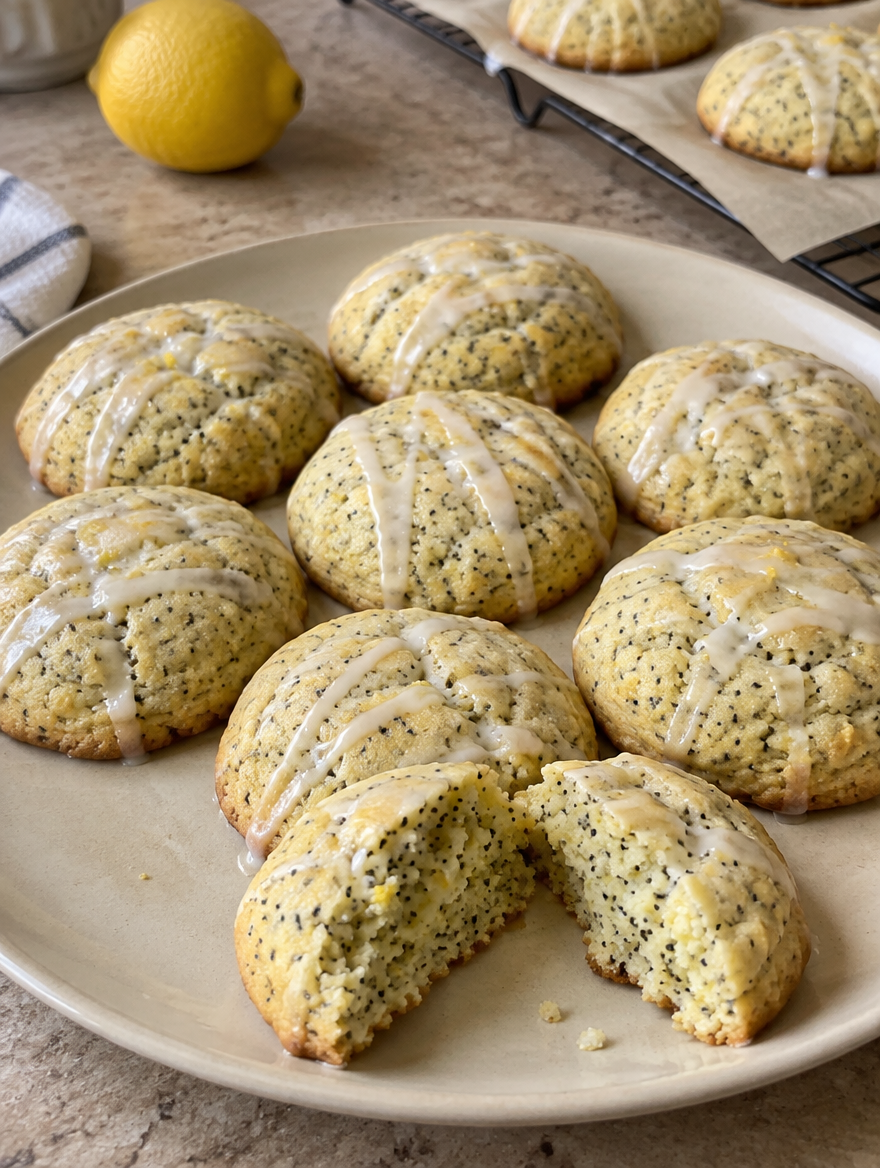
Soft lemon poppy seed cookies are a bright change from everyday chocolate chip cookies: fragrant lemon zest, tiny black poppy seeds, a lightly golden soft butter-cookie center, and a simple vanilla glaze make each bite feel special without requiring fancy baking equipment. This recipe uses basic all-purpose flour, butter, sugar, one egg, fresh lemon, and a short refrigerator chill to help the dough keep a pleasantly rounded shape.
Quick answer: cream 1/2 cup (113 g) unsalted butter with 3/4 cup (150 g) granulated sugar. Mix in 1 large egg, the finely grated zest of 2 lemons, 1 tablespoon lemon juice, and 1 teaspoon vanilla extract. Fold in 2 cups plus 1 tablespoon (260 g) all-purpose flour, 1 tablespoon poppy seeds, 1 teaspoon baking powder, 1/4 teaspoon baking soda, and 1/4 teaspoon fine salt. Chill for 30 minutes, scoop 18 cookies, and bake at 350°F (175°C) for about 12–14 minutes, until the edges are set and the centers are no longer raw or wet. Cool completely, then drizzle with a glaze made from 3/4 cup plus 2 tablespoons (100 g) powdered sugar, 1–1 1/2 tablespoons milk, and 1/2 teaspoon vanilla.
This is an original, AI-assisted editorial formulation, not independently tested in a physical kitchen. Exact spread, bake time, and yield depend on your flour, oven, pan, and scoop size. Any accompanying image is an AI-generated illustration and does not document a cooking test. The method and cues below are designed as a practical guide, not a guarantee of a kitchen-tested result.
Ingredients for Approximately 18 Cookies
Use a kitchen scale when available; cup measures can differ depending on how flour is scooped and packed.
For the Cookie Dough
- 1/2 cup (113 g) unsalted butter, softened but not melted.
- 3/4 cup (150 g) granulated sugar.
- 1 large egg, about 50 g without the shell.
- Finely grated yellow zest of 2 medium lemons, washed and suitable for using their peel.
- 1 tablespoon (15 ml) fresh lemon juice, strained to remove seeds.
- 1 teaspoon (5 ml) pure vanilla extract.
- 2 cups plus 1 tablespoon (260 g) all-purpose flour, measured by weight if possible.
- 1 tablespoon (about 9 g) poppy seeds.
- 1 teaspoon (about 4 g) baking powder.
- 1/4 teaspoon baking soda.
- 1/4 teaspoon fine salt.
For the Vanilla Glaze
- 3/4 cup plus 2 tablespoons (100 g) powdered sugar, sifted if lumpy.
- 1 tablespoon (15 ml) milk, then up to an additional 1/2 tablespoon (7.5 ml) only if needed.
- 1/2 teaspoon (2.5 ml) vanilla extract.
The finished cookie should taste of lemon first and vanilla second. The glaze is meant to form thin lines or a light drizzle, not a thick frosted cupcake layer. This recipe does not require cream cheese, lemon extract, boxed cake mix, or premade frosting.
Allergen note: the cookies contain wheat, egg, milk, and butter, and ingredients may carry additional allergen information on their packages. Poppy seeds can be processed in facilities handling other seeds or nuts, so check every label when baking for someone with food allergies. Do not imply that a cookie becomes allergen-free simply by omitting one ingredient.
Why Lemon Zest Matters More Than Extra Juice
Lemon zest contains aromatic oils that deliver a fresh citrus scent without adding much liquid. The recipe uses the yellow outer part of two lemons, with only a tablespoon of juice in the dough. That balance matters: pouring in more juice makes the dough wetter and can change how far the cookies spread on the baking sheet.
Choose lemons with a clean, intact peel that is suitable for food use. Wash and dry them before zesting, then use a fine grater and stop before the white pith. The pith can contribute bitterness. A microplane works well, but any fine grater that removes just the outer colored layer is appropriate.
The remaining lemon juice can be saved for another kitchen use, but it is not part of this cookie’s exact measurements. If you want a sharper lemon effect, the safest adjustment to explore in a future batch is a little more freshly grated zest—not several extra tablespoons of liquid.
What Do Poppy Seeds Add?
Poppy seeds bring the characteristic dark speckles and a small, pleasant textural contrast in an otherwise tender cookie. They do not make the dough rise and are not a replacement for flour. Adding them in the dry mixture helps distribute them more evenly so you do not end up with a dense patch in one cookie and almost none in another.
A tablespoon is intentionally modest. It creates a visible flecked look without making the cookies taste overwhelmingly of seeds. If you purchase a large bag, follow the package’s storage guidance and check freshness before baking. Poppy seeds can develop stale or unpleasant flavors after long storage, especially in warm cabinets.
These cookies are not a copy of a lemon-poppy-seed muffin. Muffins rely on a different batter consistency, usually bake in molds, and produce a cake-like shape. Here, a firmer dough and short chill are meant to produce individual, soft-centered cookies.
Butter Temperature and Cookie Texture
Softened butter should give slightly when pressed, while still holding its shape. Completely melted butter creates a different dough and can encourage excess spreading. Very cold butter, on the other hand, is harder to blend evenly with sugar. A short period at a moderate room temperature can help, but do not leave butter out for prolonged periods in a hot kitchen.
Creaming butter and sugar introduces some air and produces an even mixture. You do not need to beat the butter for ten minutes. A couple of minutes with a hand mixer, or somewhat longer by hand, is usually enough when it becomes smooth and lighter in appearance. Scrape the sides of the bowl to avoid pockets of unmixed butter.
Because this formulation uses one egg, the dough must be baked before eating. A silky-looking mixed dough is not an edible cookie-dough snack. Flour and raw eggs can carry harmful microbes, even if the bowl and ingredients look clean.
Tools and Oven Setup
You need a large mixing bowl, a smaller bowl for dry ingredients, measuring spoons, a scale if available, a whisk, a sturdy spatula, and a hand mixer or stand mixer. For baking, prepare two rimless or shallow baking sheets, parchment paper, and a wire cooling rack. A medium cookie scoop is helpful for uniform portions but not required.
Set the oven rack in the middle position, or use two racks spaced with room for airflow if baking both sheets simultaneously. Preheat the oven fully to 350°F (175°C). Oven dials can vary, so an independent oven thermometer is useful if your cookies routinely bake unevenly.
Line the baking sheets with parchment. Avoid putting cookie dough on a warm sheet from an earlier batch: the butter may soften before the dough reaches the oven, increasing spread. Keep unbaked portions chilled while the first tray cooks if your oven only fits one sheet.
How to Make Soft Lemon Poppy Seed Cookies
1. Mix the Dry Ingredients
In a medium bowl, whisk together 260 g all-purpose flour, 1 tablespoon poppy seeds, 1 teaspoon baking powder, 1/4 teaspoon baking soda, and 1/4 teaspoon salt. Stir long enough to distribute the small amounts of leavening and seeds throughout the flour. Set the bowl aside while you prepare the butter mixture.
Do not add the dry ingredients directly to the butter before the egg is mixed in. Keeping the stages separate makes it easier to achieve an even dough without unnecessary kneading.
2. Cream Butter and Sugar
Place 113 g softened unsalted butter and 150 g granulated sugar in a large bowl. Beat at medium speed for approximately 2–3 minutes, or until smooth, evenly mixed, and a little lighter in color. Stop once to scrape the sides and bottom. The aim is a creamy mixture, not a whipped frosting.
If the butter turns greasy or nearly liquid because your room is warm, briefly cool the bowl before continuing. Excessively warm dough is harder to scoop and may spread more in the oven.
3. Add Egg, Lemon, and Vanilla
Beat in 1 large egg until incorporated. Add the finely grated zest of two lemons, 15 ml lemon juice, and 1 teaspoon vanilla extract. Mix on low speed just until the ingredients appear evenly combined. The mixture may look slightly less smooth after adding acidic juice; do not panic or keep beating aggressively to force it to look like buttercream.
There is no need for yellow food coloring. The fresh zest creates the intended citrus aroma, and the cookies should remain pale with light golden edges after baking.
4. Fold in the Dry Mixture
Add the flour mixture in two additions, using a spatula or mixer on low speed. Stop as soon as no obvious dry patches remain. The finished dough should be soft and scoopable but not runny. Avoid prolonged mixing after adding the flour, which can develop more gluten and produce a firmer cookie.
Check the bottom of the bowl for hidden pockets of flour. If you see some, fold gently a few more times. Do not add unmeasured flour unless there is a clear measuring error; extra flour could make these cookies dry and dense.
5. Chill the Dough for 30 Minutes
Cover the dough and refrigerate for 30 minutes. Chilling makes the butter firmer and can help limit excess spreading. It also makes portioning easier. If your kitchen is especially warm, keep the second baking sheet’s portion refrigerated until you are ready to bake.
A longer chill can make the dough harder to scoop, in which case let it soften only enough to portion safely. Do not leave dough containing raw egg at room temperature for hours while preparing other foods. Use clean utensils and wash surfaces after contact with raw flour or egg.
6. Scoop and Arrange 18 Portions
Preheat the oven to 350°F (175°C) while the dough finishes chilling. Portion into about 18 even mounds, roughly 1 1/2 tablespoons each depending on the final dough volume and scoop. Space them at least two inches apart on parchment-lined sheets, giving room for moderate spread.
If your measured dough yields slightly more or fewer cookies, keep the portions consistent rather than forcing tiny or huge final scoops. Actual number and bake time depend on the size of each mound. Do not flatten the mounds heavily: a lightly rounded shape is the intended result.
7. Bake Until Set, Not Brown All Over
Bake for approximately 12–14 minutes on a center rack, checking toward the earlier end of the range. Look for edges that appear set with a light golden tint and centers that are no longer visibly wet or raw. Because these are lemon cookies, the tops may remain relatively pale, which is normal. The cookies should be baked through rather than deliberately left raw for softness.
If using two trays on separate racks, switch their positions partway through only when it can be done safely and efficiently, and adjust for the oven’s actual heat. Do not rely on a rigid timer if the dough balls are larger or the pan is dark.
8. Cool, Make the Glaze, and Finish
Leave the cookies on the baking sheet for about five minutes before transferring them to a wire rack. Allow them to cool fully, roughly 15–20 more minutes. Meanwhile whisk 100 g powdered sugar with 15 ml milk and 1/2 teaspoon vanilla until smooth; add up to an additional 7.5 ml milk only if you need a thinner drizzle.
Drizzle the glaze lightly over completely cooled cookies. Let the icing set for approximately 15 minutes, or until it is no longer wet to a gentle touch. Do not glaze hot cookies: the icing may melt and run off. Serve only after baking and cooling.
How to Tell When the Cookies Are Done
The most useful signals are the surface and edge appearance, not a dramatic golden-brown top. The outer edge should look set, the center should no longer look shiny with raw batter, and the cookie should hold together when moved after a short rest. The middle may remain tender after cooling, which is the goal.
Undercooked cookies should not be treated as safe simply because the centers are soft. A few extra minutes may be needed for a larger scoop or an oven running cool. Conversely, baking until the entire cookie turns deep brown could dry out a lemon cookie that is meant to be pale and soft.
A first tray can be used to learn how your oven and scoop behave. Keep the remaining dough cold while evaluating the baked pieces. If they spread too far, ensure the dough was chilled properly and the sheets were not hot; if they are unusually thick and dry, double-check the flour measurement and mixing technique for the next batch.
Six Common Cookie-Baking Mistakes
Measuring too much flour. Scooping a cup directly through a tightly packed bag can deliver more flour than intended. Use 260 g weighed flour if possible. Extra flour makes cookies less soft and can mute the lemon flavor.
Skipping the chill. The butter may be too warm to hold the intended shape, particularly in a hot kitchen. The short 30-minute refrigerator rest helps the dough feel less sticky and gives the cookies a better chance of retaining a slightly domed appearance.
Adding extra lemon juice. Liquid changes dough consistency. Keep the tablespoon in the dough and rely mainly on fresh zest for citrus aroma. Adding several more tablespoons of juice without reformulating the flour and sugar makes the result less predictable.
Overmixing after the flour. Stop when the dry mixture is combined. Prolonged kneading or beating can make the finished cookie tougher than intended.
Overbaking for dark color. These cookies are supposed to be lightly colored. Bake until the edges and centers are appropriately set, without waiting for the entire surface to turn brown.
Glazing warm cookies. Vanilla icing on a warm cookie can disappear into the surface or drip off the plate. Let the cookies cool completely first, then apply a thin drizzle and allow it to set.
Easy Vanilla Glaze: Getting the Thickness Right
Powdered sugar glazes are sensitive to small amounts of liquid. Begin with 15 ml milk for the 100 g powdered sugar. Whisk until smooth. The mixture should fall from a spoon in a narrow ribbon rather than a thick lump; if necessary, add milk a few drops at a time, staying below the additional half-tablespoon allowance in the ingredient list.
You want enough glaze to add a vanilla note without burying the lemon and poppy seeds. Thin lines leave the speckles visible and make the cookies look like cookies, not iced cupcakes. A spoon works fine; you do not need a piping bag.
If you prefer less icing, drizzle only part of the batch and save the remainder as plain lemon cookies. This changes the amount of glaze consumed per cookie but not the core baking method. Do not store prepared glaze unrefrigerated for extended periods, because this version contains milk.
Variations That Keep the Recipe Recognizable
More lemon aroma. If you enjoy a sharper citrus flavor, consider using a little extra fine zest in a future batch, after trying the base proportions. Avoid adding large extra volumes of juice, which affect dough moisture.
No glaze. The cookies can be served plain after cooling. They will have a less sweet finish and the little poppy specks will be easier to see. The vanilla drizzle is optional for serving but included in the named version.
Smaller cookies. You can divide the dough into more portions, but small cookies may bake faster. Begin checking earlier and rely on set edges and cooked centers rather than a copied bake time.
A little extra poppy seed. A small adjustment may increase the speckled appearance. Changing the amount too dramatically would affect texture and balance; the core recipe uses one tablespoon.
Other citrus. Orange zest gives a different flavor profile and could work in a separately adjusted recipe. Do not describe orange cookies as lemon cookies or assume the same level of tartness.
Storage, Freezing, and Food Safety
Once the cookies have baked completely and the glaze has set, place them in a clean airtight container, separating layers with parchment if needed. Because the glaze contains a little milk and homemade storage conditions vary, a prudent approach is to refrigerate glazed cookies and enjoy them within 3–4 days, following more restrictive ingredient instructions where relevant. This is an editorial storage estimate, not a laboratory-validated shelf-life study.
Plain, unglazed cookies may tolerate different storage conditions, but avoid promising a fixed room-temperature life for every home and climate. If you want to freeze part of the batch, cool the unglazed, fully baked cookies, wrap them well, and thaw in the refrigerator before adding a fresh glaze. The exact frozen quality period is not established for this untested formulation.
The CDC’s guidance on raw flour and cookie dough explains that uncooked flour and eggs can carry harmful germs, so do not taste or eat the raw dough. Keep raw flour and egg mixture away from ready-to-eat food, clean bowls and counters after handling, and bake the cookies fully before serving. Raw dough is not safe just because it tastes sweet or contains lemon.
When sharing cookies at a gathering, keep the ingredient and allergen information available. These contain wheat, egg, milk, and poppy seeds. Poppy-seed labeling and cross-contact precautions matter for guests with allergies or dietary restrictions.
Serving Ideas and Other Homemade Treats
A few soft lemon poppy seed cookies make a simple dessert with tea or coffee. They are also an easy addition to a dessert tray when you want something citrus-flavored beside richer chocolate choices. For a completely different cookie profile, our chocolate chocolate chip cookies with soft centers provide a darker cocoa-forward option.
If you prefer a snack designed for packing in a lunch bag, the homemade chewy granola bars with honey and peanut butter are another distinct recipe with different ingredients and texture. Those bars contain peanuts, while this cookie recipe contains poppy seeds, wheat, egg and milk—check each recipe’s allergens separately.
For a baked cake rather than individual cookies, our one-bowl chocolate cake with cocoa glaze offers a different format and flavor. Lemon cookies are more convenient to portion individually, while a cake requires slicing.
Serve the cookies after the glaze has set so they are less likely to stick together. You do not need to invent decorations, candy brands, or bright food coloring: lemon zest, poppy seeds, and a light vanilla drizzle provide all the visual details.
Frequently Asked Questions
Can I make lemon poppy seed cookies without a mixer?
Yes. Softened butter and sugar can be creamed by hand with a sturdy spoon, though it may take longer. Add the egg and aromatics, then fold in the dry ingredients until just combined. Do not overwork the dough once flour is present.
Why do my lemon cookies spread too much?
Butter that was melted rather than softened, an overly warm baking sheet, or skipping the 30-minute chill may contribute. Measure the flour accurately and keep the dough cool until baking. Oven temperature and scoop size also affect spread.
Can I use bottled lemon juice?
Freshly squeezed juice gives a straightforward flavor, and fresh lemons are also needed for the zest. Bottled juice would not provide the peel’s essential oils and may have a slightly different taste. The intended version uses 15 ml fresh juice and zest of two lemons.
Can I skip the poppy seeds?
You can omit them for a plain lemon cookie variation, but it would no longer have the distinctive poppy-seed texture and appearance. For a specific seed allergy, check cross-contact in the other ingredients and baking equipment rather than assuming omission alone makes the kitchen safe.
How many cookies does the recipe make?
Approximately 18 moderate cookies. Actual yield changes with scoop volume and how much dough you scrape from the bowl. Keep portions uniform for more even baking, and adjust oven time if making larger or smaller cookies.
How long should the dough chill?
About 30 minutes in the refrigerator before portioning and baking. The goal is to firm the butter enough to make the dough easier to handle. Longer chilling may require a brief pause before scooping.
Should the cookies be brown on top?
No. Lemon butter cookies can remain pale, with just lightly golden edges. They should still be baked through, with centers that are no longer visibly wet or raw. Do not serve uncooked cookie dough.
Why is my glaze disappearing?
The cookies may have been too warm, or the glaze may contain too much milk. Let the cookies cool completely, start with the smaller amount of milk, and add drops only until the icing falls in a thin ribbon.
Can I glaze only half of the batch?
Yes. Divide the glaze or drizzle only some cookies; the baked cookie formula does not change. Store any milk-containing glaze safely and do not leave it sitting out for extended periods.
Can I freeze the dough?
Freezing raw dough introduces separate handling and baking variables not independently tested for this formulation. If you try it, label and store the dough appropriately, maintain food-safe temperatures, and adjust the baking process until cookies are cooked through.
Are these cookies gluten-free?
No. They use regular all-purpose wheat flour. A gluten-free substitution is not guaranteed to give the same texture or spread and needs a separately developed recipe, with appropriate allergen verification.
Can children help make the cookies?
They can help with age-appropriate, supervised tasks such as measuring cooled ingredients or drizzling glaze on fully baked cookies. Keep children from tasting raw flour or egg dough and supervise hot pans and oven use.
Final Tips for Soft Cookies With Bright Lemon Flavor
Start with butter that is soft but not melted, weigh the flour if possible, and let fresh zest provide most of the lemon character. Fold the dough gently, chill it, scoop evenly, and bake until the cookies are properly set rather than waiting for a deeply browned top. Cool completely before applying the light vanilla glaze.
This creates a practical recipe for soft lemon poppy seed cookies with vanilla glaze, with ingredients available in a typical U.S. grocery store and no unusual kitchen tools required.
Editorial disclosure: Original AI-assisted recipe formulation; not independently kitchen-tested. Featured media, if used, is an AI-generated illustration, not documentation of a physical bake. Nutrition information has not been calculated or verified.
Print
Soft Lemon Poppy Seed Cookies With Vanilla Glaze
- Prep Time: 25 minutes
- Cook Time: 13 minutes
- Total Time: Approximately 1 hour 45 minutes including 30 minutes chilling, cooling and glaze setting
- Yield: Approximately 18 cookies 1x
- Category: Sweet & Savory Mashups
- Method: Creamed-butter cookie dough, refrigerator chill and oven baking at 350°F (175°C)
- Cuisine: American home baking
Description
Soft golden lemon poppy seed cookies with fragrant fresh lemon zest, tiny black poppy seed speckles and a light vanilla-powdered-sugar glaze drizzled on cooled cookies.
Ingredients
1/2 cup (113 g) unsalted butter, softened not melted
3/4 cup (150 g) granulated sugar
1 large egg (about 50 g without shell)
Finely grated yellow zest of 2 medium food-safe lemons
1 tablespoon (15 ml) freshly squeezed lemon juice, strained
1 teaspoon (5 ml) vanilla extract for dough
2 cups plus 1 tablespoon (260 g) all-purpose flour, preferably weighed
1 tablespoon (about 9 g) poppy seeds
1 teaspoon (about 4 g) baking powder
1/4 teaspoon baking soda
1/4 teaspoon fine salt
3/4 cup plus 2 tablespoons (100 g) powdered sugar for glaze
1 tablespoon (15 ml) milk, up to 1/2 tablespoon (7.5 ml) additional if needed
1/2 teaspoon (2.5 ml) vanilla extract for glaze
Instructions
Whisk 260 g all-purpose flour, 1 tablespoon poppy seeds, 1 teaspoon baking powder, 1/4 teaspoon baking soda and 1/4 teaspoon salt together in a medium bowl.
Beat 113 g softened unsalted butter with 150 g granulated sugar for roughly 2–3 minutes until evenly creamy and slightly lighter.
Mix in 1 large egg, finely grated zest from 2 lemons, 15 ml lemon juice and 1 teaspoon vanilla extract just until combined.
Fold the dry ingredient mixture into the wet ingredients in two additions, mixing only until no dry flour patches remain; avoid overworking.
Cover cookie dough and chill in the refrigerator for 30 minutes. Preheat oven to 350°F (175°C); line baking sheets with parchment.
Portion approximately 18 even cookie mounds, about 1 1/2 tablespoons each depending on final dough volume; place at least 2 inches apart on parchment-lined baking sheets.
Bake at 350°F (175°C) for about 12–14 minutes per tray, until edges are lightly golden and set, centers no longer visibly raw or wet. Cool on pan 5 minutes, transfer to a rack and cool fully about 15–20 minutes more.
Whisk 100 g powdered sugar with 15 ml milk and 1/2 teaspoon vanilla. Add up to 7.5 ml more milk only if needed for a light drizzle. Drizzle onto COMPLETELY cooled cookies and let set approximately 15 minutes before serving. Keep refrigerated as appropriate for dairy glaze.
Notes
Original AI-assisted editorial recipe NOT independently kitchen-tested; any accompanying image is AI-generated illustrative media, not a physical baking photograph. Always bake before tasting: CDC https://www.cdc.gov/food-safety/foods/no-raw-dough.html warns both raw flour and eggs can contain germs. Use a clean kitchen, do not let children eat raw dough; wash surfaces/utensils/hands after contact. Core allergens: WHEAT, EGG, MILK/butter; check poppy seed package cross-contact. Baking durations depend on actual cookie size, pan and oven, and centers must be set rather than wet/raw. Homemade milk-based glazed cookies are conservatively refrigerated and best enjoyed within 3–4 days; not a laboratory-validated shelf life. No nutrition assertions.
Nutrition
- Serving Size: 1 cookie out of approximately 18
Keywords: easy lemon poppy seed cookies, soft lemon cookies, lemon poppy seed cookie recipe, vanilla glaze cookies, easy cookie recipe