
Chocolate Chocolate Chip Cookies With Soft, Fudgy Centers
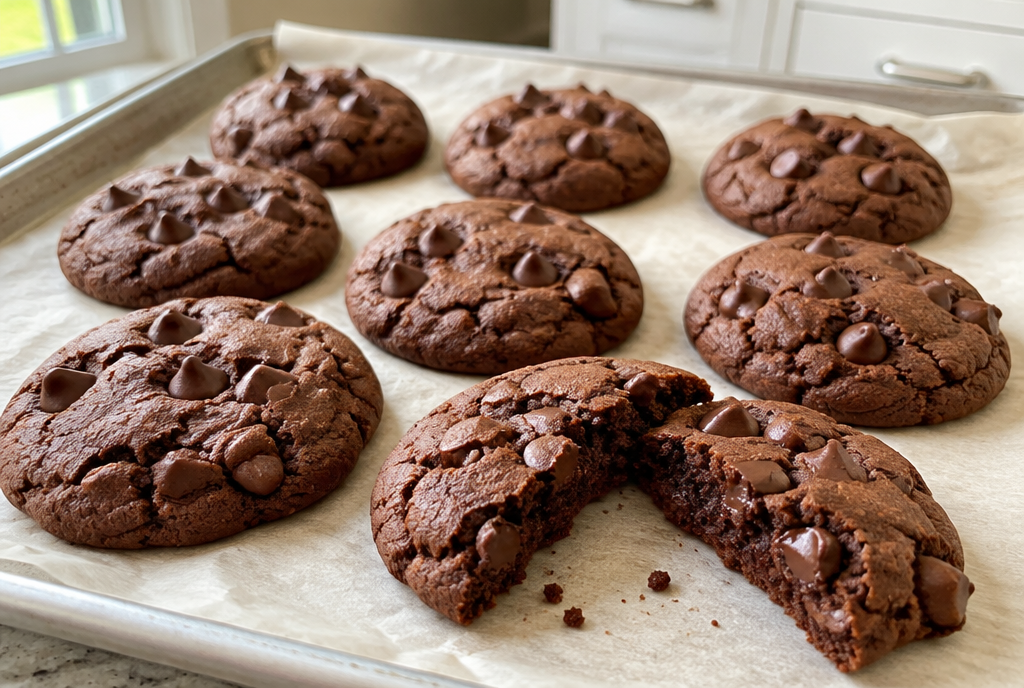
A chocolate chocolate chip cookie recipe should deliver chocolate in two ways: a cocoa-rich cookie dough and distinct pockets of melted chocolate chips. These cookies are designed for gently set edges, a chewy bite, and soft centers that finish setting as they cool. They are not meant to be uncooked or gooey with raw batter, and they do not require a boxed brownie mix.
The proposed method uses softened butter, a combination of brown and granulated sugars, unsweetened cocoa powder, and plenty of semisweet chocolate chips. The dough rests briefly in the refrigerator to make portioning more consistent. A moderate oven temperature allows the outside to take shape before the center dries out. Once baked, leave the cookies on the hot sheet for a few minutes before moving them to a wire rack.
At a glance: Plan for 24 medium cookies, approximately 20 minutes of active preparation, 30 minutes of chilling, and 10–12 minutes of baking per tray at 350°F (175°C). Exact oven time depends on cookie size, pan color, and oven calibration. The method and ingredient balance below are an original editorial recipe formulation, not represented as independently kitchen-tested. Use the visual doneness cues and make adjustments based on your oven.
The first source of chocolate is unsweetened cocoa powder mixed directly into the dough. It provides a dark brown color and a deep chocolate flavor without adding a large amount of liquid. The second source is the semisweet chocolate chips, which stay recognizable as little pockets in the cookie and soften during baking.
This is different from a plain chocolate chip cookie, where most of the flavor comes from a vanilla-brown-sugar dough, and different from a brownie, which generally has a much denser batter. You can think of these as classic American drop cookies with a cocoa-forward base rather than a brownie mixture pressed into cookie shapes.
For comparison, the professional bakers at King Arthur Baking discuss the roles of cocoa and chocolate chips in double chocolate chip cookies. Our recipe is formulated with different quantities and a deliberate chilling step, so follow the ingredient amounts and instructions on this page rather than mixing directions from two recipes.
Wet ingredients
- 3/4 cup (170 g) unsalted butter, softened but not melted
- 3/4 cup packed (150 g) light brown sugar
- 1/2 cup (100 g) granulated sugar
- 2 large eggs, at cool room temperature
- 2 teaspoons pure vanilla extract
Dry ingredients
- 2 cups (240 g) all-purpose flour
- 1/2 cup (42 g) natural unsweetened cocoa powder
- 3/4 teaspoon baking soda
- 1/2 teaspoon fine salt
Chocolate mix-in
- 1 1/2 cups (about 255 g) semisweet chocolate chips
These quantities are intended as one complete batch. Weighing the flour and cocoa gives more reproducible results than packing either ingredient into a measuring cup. If you use cups, spoon flour lightly into the cup and level it without pressing it down. Cocoa can be sifted if it contains stubborn lumps.
There is no need to add extra espresso, milk, frosting, candy or flavored chips to make the original recipe work. Optional changes are described later as separate variations.
Butter: what softened really means
The butter should yield gently when pressed but still hold its shape. Butter that is liquid or visibly greasy will behave differently during creaming and may cause the cookies to spread excessively. On a warm day, you may need only a short period outside the refrigerator; in a cool kitchen it may take longer. The goal is a pliable texture, not a precise number of minutes.
Use unsalted butter so that the listed half teaspoon of fine salt is easier to control. If you only have salted butter, the added salt should be reduced, but the exact amount depends on the brand’s formula.
Brown sugar and white sugar work together
Brown sugar contributes moisture and a caramel-like background flavor that balances the cocoa. Granulated sugar helps provide a slightly more defined edge. Using both aims for a cookie that is chewy in the middle rather than uniformly cakey or uniformly crisp.
Do not increase the sugar arbitrarily to compensate for bitter cocoa. If your cocoa tastes particularly strong, selecting a pleasant semisweet chip is a more controlled adjustment. Sugar changes can affect texture, spreading, and browning, not just sweetness.
What type of cocoa powder to use
This version specifies natural unsweetened cocoa powder. Natural and Dutch-process cocoa are not always interchangeable in recipes that rely on baking soda because their acidity can differ. To preserve the intended balance, use the type listed. Do not substitute hot cocoa drink mix, which may contain sugar, milk solids, and other additives.
A good cocoa powder has a recognizable chocolate aroma without a stale smell. Store it in a dry place with the lid closed. A fine mesh sieve is helpful if the powder has formed little clumps.
Choosing the chocolate chips
Semisweet chips make a reliable starting point because they add sweetness without turning every bite into candy. Bittersweet chips can make the cookies less sweet; milk chocolate chips will usually make them sweeter. If you replace the chips, keep the overall amount close to 1 1/2 cups, so the dough-to-chocolate ratio stays reasonable.
For a more irregular appearance you can replace some chips with roughly chopped chocolate. Chocolate chunks often leave broad melted patches that look particularly appealing, but they may spread into the dough differently from chips designed to retain their shape.
Equipment and preparation
You will need two mixing bowls, a hand mixer or stand mixer, a sturdy spatula, measuring cups or a kitchen scale, a cookie scoop or tablespoon, two light-colored baking sheets, parchment paper, and a cooling rack. A small sieve is helpful for the cocoa but not essential if you can break lumps apart properly.
Use light-colored metal baking sheets when possible. Very dark trays can brown bottoms quickly, and insulated sheets may behave differently. Parchment makes removal easier and usually helps keep cookies from sticking. Greasing a pan heavily can encourage extra spreading, so parchment is preferable here.
Before measuring anything, check that you have refrigerator space for a tray or a covered dough bowl. Chilling makes the mixture easier to handle and helps control spread. It is a planned part of the method, not an emergency rescue after overly soft dough has already been baked.
Step 1: Mix the dry ingredients
In a medium bowl, whisk together 2 cups flour, 1/2 cup natural cocoa powder, 3/4 teaspoon baking soda, and 1/2 teaspoon salt. Break up obvious cocoa lumps. Combining the dry ingredients separately helps distribute the baking soda and salt before they enter the butter mixture.
Do not add the chocolate chips yet. They go in at the end so the chips can be distributed without prolonged mixing, which may make the finished cookies tougher.
Step 2: Cream the butter and sugars
Place 3/4 cup softened unsalted butter, 3/4 cup packed brown sugar, and 1/2 cup granulated sugar in a large mixing bowl. Beat at medium speed for about 2–3 minutes, scraping the sides of the bowl once. The mixture should look more cohesive and slightly lighter, but it does not need to become white or whipped like frosting.
If the mixture looks oily and very loose, the butter may have become too warm. Briefly cool the bowl before continuing rather than adding random extra flour. Adding dry ingredients as a guess can make the cookies dry.
Step 3: Add the eggs and vanilla
Add the two large eggs one at a time, mixing until each is incorporated. Add 2 teaspoons vanilla and scrape the bottom and sides of the bowl. It is normal for the mixture to look somewhat uneven just after adding eggs; it should come together when the remaining ingredients are added.
Avoid beating for many additional minutes once everything is combined. The goal is to emulsify the mixture adequately, not to create a cake batter full of excess air.
Step 4: Combine wet and dry
Add the flour-cocoa mixture in two additions. Mix on low speed just until no broad dry streaks remain. Switch to a spatula for the final folds so you can see whether flour is hiding at the bottom of the bowl.
The finished dough should be chocolate brown, thick, and somewhat soft. It will not have the same texture as plain cookie dough because cocoa absorbs moisture. Resist the temptation to add milk without evidence of a real need; extra liquid changes the baking balance.
Step 5: Fold in the chocolate chips
Add 1 1/2 cups semisweet chocolate chips and fold gently until distributed. If you want a few visible chips on the surface for presentation, reserve a tablespoon or two from that measured quantity and press them onto the scooped portions before baking. Do not increase the total chips beyond the listed amount for a first attempt.
The dough should hold a rough mound on a spoon. A slightly sticky feel is normal. If it is difficult to handle, the planned chilling time should help.
Step 6: Chill the dough
Cover the bowl and refrigerate for at least 30 minutes. This gives the butter time to firm up and the dough a chance to become easier to portion. Longer chilling may be fine, but very cold dough may need a few minutes to soften enough for scooping.
If chilling overnight, keep the dough covered in the refrigerator and do not assume it has become safe to taste raw. The flour and eggs remain uncooked until the cookies are baked.
Step 7: Preheat, scoop and space the cookies
Preheat the oven fully to 350°F (175°C). Line two light-colored baking sheets with parchment. Portion the dough into roughly 24 mounds, about 2 tablespoons or 38–40 g each. Space them about 2 inches apart because the dough will spread.
Do not flatten every mound aggressively. Slightly rounded scoops help preserve a thicker center. For a neater top, lightly press any reserved chocolate chips onto the surface, but there is no need for elaborate styling.
Step 8: Bake until the centers are cooked
Bake one sheet on the center rack for 10–12 minutes, checking earlier if your scoops are smaller. The edges should look set and the tops should lose the appearance of wet raw batter. The centers may remain soft, but they should not be liquid or underbaked. Baking time alone cannot guarantee safe doneness across all ovens and portion sizes.
For more even batches, bake one sheet at a time. If using two oven racks, you may need to rotate the sheets, but opening the door repeatedly can create extra variation. Adjust based on your oven rather than forcing identical times.
Step 9: Cool on the sheet, then a rack
Let the cookies rest on the baking sheet for about 8 minutes so they become easier to move without breaking. Transfer them to a wire rack to finish cooling. If you lift them immediately, the soft centers may collapse; if you leave them too long on a very hot pan, residual heat may dry the bottoms.
The chocolate chips may remain soft for a while after the cookies are baked. Let them cool enough before packing them together or placing them in a storage container.
With deeply chocolate-colored cookies, browning is difficult to judge by color alone. Look instead for a set outer ring, a mostly matte surface, and a center that does not look like wet raw dough. Gently nudging the edge with a spatula should reveal a cookie that has developed some structure.
The cookies will continue to firm as they cool. A soft finished cookie is not synonymous with an undercooked cookie; likewise, an obviously raw middle is not made safe simply by a few minutes of cooling. If a cookie appears underdone, return it to the oven for additional baking while it is still on the sheet.
Keep in mind that oversized scoops may need longer than the stated 10–12 minutes. A kitchen timer is a reminder to start checking, not a substitute for judging what is in the oven.
The secret to soft centers without raw dough
The main controls are portion size, butter temperature, dough temperature, and accurate measurement. Weighing flour reduces guesswork. Chilling the dough helps keep it from running outward before the edges establish themselves. Measuring similar mounds makes the baking time more consistent.
Bake until the cookies are cooked, and then allow their texture to develop during cooling. Very thick cookies may feel soft for longer because their internal temperature equalizes gradually. This is normal, but should not be used as an excuse to serve raw batter.
One more point is often overlooked: a freshly baked cookie containing a large amount of melted chocolate can seem wetter than its dough really is. Wait until it is cool enough to assess the actual crumb, not just the warm chocolate chip pockets.
Common problems and how to fix them
Cookies spread too much
Your butter might have been too warm, the dough might have skipped chilling, or the flour amount might be low because of measuring technique. On your next batch, weigh the flour, use genuinely softened rather than melted butter, and chill the portions before baking.
A hot baking sheet can also make the second tray spread faster. Let the sheet cool before adding raw dough to it. Never place raw dough onto a pan that is still scorching from the previous batch.
Cookies are cakey rather than chewy
Too much flour, excessive mixing, or very small dough portions can change the result. Spoon and level if using cups and keep the portion size reasonably consistent. Avoid beating the dough heavily after the dry ingredients are added.
There is some natural variation across brands of cocoa and flour, so a small texture difference does not necessarily mean you did something wrong. Make one change at a time rather than replacing several ingredients without testing.
Cookies are dry or crumbly
They may have baked too long, or the flour and cocoa were measured heavily. Check the timer earlier on the next tray and keep the cookies on the middle rack rather than near a strong top or bottom heating element.
Remember that chocolate cookies can continue drying on a hot metal tray after removal. Transfer them to a rack once they are stable enough to lift.
Cookies taste bitter
Natural cocoa has some bitterness, and different chips contain different amounts of sugar. Use a semisweet chocolate you already enjoy eating, and double-check that you did not accidentally use an unsweetened baking-chocolate product instead of semisweet chips.
Do not pour extra sugar into an already mixed dough in hopes of an immediate fix. That affects texture and may leave undissolved granules.
Chips sink or gather on one side
The dough was probably not folded uniformly. Mix gently until the chips are spread through the bowl, then inspect several scoops. Pressing a few of the measured chips onto the tops is mainly an appearance option; it does not replace good mixing.
Variations that keep the recipe recognizable
Dark chocolate version: Replace the semisweet chips with bittersweet chips of similar size. The resulting cookies may taste less sweet, but the dough measurements can stay the same for this small change.
Chocolate chunks instead of chips: Use roughly chopped semisweet chocolate in place of the chips. The chocolate may melt in broader patches. Chill the dough as directed because chopped chocolate does not fix warm butter.
Slightly smaller cookies: Make about 30 smaller mounds instead of 24, allow generous space between them, and check doneness earlier. This changes yield and baking time, so do not keep a rigid 12-minute rule.
Dairy-free adaptation: Choose a baking-appropriate dairy-free butter alternative and chocolate chips that meet the dietary need. The behavior of those substitutes varies widely; this is an adaptation, not a separately tested equivalent recipe.
Nuts: If you want walnuts or pecans, replace a modest portion of the chocolate chips with chopped nuts rather than adding a full extra cup. Clearly disclose the additional allergen if you serve the cookies to guests.
Serving ideas and complementary desserts
These cookies are rich enough to serve on their own, especially while the chips are still a little soft. Arrange them on a plain plate rather than stacking them too tightly when warm. With a cold glass of milk, they make a familiar American after-school-style treat; serve with an alternative beverage if you need to avoid dairy.
For a deliberately bold sweet-and-savory dessert table, our bacon chocolate chip cookie sandwiches explore a completely different flavor direction. That is a separate recipe, not an extra ingredient suggested for this chocolate cookie dough.
If you enjoy dessert bars as well as cookies, the chocolate chip bacon cheesecake bars give you another make-ahead-style party dessert. For a different chocolate bake, compare the maple pecan cheesecake swirl brownies and their denser brownie texture. These are related dessert ideas, not duplicate versions of the recipe on this page.
Food safety: do not taste the raw dough
Do not eat uncooked cookie dough. Raw flour can carry germs, and raw or undercooked eggs can also pose a foodborne-illness risk. The CDC explains why raw flour and raw dough are unsafe to eat even though cookie dough may look and smell appetizing.
Wash hands, utensils, mixing bowls, scoops, and counters after contact with raw ingredients. Keep the raw dough separate from ready-to-eat food. Refrigerate the dough promptly when making it ahead, and bake the cookies before serving.
A dough made from raw flour and standard eggs is not an edible-cookie-dough product. This recipe is designed to be baked. If you want edible dough to eat unbaked, use a separate formula developed for that purpose with appropriately treated ingredients.
Storage, freezing, and making ahead
Let the cookies cool completely before putting them into an airtight container. Warm cookies can release steam inside the container, softening their surfaces. For best texture, enjoy them within a few days at room temperature in a cool, dry environment. Actual safe storage depends on ingredients, handling, humidity, and room temperature; discard food showing signs of spoilage.
For longer storage, freeze fully cooled baked cookies in a sealed freezer-safe container, with parchment between layers if needed. Thaw at room temperature while protected from excess moisture. Frozen cookies can lose a little of their freshly baked texture, but the chocolate flavor usually remains pleasant.
You can also portion the raw dough and refrigerate it, covered, for a short make-ahead period. For storage beyond that, freeze the individual raw scoops and bake them from frozen with a baking-time adjustment. The dough remains raw until baked, so keep it away from ready-to-eat food and never taste it.
If baking for a crowd, label the container with a preparation date. Avoid mixing an old batch with new cookies without knowing which is which.
Scaling the batch for a party
This recipe targets about 24 medium cookies. For 48 cookies, doubling the ingredients is more reliable than trying to extend the dough with extra flour or milk. Work in batches if the mixer bowl is small, and chill the dough before baking.
For a smaller household, you can freeze half the portioned dough and bake the remainder. Halving this recipe exactly would require handling one egg’s contribution carefully, which is awkward for casual measurement; freezing dough portions is usually more convenient.
Keep the original dough weight consistent if you want similar cookies on multiple trays. A cookie scoop and kitchen scale are practical tools, not professional-only equipment.
Frequently asked questions
What’s the difference between chocolate chip and chocolate chocolate chip cookies?
Regular chocolate chip cookies usually have a pale vanilla-brown-sugar dough with chocolate chips. Chocolate chocolate chip cookies include cocoa in the dough as well as separate chocolate chips, producing a more chocolate-forward flavor and darker cookie.
Should I chill chocolate cookie dough?
For this version, yes. The 30-minute chill helps the butter firm up and makes the dough easier to portion. If your kitchen is especially warm, a little more chilling may help; avoid baking very warm, loose dough if you want thicker cookies.
Can I use Dutch-process cocoa instead of natural cocoa?
The recipe is formulated for natural unsweetened cocoa and baking soda. Dutch-process cocoa can behave differently. For the first attempt, use the stated type rather than substituting and assuming the cookies will spread and rise identically.
How long do chocolate chocolate chip cookies bake at 350°F?
For approximately 2-tablespoon portions, begin checking after about 10 minutes, with an estimated total of 10–12 minutes. Larger or colder scoops may take longer. Fully bake the dough and check for set edges and centers without wet raw batter.
Why are my double chocolate cookies flat?
Warm or melted butter, skipped chilling, inaccurate flour measurements, or a hot baking sheet may contribute. Use softened butter, weigh flour if possible, cool baking sheets between batches, and follow the chilled-dough step.
Can I freeze chocolate chocolate chip cookie dough?
Yes, portioned dough can be frozen in a sealed, labeled freezer container. Keep it separate from ready-to-eat foods because it contains raw flour and eggs. Bake the pieces thoroughly, allowing extra time if needed.
Are these cookies brownies?
No. Cocoa gives them a brownie-like flavor, but the mixture is designed as a scoopable drop-cookie dough rather than a brownie batter. The finished texture should be chewy with a set edge and soft center, not a sliceable brownie slab.
Can I make them without eggs?
A true egg-free version needs a tested substitution strategy. Simply omitting the eggs can produce a dry, crumbly dough. This original recipe has two large eggs, so it is not egg-free or vegan.
How do I know the cookies are baked and not raw inside?
Look for a set outer edge and a center that no longer looks like wet raw batter. Portion size and oven temperature affect the result. If a cookie is clearly underdone, return it to the oven rather than relying on cooling alone.
Can I use chocolate chunks instead of chips?
Yes. Replace the measured chips with an approximately equal weight of chopped semisweet chocolate. Larger pieces melt into broader pockets; the cookies may look less uniform, which is a preference rather than a problem.
How many cookies does the recipe make?
Expect about 24 medium cookies when you portion the batch into mounds of roughly 38–40 g. Scoop size and dough left in the bowl can change the precise count.
Can I use cocoa drink mix instead of unsweetened cocoa?
No. Sweetened drinking cocoa or hot chocolate powder can contain sugar and milk ingredients that change the recipe. Use natural unsweetened cocoa powder for the intended result.
Final baking checklist
Measure the flour and cocoa carefully. Use softened, not melted, butter. Cream the butter with brown and granulated sugar, add the eggs and vanilla, and fold in the dry ingredients before the chocolate chips. Chill for at least 30 minutes. Scoop evenly, space the cookies, and bake at 350°F until the centers are cooked and the edges are set. Cool briefly on the tray before transferring to a rack.
This is an AI-assisted editorial recipe formulation, not one claimed to have been physically kitchen-tested. It is written to be cookable, to make the role of each ingredient clear, and to explain the checks that matter more than a clock alone. For a consistently good cookie, pay attention to ingredient temperatures, pan choice, portion size and actual doneness.
Editorial transparency: this recipe is an AI-assisted original editorial formulation, not independently kitchen-tested. The illustrative image was generated with AI and does not document a physical cooking test.
Print
Chocolate Chocolate Chip Cookies With Soft Centers
- Prep Time: 20 minutes
- Cook Time: 24 minutes (two trays, 10–12 minutes each)
- Total Time: 82 minutes including chilling and sheet rest
- Yield: About 24 medium cookies 1x
- Category: Dessert
- Method: Creamed drop cookies; chilled dough; oven baking
- Cuisine: American
Description
Cocoa-rich chocolate chocolate chip cookies with semisweet chocolate chips, chewy set edges and soft baked centers.
Ingredients
3/4 cup (170 g) unsalted butter, softened, not melted
3/4 cup packed (150 g) light brown sugar
1/2 cup (100 g) granulated sugar
2 large eggs, at cool room temperature
2 teaspoons pure vanilla extract
2 cups (240 g) all-purpose flour
1/2 cup (42 g) natural unsweetened cocoa powder
3/4 teaspoon baking soda
1/2 teaspoon fine salt
1 1/2 cups (about 255 g) semisweet chocolate chips
Instructions
In one bowl whisk flour, natural unsweetened cocoa, baking soda and fine salt; break up cocoa lumps.
In a separate bowl beat softened unsalted butter with brown and granulated sugar at medium speed for about 2–3 minutes until cohesive and slightly lighter.
Add the two eggs one at a time, then vanilla, mixing only until combined.
Add the dry mixture in two additions on low speed; finish folding by hand until no broad dry streaks remain.
Fold in 1 1/2 cups chocolate chips, reserving a spoonful from that measured amount if desired for visible tops.
Cover and refrigerate the dough at least 30 minutes; chill longer if the dough is unusually soft.
Preheat the oven to 350°F (175°C). Line light-colored baking sheets with parchment and scoop about 24 mounds, roughly 2 tablespoons or 38–40 g each, 2 inches apart.
Bake one sheet at a time for about 10–12 minutes; check for set edges and no wet raw center, adjusting for scoop size and oven.
Rest on the hot baking sheet about 8 minutes; then move to a wire rack until completely cool before storing.
Wash utensils and surfaces touched by raw flour or eggs; never taste raw cookie dough.
Notes
Original AI-assisted editorial recipe not independently kitchen-tested. Do not taste raw cookie dough: raw flour and eggs can carry harmful pathogens. Bake until centers are set, not wet. Image is AI generated and illustrative.
Nutrition
- Serving Size: 1 medium cookie
Keywords: chocolate chocolate chip cookie recipe, double chocolate chip cookies, soft chocolate cookies