
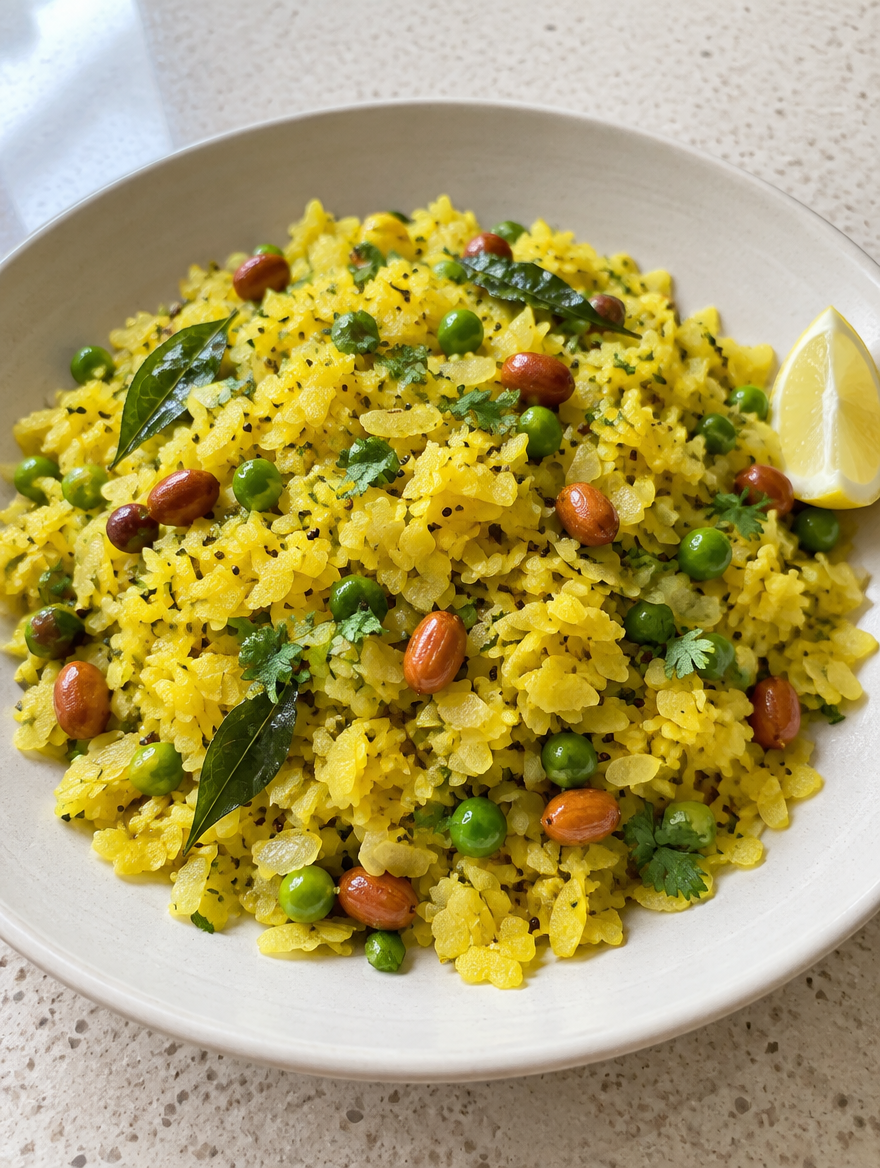
Vegetable poha is a savory Indian breakfast made from flattened rice flakes rather than the familiar long grains used for steamed rice or pilaf. The flakes become soft after a brief rinse, then get folded into a warm skillet of onion, mustard seeds, turmeric, green peas, curry leaves, and toasted peanuts. Fresh lemon juice at the end brightens the whole dish. The result should be tender but fluffy, with flakes that remain distinguishable instead of becoming a sticky paste.
Quick answer: rinse 2 cups of thick poha (about 180 g) briefly in a colander and let it drain for five minutes. Toast 1/4 cup of raw peanuts (about 35 g) separately, then gently cook 3/4 cup diced onion, 1/2 cup peas, 3/4 teaspoon mustard seeds, 8–10 curry leaves, and 1/2 teaspoon turmeric in 2 tablespoons neutral oil. Fold in the poha with 3/4 teaspoon fine salt, cover over low heat for 3–4 minutes, and finish with 1 1/2 tablespoons lemon juice, chopped cilantro, and the peanuts. Yield: four moderate breakfast portions. Prep is about 15 minutes and active cooking about 15 minutes.
This recipe is a new editorial formulation written with AI assistance and has not been independently kitchen-tested. Product thickness, skillet size, and burner strength may change the exact timing and water needs. Any accompanying image is a generated illustration, not a photograph of a documented kitchen test.
What Is Poha, and Why Is It Different From Rice Pilaf?
Poha refers to flattened rice and to dishes made with those flakes. In much of India, particularly western and central regions, savory poha dishes commonly combine onion, mustard seeds, curry leaves, peanuts, turmeric, and a squeeze of citrus. Families and regions prepare many variations, so this version is not presented as the one definitive or universally traditional recipe. It is a practical, vegetable-forward adaptation for an American kitchen that retains recognizable ingredients and cooking logic.
The important distinction is the rice itself. Poha flakes have already been processed and flattened; they are thin, broad, and able to absorb water surprisingly quickly. They do not need to simmer in a pot of measured liquid the way ordinary white rice would. Here, a short rinse and a covered, low-heat finish are enough to soften them. Trying to cook thick poha like dry jasmine rice with a full cup of boiling water is a reliable way to get a mushy mixture.
For a family breakfast, the dish offers something very different from eggs, pancakes, and oatmeal. It has savory warmth rather than sweetness, a light but noticeable lemon finish, and contrasting textures from soft rice flakes and toasted peanuts. It can also be served as a light lunch or after-school snack. The ingredient list does not include eggs, dairy, meat, fish sauce, or stock.
Ingredients for Four Servings
Use the following measured quantities for four moderate portions, not four oversized restaurant-size bowls.
- 2 cups (about 180 g) thick poha, also labeled thick flattened rice, thick beaten rice, or jada poha. Do not substitute thin or instant poha without adjusting the rinse.
- 1/4 cup (about 35 g) raw unsalted peanuts, or the same volume of plain dry-roasted unsalted peanuts if you want to skip the toasting stage.
- 2 tablespoons neutral cooking oil, such as canola or sunflower oil.
- 3/4 teaspoon black mustard seeds, not prepared yellow mustard.
- 8–10 fresh or frozen curry leaves, rinsed and thoroughly dried before they hit hot oil.
- 3/4 cup finely diced yellow onion, about one medium onion.
- 1/2 cup frozen green peas (about 75 g), thawed if possible.
- 1 small mild green chile, seeded and finely chopped, optional; omit for a completely mild family version.
- 1/2 teaspoon ground turmeric, for earthy flavor and a warm golden color.
- 3/4 teaspoon fine salt, then more only after tasting if needed.
- Up to 2 tablespoons water, only if the flakes seem dry during the covered finish.
- 1 1/2 tablespoons freshly squeezed lemon juice.
- 1/4 cup roughly chopped fresh cilantro, plus a few leaves if you want a simple finish.
Peanuts are not a minor decoration here: they add a distinctive crunchy contrast and their presence creates a major allergen. Do not serve this version to somebody with a peanut allergy. For a peanut-free variation you would have to verify every package and utensil, omit the peanuts, and recognize that the finished flavor and texture would change.
If fresh curry leaves are difficult to find in your local grocery store, check an Indian or South Asian market or a reputable frozen-food supplier. Curry leaves are not the same thing as curry powder. Replacing eight leaves with eight teaspoons of curry powder would make an entirely different dish; if the leaves are unavailable, it is better to explain that the aroma will be less traditional than to invent an equivalent.
Buying the Right Poha in the United States
The package may read thick poha, thick flattened rice, beaten rice, or jada poha. Choose a bag with relatively sturdy flakes; avoid an ultrathin variety if you are new to this technique. The flakes should be dry, distinct, and pale before cooking. Check that the package is intact, that there are no signs of moisture damage or pests, and that the use-by instructions are appropriate for the product.
You might also see thin poha or very fine flakes intended for different recipes. They absorb water faster and may fall apart after a rinse intended for thick poha. A traditional rice cooker is unnecessary for this recipe, and a package of ordinary long-grain white rice will not give the same result.
For measurement, a U.S. dry measuring cup works for a home recipe. Since flakes vary in shape, the approximate gram value is a guide rather than a laboratory standard. If you have a scale, you can weigh the amount from the package, note the brand, and repeat the same method next time. The recipe relies more on the soft-but-intact flake test than on an exact soaking minute.
Equipment and Preparation Before Turning on the Stove
Set out a medium-fine colander, a 10–12-inch wide nonstick or heavy-bottomed skillet with a lid, a cutting board, a knife, measuring cups and spoons, and a wide spatula. A slotted spoon or small bowl is useful for removing the roasted peanuts so they stay crisp. Have all aromatics chopped before you heat the oil: mustard seeds and curry leaves cook quickly, and you do not want to chop an onion while the seeds are burning.
Rinse the curry leaves and pat them dry. Water droplets meeting hot oil can splatter, so always handle leaves carefully and keep your face and hands clear of the skillet. Dice the onion into small pieces that will soften in a few minutes. If using a green chile, remove its seeds if you prefer less heat, then wash hands and utensils thoroughly after handling.
Measure the poha before rinsing it, keep the lemon for the end, and move the cilantro away from the hot pan so it stays fresh. The recipe has two brief stages: preparing the flakes and building the flavored skillet base. Both need attention, but neither requires complicated equipment.
How to Make Vegetable Poha Step by Step
1. Rinse Thick Poha Briefly
Transfer the two cups of thick poha to a colander. Run cool potable water over the flakes for about 15–25 seconds, gently lifting and turning them rather than scrubbing. Drain thoroughly and leave them in the colander for about five minutes. Pinch one flake between your fingertips: it should bend and feel soft enough to break, but it should not dissolve into paste. If it is still hard after draining, sprinkle on just a little water, wait a minute, and test again.
Do not leave the poha submerged in a bowl of water. Thick varieties differ by brand, so the feel of the flakes matters more than a rigid clock. This is the main step that prevents the finished breakfast from becoming gummy.
2. Toast the Peanuts
Place a wide skillet over medium heat. Add the 1/4 cup raw peanuts and stir frequently for roughly 3–5 minutes, until their aroma deepens and they begin to take on color. The exact time depends on the skillet and heat. Remove them to a clean bowl before they darken too far. They continue to firm up as they cool. If you chose plain dry-roasted unsalted peanuts, skip this step and reserve them for the finish.
Do not leave peanuts unattended, and do not assume a dark outside means the centers are ready. Gentle, frequent stirring gives a more even result than a blast of high heat. Keeping the peanuts out of the moist poha until the end also preserves their crunch.
3. Bloom the Mustard Seeds and Curry Leaves
Add 2 tablespoons neutral oil to the same skillet and reduce the heat to medium. When the oil is warm and shimmering but not smoking, add 3/4 teaspoon black mustard seeds. They should begin to pop or crackle. Carefully add the 8–10 dry curry leaves; shield yourself from splatter. Stir briefly, around 15–30 seconds, until the leaves are fragrant.
The pan should smell toasted and aromatic, never acrid or burned. If the seeds are scorching, pull the skillet away from the heat for a moment. Starting over is better than pouring burned spices into the rest of the breakfast.
4. Soften the Onion and Green Chile
Add 3/4 cup finely diced yellow onion and the chopped optional green chile. Cook for 4–5 minutes, stirring occasionally, until the onion softens and looks translucent with perhaps a little color at the edges. Avoid deep browning: the onion should be tender and sweet enough to fold evenly through delicate rice flakes.
For a mild version, omit the chile completely. You can serve hot sauce separately to adults who want it, without making the base dish too spicy for everyone. The dish does not require garlic or ginger in this particular formulation.
5. Warm the Peas and Add Turmeric
Stir in 1/2 cup green peas and cook for 2–3 minutes or until fully heated and tender; frozen peas must not remain icy in the middle. Sprinkle in 1/2 teaspoon ground turmeric and mix until it coats the onion and peas. The oil should turn a golden yellow, which will color the poha during the next step.
The peas add a fresh, slightly sweet bite. If you use canned peas instead, drain them very well and add them only long enough to warm through so they do not collapse. Use the frozen amount in the core recipe if you want repeatable timing.
6. Fold in Poha and Salt
Add the drained, softened poha to the skillet. Sprinkle 3/4 teaspoon fine salt across the surface and use a wide spatula to fold everything together with light lifting motions. Stop when the mustard seeds, curry leaves, vegetables, and golden seasoning look evenly distributed. Avoid vigorous mashing or stirring as if making risotto.
The flakes may look slightly irregular, which is correct. If they seem dry and firm, sprinkle in one tablespoon of water, not a large pour. Only add the second tablespoon if needed after a short wait. Too much liquid will destroy the separate, tender texture this dish is meant to have.
7. Cover for a Short Gentle Steam
Turn the heat to low and cover the skillet for about 3–4 minutes. The residual moisture from the rinsed poha, vegetables, and optional water helps the flakes heat through evenly. Lift the lid once near the end to check the consistency. A properly finished flake is soft and pleasantly warm, not crunchy in the center and not waterlogged.
If the skillet is very crowded or the burner runs hot, adjust the time. Do not assume a four-minute finish is a safety guarantee for all quantities or appliances. The food should be cooked and thoroughly hot when served.
8. Finish With Lemon, Cilantro, and Peanuts
Turn off the heat. Add 1 1/2 tablespoons fresh lemon juice, 1/4 cup chopped cilantro, and the reserved peanuts. Gently lift and fold a few times, then taste and adjust salt if necessary. The lemon should add brightness without drowning the other flavors. Serve immediately in warm bowls while the flakes are fluffy and the peanuts are crisp.
The peanuts go in last intentionally: if they cook under the lid for several minutes, they absorb moisture and lose much of their contrast. The same is true of the cilantro, which tastes fresher when added off the heat.
How Should Good Poha Look and Taste?
Finished poha is golden-yellow from turmeric, with flattened rice flakes that remain discernible. The onions should be soft and lightly sweet, peas tender, and peanuts crisp. Mustard seeds contribute tiny toasted pops; curry leaves give a distinctive aroma, and a restrained lemon finish prevents the dish from feeling heavy.
Poha is not meant to resemble a pile of separate long-grain basmati rice. It is also not supposed to look like mashed potatoes or very wet porridge. Because the flakes are soft and somewhat irregular, a little clustering is normal. Your goal is tender and loose, not perfectly grain-by-grain separation.
If you are introducing this breakfast to a family unfamiliar with Indian dishes, consider serving small portions alongside other options. A familiar savory breakfast such as our cheesy bacon and egg breakfast skillet offers a very different flavor and protein profile, while poha itself keeps the meal vegetarian in its core version.
The Five Biggest Mistakes That Make Poha Mushy
Soaking instead of rinsing. Flattened rice absorbs moisture quickly. A long bath that might seem logical for ordinary dry rice can damage poha before it ever reaches the skillet. Drain after a brief rinse and let residual moisture do the rest.
Choosing very thin flakes. Thin poha can be excellent for other snacks, but it behaves differently. For this method start with thick or medium-thick flakes. If your package says instant, follow its own manufacturer instructions rather than insisting on this recipe’s rinse schedule.
Using too much water during the covered step. A large splash can change the texture dramatically. Add moisture by the tablespoon only after checking the rice. The warm covered skillet is not a stockpot: it needs just enough steam to finish softening flakes already hydrated during rinsing.
Stirring hard after the flakes go in. Poha is fragile. Lift and fold with a broad spatula. The grains do not need to be beaten or continuously tossed. A few gentle passes can distribute seasoning without breaking the flakes apart.
Adding the peanuts too soon. Peanuts taste best with bite and crunch. Toast and reserve them, then fold them through after the heat is off. The finished dish will offer a more noticeable contrast and will be more visually appealing.
What if You Cannot Find Fresh Curry Leaves?
Curry leaves can be sold fresh or frozen in Indian grocery stores and some specialty markets. Use a small amount; they are aromatic and should blend into the seasoning rather than form a leafy salad. If you have frozen leaves, handle them carefully around hot oil because ice crystals can cause splattering.
There is no direct substitute that tastes identical. Curry powder is a spice blend and is not made simply by grinding curry leaves. If you omit the leaves, you can still make a pleasantly spiced onion-and-pea poha, but the aroma will differ. Tell readers what changed rather than claiming the same result.
When working with an unfamiliar ingredient, read the package. Some dried curry leaves are weak, others have more aroma, and the texture can remain firm even after brief frying. This recipe specifically describes fresh or properly stored frozen leaves.
Ways to Customize Your Skillet
Add diced carrots. For a more colorful vegetable mix, finely dice a small carrot and cook it with the onion until tender before adding the peas. A larger or harder vegetable may require more time, so adjust the sauté stage rather than expecting it to soften during a three-minute covered steam.
Adjust the heat. For children or people sensitive to spicy food, leave out the green chile. To make it warmer, use a little finely chopped chile but taste carefully. Different peppers can have very different heat levels even when they look similar.
Skip the peanuts when necessary. This substantially changes the texture, but it is possible to omit them if you are making a separate allergen-aware version. For a diagnosed peanut allergy, however, omission alone does not guarantee safety: verify packaged foods and cross-contact throughout preparation.
Add extra lemon at the table. People who enjoy a sharper finish can squeeze a little more lemon over their own serving. Keep the measured amount in the pan modest, because extra acid is a preference, not a structural requirement for poha.
Make a vegetable-forward lunch bowl. Poha need not be restricted to morning. Served right after cooking, it can make a simple light meal. Avoid claiming it offers a specific number of calories or grams of protein without calculating your particular ingredient brands and serving sizes.
Is Poha Good for Meal Prep?
It is best immediately after cooking because the delicate flattened-rice texture and toasted peanut crunch are most noticeable then. You can reduce morning work by dicing the onion ahead, measuring the dry seasonings, and keeping the peas frozen until needed. Store chopped vegetables safely in the refrigerator and toast peanuts only when you are ready to assemble.
Preparing the entire dish well ahead has a tradeoff: the flakes may become softer and the peanuts lose crunch. If you must save leftovers, transfer them to shallow clean containers and refrigerate promptly at 40°F (4°C) or lower, within two hours of cooking. Keep the peanuts separate when possible. Reheat leftovers thoroughly to 165°F (74°C), then finish with fresh lemon and cilantro; do not reheat the same batch repeatedly.
Rice dishes require careful handling. FoodSafety.gov’s guidance on Bacillus cereus highlights rice and prepared foods left for too long at room temperature as possible sources of illness and recommends cooling cooked food rapidly in shallow containers. Poha is made from rice flakes, so the same sensible time-and-temperature discipline matters here. A dish that smells normal is not proof that it was stored safely.
Do not leave the skillet out overnight and then serve it cold the next morning. Do not assume lemon juice sterilizes cooked rice. Refrigerate as soon as practical, and discard leftovers if you cannot confirm safe handling. This is a more useful breakfast habit than stretching storage time to save a small portion.
How Poha Fits Into an American Breakfast Routine
A bowl of savory flattened rice is a welcome alternative when the household has had enough syrup-heavy breakfasts. It is also easy to customize by setting out lemon wedges and fresh herbs separately. You can prepare the vegetables while coffee brews, rinse the poha as the skillet warms, and finish with a few minutes under the lid.
It is worth keeping expectations realistic: breakfast does not have to be the same type of meal for every family member. Someone who prefers a potato-forward brunch might enjoy our savory sweet-potato and bacon hash instead. Those are different recipes with different ingredients and cooking methods, and there is no reason to force them together into one skillet.
For grab-and-go mornings, our homemade chewy granola bars are a separate make-ahead option. Poha, by contrast, is at its best fresh and warm. When you have time for a skillet breakfast, its familiar onion, lemon, and peanut flavors make the ingredients approachable even if flattened rice is new to your pantry.
Frequently Asked Questions
What is the difference between thick and thin poha?
Thick poha has sturdier flattened rice flakes that tolerate a short rinse and a gentle finish in a covered skillet. Thin poha absorbs water faster and may turn mushy if treated with the same procedure. Buy thick poha for the most reliable result with this method.
Should I soak poha before cooking?
No. For thick poha, rinse briefly under cool water, drain thoroughly, and rest it for about five minutes. Test a flake between your fingers. It should soften and bend but hold its basic shape. Do not soak it in a deep bowl of water.
Can I make this breakfast without peanuts?
You can make an adapted version without peanuts, but the texture and taste change. If someone has a peanut allergy, inspect all ingredient labels and avoid cross-contact with peanut-containing foods or utensils. The recipe as written contains peanuts.
Can I use regular white rice instead of poha?
Not as a one-for-one substitution. Regular long-grain rice needs a different amount of liquid and cooking process. Using it will make a different breakfast dish, not this tender flattened-rice poha.
How spicy is this vegetable poha?
It can be very mild. The green chile is optional and can be omitted completely. Turmeric, mustard seeds, and curry leaves add flavor and aroma rather than the same heat as chopped hot peppers.
Can I add more vegetables?
Yes, but use small pieces and cook firm vegetables until tender before folding in the poha. Do not compensate by adding large amounts of water, or the rice flakes may collapse. Peas already provide color and a slightly sweet contrast in the core version.
Can I make poha the night before?
You can prep components the night before, but the whole cooked dish is better fresh. For leftover poha, promptly refrigerate in shallow containers and reheat thoroughly to 165°F. Toasted peanuts taste best if stored separately until serving.
Where can I buy poha in the United States?
Check Indian or South Asian grocery stores and the international aisle at some larger supermarkets. Look for packages labeled thick poha, flattened rice, or beaten rice. Read the package directions and ingredient/allergen labeling.
Is poha gluten-free?
Rice itself is naturally gluten-free, but a finished packaged product may have cross-contact or added ingredients. Do not promise that an entire meal is safe for someone with celiac disease unless the specific ingredients, seasonings, and preparation environment meet their needs.
Why do the peanuts go in at the end?
They remain more crunchy when they are not steamed along with the softened poha. Toast them separately, cool briefly, and add them after turning the heat off, along with lemon and cilantro.
Can I leave out curry leaves?
Yes, but you will lose one of the most characteristic aromas. Curry powder does not replace them in equal amounts. If you cannot find the leaves, prepare the dish without them and consider the flavor a simplified adaptation.
Can I freeze the finished poha?
Freezing may change the texture of these already softened flakes and make them more prone to clumping after thawing. This particular recipe has not been tested for freezing or reheating from frozen. For best texture, prepare it fresh rather than planning a freezer batch.
Final Tips for a Fluffy Indian Breakfast
Start with thick poha, give the flakes a brief rinse rather than a soak, and build flavor in the skillet before the rice goes in. Cook onions until tender, warm the peas, and coat everything in turmeric and mustard seed. Finish covered over low heat just long enough for the flakes to become warm and soft, then fold in lemon, fresh cilantro, and toasted peanuts. Keep the water addition small and controlled.
That sequence makes an approachable Indian-inspired breakfast for an American home cook while respecting the key flattened-rice technique. The recipe is intended as a practical editorial guide—not a claim of one universal Indian tradition, a physical kitchen test, or independently calculated nutrition.
Editorial disclosure: This is an original AI-assisted recipe formulation and has not been kitchen-tested by MySavorista. An image used with this article is an AI-generated illustration, not documentation of a prepared recipe. Ingredients and storage guidance should always be checked against the actual foods, equipment, and instructions used at home.
Print
Vegetable Poha With Peas and Peanuts
- Prep Time: 15 minutes
- Cook Time: 15 minutes
- Total Time: 30 minutes
- Yield: 4 servings 1x
- Category: Breakfast & Brunch Upgrades
- Method: Skillet stovetop; brief rinsing and low-heat steaming
- Cuisine: Indian-inspired
Description
Easy Indian-style vegetable poha breakfast with soft thick flattened rice flakes, green peas, toasted peanuts, onions, turmeric, curry leaves, and fresh lemon, finished in one skillet.
Ingredients
2 cups (about 180 g) thick poha (thick flattened rice flakes)
1/4 cup (about 35 g) raw unsalted peanuts, or plain dry-roasted unsalted peanuts
2 tablespoons neutral cooking oil
3/4 teaspoon black mustard seeds
8–10 fresh or frozen curry leaves, rinsed and thoroughly dried
3/4 cup finely diced yellow onion (about 1 medium onion)
1/2 cup (about 75 g) frozen green peas, thawed if convenient
1 small mild green chile, seeded and finely chopped, optional
1/2 teaspoon ground turmeric
3/4 teaspoon fine salt, plus more to taste if needed
Up to 2 tablespoons water, only if poha feels dry while steaming
1 1/2 tablespoons fresh lemon juice
1/4 cup chopped fresh cilantro
Instructions
Rinse thick poha in a colander under cool potable water for about 15–25 seconds, gently turning the flakes. Drain well for about 5 minutes, until a flake is soft when pressed but still intact; do not soak.
In a wide skillet, dry-toast raw unsalted peanuts over medium heat for about 3–5 minutes, stirring frequently until aromatic; transfer to a bowl. If using dry-roasted peanuts, reserve them without reheating.
Add neutral oil to the skillet over medium heat. Add black mustard seeds and allow them to pop, then carefully add dry curry leaves for 15–30 seconds; beware hot-oil splatter.
Add diced onion and optional green chile. Cook about 4–5 minutes, stirring, until onion softens and turns translucent.
Add green peas and cook about 2–3 minutes until heated and tender. Stir in the turmeric so the onion and peas are evenly coated.
Add drained softened poha and fine salt, lifting and folding gently without mashing the rice flakes. Sprinkle in 1 tablespoon of water only if the mixture seems dry; add no more than 1 extra tablespoon if truly needed.
Reduce heat to low, cover the skillet and let the poha warm and steam about 3–4 minutes until tender and thoroughly hot, not soggy. Check the flakes and adjust for the brand’s thickness and skillet heat.
Turn off heat. Fold in fresh lemon juice, chopped cilantro, and reserved toasted peanuts. Taste for salt and serve immediately. Promptly refrigerate leftovers in a shallow container at 40°F (4°C) or below within 2 hours and reheat thoroughly to 165°F (74°C) if served later.
Notes
Original AI-assisted editorial recipe; NOT independently tested in a physical kitchen. Image, when supplied, is an AI-generated illustration, not a record of an actual cooking test. Use thick poha, not long-grain rice or thin instant flakes. Rinse briefly rather than soaking. Contains peanuts: not appropriate for a peanut allergy; check packaged product labels and cross-contact. Curry leaves can splatter in hot oil; dry them well. For leftover rice/flakes, FoodSafety.gov describes Bacillus cereus risk from improperly held cooked rice; refrigerate promptly within 2 hours at or below 40°F, keep in shallow containers, and reheat leftovers thoroughly to 165°F. No nutrition calculation is claimed.
Nutrition
- Serving Size: 1 of 4 portions
Keywords: Indian breakfast poha recipe, vegetable poha, breakfast poha with peas and peanuts, thick flattened rice recipe