
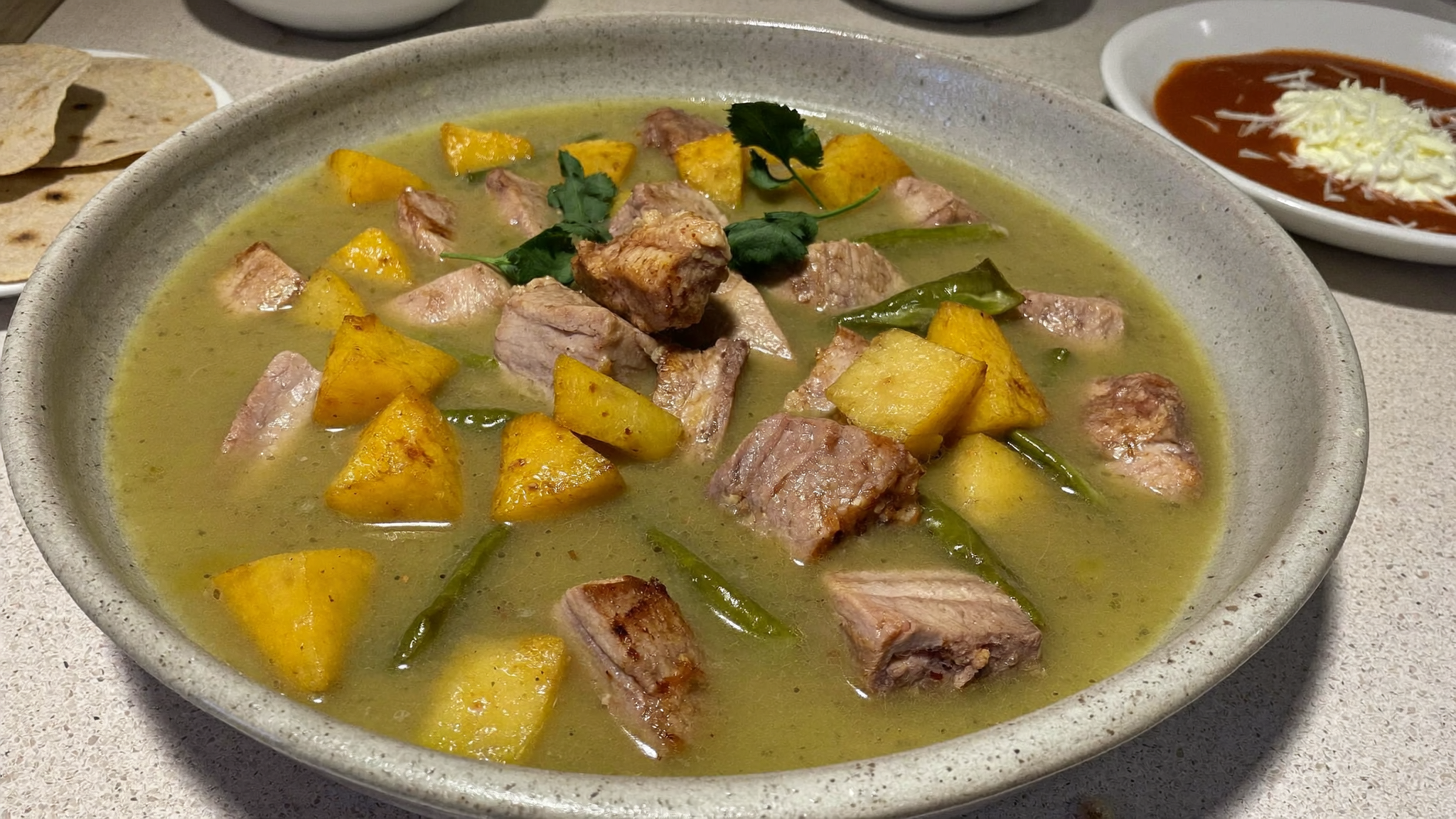
This green chile recipe turns roasted green chiles, pork shoulder, potatoes, onion and garlic into a thick, spoonable Southwest-style stew. The goal is a chile-forward bowl rather than a tomato-heavy chili: roasted green chile supplies most of the flavor, while tender pork and waxy potatoes give the broth enough body to feel substantial without a flour-thickened gravy.
The recipe is inspired by the long tradition of green chile stew in New Mexico, where roasted chile is a defining ingredient in home cooking. New Mexico Tourism publishes a classic stew built around meat, potatoes, stock and roasted green chile, while New Mexico State University documents how fresh chile is blistered, peeled and stored safely. This MySavorista version uses its own ingredient ratios and seasoning choices; it is not presented as a historic family recipe or as the single authentic formula.
For six moderate servings, plan on 1½ pounds boneless pork shoulder, about 2½ cups roasted peeled green chile, one pound Yukon Gold potatoes and four cups low-sodium chicken broth. The stew cooks gently until the pork is tender and the potatoes hold their shape. The formulation is original editorial work and has not been independently kitchen-tested, tasted or photographed by MySavorista, so timing and yield remain informed estimates that should be validated in an actual kitchen before any claim of firsthand testing.
Why green chile stew works for this keyword
Searchers using a broad phrase such as green chile recipe can mean sauce, stew, enchiladas or a dish made with roasted chile. A pork-and-potato stew is a useful primary answer because green chile remains the obvious central ingredient rather than a garnish. It also creates a complete meal that can be eaten from a bowl or spooned over rice, beans or a warm tortilla.
The official New Mexico tourism recipe for green chile stew uses meat, onion, garlic, potatoes, stock and a generous amount of green chile. That pattern supports the identity of the dish without requiring this article to duplicate another source’s exact measurements. Our version uses less salt, a clearly measured amount of chile and a different order of seasoning so readers can reproduce it consistently.
Green chile means the pepper, not a bowl of red chili
In New Mexican cooking, chile refers to the pepper itself. Green chile is harvested while the pods are green and commonly roasted so the skin can be removed before the flesh is chopped into dishes. A bowl of green chile stew should therefore taste primarily of roasted peppers, pork and savory broth rather than tomato sauce, kidney beans or chili powder.
That distinction matters for both flavor and images. The finished stew should look pale green to olive-gold with visible roasted chile pieces and potato cubes. It should not resemble a bright red Texas-style chili, a creamy white chicken chili or a tomatillo-heavy chile verde unless the recipe explicitly says so.
Ingredients for six servings
For the stew, prepare 1½ pounds boneless pork shoulder cut into roughly ¾-inch cubes, 1 teaspoon kosher salt plus more only after tasting, ½ teaspoon black pepper, 2 tablespoons neutral high-heat oil, 1 large yellow onion diced, 4 garlic cloves minced, 1½ teaspoons ground cumin and 1 teaspoon dried Mexican oregano or regular dried oregano.
You will also need 2½ cups roasted, peeled and chopped green chile, 1 pound Yukon Gold potatoes cut into ¾-inch cubes, 4 cups low-sodium chicken broth and 1 bay leaf. Keep ½ cup additional broth or water nearby in case the stew reduces more quickly than expected. Optional finishes are chopped cilantro and warm flour or corn tortillas served separately.
Choosing Hatch, Anaheim or another green chile
Fresh New Mexico-type chiles vary widely in heat. Hatch is a geographic designation associated with chile grown in New Mexico’s Hatch Valley, while Anaheim-style peppers are often milder and easier to find in supermarkets. For a family pot, choose a heat level you already know you enjoy instead of assuming every green pod is mild.
New Mexico State University recommends selecting chile that is fresh, firm, smooth and free of shriveling, mold or bruised soft spots. If you purchase already roasted chile, check the ingredient label and heat designation. Frozen roasted green chile can be practical because it gives you a consistent measured amount without requiring a home roasting session every time.
How to roast fresh green chiles
If starting with fresh peppers, wash and dry them, make a small slit so steam can escape, then blister them under a broiler or in a 400–450°F grill or oven environment. NMSU describes roughly 6–8 minutes of roasting with frequent turning as a typical range, but actual time depends on equipment and pepper size. The skin should blister broadly without the flesh turning completely black and dry.
Place roasted peppers in a heat-safe covered container for a few minutes so trapped steam loosens the skins. Once cool enough to handle, peel away the blistered skin, remove stems and most seeds, then chop. Wear gloves if the chiles are hot, avoid touching your eyes and clean the cutting board and knife afterward.
Using prepared roasted chile instead
Prepared frozen roasted green chile is the easiest substitute for freshly roasted peppers. Thaw it in the refrigerator, drain only excessive watery liquid and measure 2½ cups of chopped chile flesh. A little roasting juice is flavorful and can go into the pot; a large pool of water can dilute the stew.
Canned diced green chiles work in an emergency but are usually milder and softer. Because small cans contain relatively little chile, the flavor can become faint if you simply replace 2½ cups with one can. Measure by volume and choose a product with a simple ingredient list rather than guessing from package count.
Cut pork shoulder into even cubes
Trim only large, hard pieces of exterior fat and cut the pork into approximately ¾-inch cubes. Pork shoulder contains connective tissue and intramuscular fat that soften during a longer simmer, which makes it better suited to stew than a very lean cut that can become dry before the broth develops body.
Pat the pieces dry with paper towel, season with the measured salt and pepper and keep raw pork away from produce and cooked foods. Wash hands and utensils after handling it. Do not rinse raw pork in the sink, because splashing can spread microorganisms to nearby surfaces.
Brown the pork in batches
Heat one tablespoon of oil in a Dutch oven or heavy soup pot over medium-high heat. Add half the pork in a single uncrowded layer and let it brown on two or three sides, about 4–6 minutes total as an initial estimate. Transfer the browned pieces to a clean plate and repeat with the second tablespoon of oil and remaining pork.
The meat does not need to be fully cooked during browning; it will finish during the simmer. Crowding the pot can release enough moisture to steam the cubes rather than brown them. Dark golden fond on the bottom is useful, but burnt black residue will make the broth bitter and should not be treated as extra flavor.
Soften onion before adding garlic and spices
Reduce heat to medium and add the diced onion to the same pot. Cook for about 5 minutes, stirring and scraping up browned bits. If the pot is very dry, add a tablespoon of broth instead of pouring in much more oil. The onion should soften and become translucent around the edges without deeply caramelizing.
Add minced garlic, cumin and oregano and stir for about 30 seconds, just until fragrant. Garlic scorches quickly, so it belongs near the end of the sauté rather than at the beginning. Briefly warming the dried spices in the residual oil helps distribute them throughout the broth.
Build the broth around roasted chile
Return the browned pork and any collected juices to the pot. Add the 2½ cups roasted chopped green chile, four cups low-sodium chicken broth and the bay leaf. Stir to release any remaining fond from the bottom and bring the liquid just to a gentle boil.
Immediately lower the heat to maintain a steady simmer. A violent boil can make the pork tighten and break the chile and potatoes into a muddy texture. Partially cover the pot, leaving a small gap for steam, and simmer about 45 minutes before the potatoes go in.
Add potatoes after the pork has a head start
Yukon Gold potatoes hold their shape better than very starchy baking potatoes while still releasing enough starch to give the broth a little body. Cut one pound into roughly ¾-inch cubes so they cook at a similar rate. There is no need to peel thin-skinned potatoes unless you prefer a smoother appearance.
After the pork has simmered about 45 minutes, add the potato cubes. Continue simmering uncovered or partially covered for another 25–35 minutes, stirring occasionally, until the potatoes are tender and the pork is easy to bite. If the liquid drops below the solids too early, add some of the reserved ½ cup broth or water.
Use a thermometer, then cook for tenderness
FoodSafety.gov lists 145°F with a three-minute rest as the safe minimum for whole cuts of pork. Cubed shoulder in a stew will normally spend much longer at simmering temperature than the minimum required for safety. A thermometer can confirm the largest pieces have exceeded the safe threshold, but tenderness is a separate quality test.
Pork shoulder may be safe before its connective tissue has softened. Continue the gentle simmer until a cube can be cut easily with a spoon or fork and no chewy center remains. Do not use pink color alone as a safety test, and do not stop the entire stew at a fixed minute if the largest pieces are still tough.
How thick should green chile stew be?
The ideal texture is looser than gravy but thicker than plain broth. Potatoes release some starch naturally, and the chile flesh also adds body. If the stew looks thin after the pork and potatoes are tender, simmer uncovered for 5–10 additional minutes and stir more frequently so the bottom does not scorch.
If it becomes too thick, add warm broth or water a few tablespoons at a time. Avoid dumping dry flour directly into the pot because it can form lumps. A roux or slurry is unnecessary for this formula; the goal is a chile-rich broth with visible pieces rather than a smooth sauce.
Taste for salt only near the end
Roasted chile, broth and packaged ingredients can contain different amounts of sodium, so the recipe begins conservatively with one teaspoon kosher salt for the pork. Once the stew has reduced and the potatoes are tender, remove the bay leaf and taste the broth before adding more.
If the flavor seems flat rather than salty, a little more roasted chile or a pinch of oregano may help more than another large dose of salt. Keep optional cheese, salty tortilla chips and other garnishes separate, since they can make a properly seasoned bowl taste much saltier.
Serving ideas that keep the chile central
Serve the stew in warm bowls with chopped cilantro if desired. Warm corn or flour tortillas are a practical side for scooping up the broth. A small spoonful of sour cream can soften a very hot batch, but it is optional and should not cover the roasted-chile flavor.
For another fresh table component, MySavorista’s fresh tomato salsa with lime and cilantro can be served separately. The salsa is not stirred into this stew; keeping it on the side preserves the green chile identity and lets each person decide how much fresh acidity they want.
Pair the stew with grilled or roasted dishes
If you are building a larger Southwest-inspired meal, garlic-lime skirt steak works as a separate grilled main for guests who want another protein. It should not be mixed into the pork stew, since doing so would change the recipe and make the measured yield unreliable.
For a chicken option on another night, spicy chipotle chicken tacos with avocado cream provide smoky heat from a different chile profile. Linking these dishes helps readers navigate related flavors without pretending green chile, chipotle and jalapeño are interchangeable peppers.
Make-ahead and storage guidance
Like many stews, green chile pork stew can be cooked ahead and reheated, but cool it promptly rather than leaving a deep hot pot on the counter for hours. Divide leftovers into shallow containers so heat can escape more efficiently and refrigerate within two hours under normal room-temperature conditions.
FoodSafety.gov recommends reheating leftovers to 165°F. Add a splash of broth during reheating because potatoes continue absorbing liquid in the refrigerator. For best quality, use refrigerated portions within several days and discard food that shows signs of spoilage rather than relying on reheating to make unsafe storage acceptable.
Freezing roasted chile versus freezing the finished stew
NMSU notes that roasted green chile is commonly frozen and should be chilled promptly before freezing. If you buy a large autumn batch of roasted chile, freezing measured portions gives you a convenient base for later stew without needing to freeze an entire pot.
The finished stew can also be frozen after cooling, though potato texture may become a little softer after thawing. Use freezer-safe containers with room for expansion, thaw in the refrigerator and reheat thoroughly. Do not use this stew recipe as a home-canning formula; shelf-stable canning requires separately tested pressure-canning instructions.
What makes this New Mexico-inspired rather than strictly traditional
Green chile stew is strongly associated with New Mexico, but households differ on meat, tomatoes, potatoes, corn and seasoning. The New Mexico Tourism recipe allows pork or beef and includes optional vegetables. This MySavorista formula keeps pork shoulder and potatoes at the center, omits tomatoes and uses cumin and oregano in restrained amounts.
Calling it New Mexico-inspired acknowledges that lineage without claiming a family or regional authority we do not have. Readers interested in regional context can consult the New Mexico Tourism green chile stew and the NMSU guide to processing fresh chile peppers.
Food-safety and editorial transparency
Use separate cutting surfaces for raw pork and ready-to-eat vegetables, wash hands after raw-meat handling and verify safe pork temperature with a food thermometer. FoodSafety.gov’s temperature chart is the reference for minimum internal temperatures and reheating leftovers.
This article is an original source-informed editorial recipe. MySavorista has not independently cooked, tasted or photographed this exact formula. The ingredient ratios, cooking ranges and yield should therefore be validated in a real kitchen before they are represented as firsthand test results. Any future AI-generated image must be disclosed as illustrative and must match the measured pork, potatoes and roasted green chile rather than inventing unrelated toppings.
Frequently asked questions about green chile stew
What is a good green chile recipe for dinner?
A pork-and-potato green chile stew is a practical dinner because roasted chile is the central flavor and the pork and potatoes make it a complete bowl. This version serves about six.
What kind of green chile should I use?
Use roasted New Mexico-style green chile, Hatch chile, Anaheim-type peppers or another roasting chile at a heat level you enjoy. Freshly roasted, frozen roasted or well-drained prepared chile can work.
How much roasted green chile goes into the stew?
This recipe uses 2½ cups of roasted, peeled and chopped green chile for 1½ pounds pork shoulder and four cups broth. The chile should remain prominent after simmering.
Can I use canned diced green chiles?
Yes, but measure by volume because small cans are much milder and softer than freshly roasted chile. Use enough to approach the 2½-cup target rather than substituting a single small can.
Do I have to peel roasted green chiles?
For fresh roasted chile, the blistered outer skin is normally removed. NMSU specifically recommends blistering and peeling because the tough skin affects texture.
How spicy is green chile stew?
Heat depends almost entirely on the chile variety and batch. Choose mild, medium or hot roasted chile according to your tolerance and taste before adding extra peppers.
Can I make green chile stew without pork?
You can develop a chicken, beef or bean variation, but cooking times and food-safety endpoints change. This specific formula is measured around boneless pork shoulder.
Why add potatoes later instead of at the beginning?
Pork shoulder needs a longer simmer to become tender. Adding potatoes after about 45 minutes lets them cook through without dissolving before the pork is ready.
What temperature should pork reach?
FoodSafety.gov lists 145°F with a three-minute rest for whole cuts of pork. In this stew, cubed shoulder continues simmering beyond the safety minimum until it is tender.
How do I thicken green chile stew?
Let the potatoes release some starch and simmer the uncovered finished stew for several minutes. This version does not require a flour roux or cornstarch slurry.
Can I freeze this green chile recipe?
Yes. Cool the stew promptly, portion into freezer-safe containers and thaw in the refrigerator. The potatoes may soften slightly after freezing and reheating.
Has MySavorista kitchen-tested this recipe?
No. It is an original editorial formulation informed by established green chile techniques and food-safety sources, not an independently cooked or tasted MySavorista test-kitchen result.
Print
Green Chile Recipe: New Mexico-Style Pork Stew
- Prep Time: 25 minutes with prepared roasted chile; add roasting/cooling time if starting from fresh chiles
- Cook Time: About 1 hour 20 minutes to 1 hour 35 minutes
- Total Time: About 1 hour 50 minutes with prepared roasted chile
- Yield: 6 moderate servings 1x
- Category: Global Flavors & Street Food
- Method: Brown pork, simmer with roasted green chile and broth, then finish with potatoes
- Cuisine: New Mexico-inspired American Southwest
Description
A green chile pork stew with roasted green chiles, tender pork shoulder, Yukon Gold potatoes, onion, garlic and a light Southwest-style broth.
Ingredients
1½ lb (680 g) boneless pork shoulder, cut into about ¾-inch cubes
1 tsp kosher salt, plus more only after tasting
½ tsp freshly ground black pepper
2 tbsp neutral high-heat oil, divided
1 large yellow onion (about 200 g), diced
4 garlic cloves, minced
1½ tsp ground cumin
1 tsp dried Mexican oregano or regular dried oregano
2½ cups roasted, peeled and chopped green chile, mild to hot as preferred
1 lb (454 g) Yukon Gold potatoes, cut into about ¾-inch cubes
4 cups low-sodium chicken broth
1 bay leaf
Up to ½ cup additional broth or water only if needed during simmering
Optional for serving: chopped cilantro and warm corn or flour tortillas
Instructions
Pat pork shoulder cubes dry and season with 1 tsp kosher salt and ½ tsp black pepper. Keep raw pork and its utensils separate from ready-to-eat ingredients.
Heat 1 tbsp oil in a Dutch oven over medium-high. Brown half the pork in a single layer for roughly 4–6 minutes total, turning to color multiple sides, then transfer to a clean plate. Repeat with remaining oil and pork.
Reduce heat to medium. Add diced onion and cook about 5 minutes, stirring and scraping browned bits, until softened. Add garlic, cumin and oregano and stir about 30 seconds until fragrant.
Return browned pork and collected juices to the pot. Add 2½ cups roasted chopped green chile, 4 cups low-sodium chicken broth and the bay leaf. Scrape the pot bottom and bring just to a gentle boil.
Reduce to a steady simmer, partially cover and cook about 45 minutes. Do not maintain a violent boil.
Add the 1 lb diced Yukon Gold potatoes. Continue simmering 25–35 minutes, stirring occasionally, until potatoes are tender and pork is easy to bite. Add some reserved ½ cup broth or water only if the liquid reduces too far.
Verify the largest pork pieces have exceeded the FoodSafety.gov minimum of 145°F (63°C); continue cooking beyond the safety minimum until shoulder pieces are tender. Do not rely on color alone.
Remove the bay leaf. If the stew is too thin, simmer uncovered another 5–10 minutes. If too thick, add warm broth a few tablespoons at a time.
Taste only after the pork is fully cooked. Adjust salt conservatively and add more roasted chile if a stronger chile flavor is desired.
Divide into six warm bowls. Add cilantro only if desired and serve tortillas separately so the stew remains chile-forward.
Cool leftovers promptly in shallow containers and refrigerate within two hours. Reheat leftovers to 165°F (74°C).
Notes
This is an original MySavorista editorial formulation inspired by New Mexican green chile stew traditions; it has NOT been independently kitchen-tested or tasted by MySavorista. Fresh green chiles should be blistered, peeled and handled according to NMSU guidance; wear gloves with hot varieties and refrigerate roasted chile promptly. Pork shoulder cubes must reach at least the FoodSafety.gov safe pork threshold and should continue simmering until tender. Do not use this stew as a home-canning recipe. AI-generated images, if authorized later, must be disclosed as illustrative and show the actual measured dish: roasted green chile, pork and potato stew, not red chili, tomatillo salsa, white chicken chili or decorative cheese-heavy toppings.
Nutrition
- Serving Size: About 1½ cups stew, depending on final reduction
Keywords: green chile recipe, green chile pork stew, New Mexico green chile stew, roasted green chile stew