
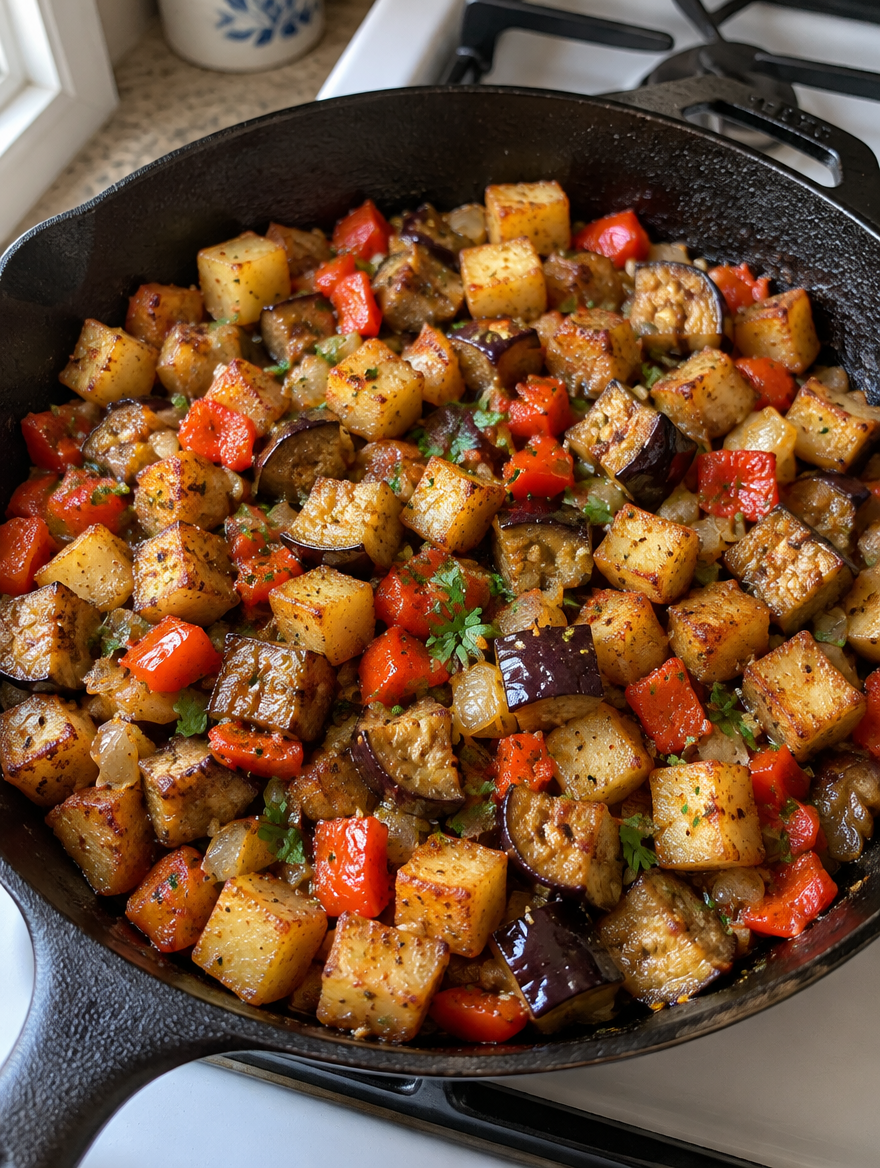
This eggplant and potato breakfast hash turns an everyday vegetable into something wonderfully practical for a savory morning meal. Yukon Gold potatoes supply crisp golden edges, diced eggplant becomes tender and browned, and red bell pepper adds color and a little sweetness. A small amount of smoked paprika, thyme, garlic, and lemon brings the skillet together without the need for bacon, sausage, eggs, or cheese.
Quick answer: cut 1 pound Yukon Gold potatoes and 12 ounces eggplant into even 1/2-inch pieces. Briefly simmer the potatoes for 6–8 minutes, drain and dry them, then brown them in a large skillet with a portion of 3 tablespoons olive oil. Cook eggplant separately until the cubes are tender and golden, sauté diced red bell pepper and onion, and combine everything with smoked paprika, thyme, garlic, salt, and black pepper. Finish with a little fresh lemon and chopped parsley. Serve hot in four moderate portions. Expect approximately 15 minutes of preparation and 35 minutes of cooking, with times varying by stove and skillet.
This is an original AI-assisted editorial recipe formulation. It has not been independently kitchen-tested, so check actual vegetable tenderness and cooking temperature rather than relying on an exact number of minutes. Any image accompanying the recipe is an AI-generated illustration and not a photograph of an independently performed kitchen test.
Why Eggplant Works in a Breakfast Skillet
Eggplant is often treated as a dinner vegetable, but it can work in a breakfast hash when it is cooked carefully. Its flesh softens and takes on a lightly browned surface in the pan, while the darker purple skin provides a visible contrast to the golden potatoes. Cutting the pieces small enough helps them cook in a reasonable amount of time, and avoiding a crowded skillet helps excess moisture escape.
The potato is the structural partner. Yukon Gold potatoes can develop golden faces while staying tender within, especially when partially cooked before pan-browning. Unlike a classic hash-brown patty, this dish uses clearly recognizable diced pieces. The pepper and onion soften into the spaces between them, creating a savory skillet that tastes satisfying without requiring heavy sauces.
This is not meant to replace every familiar American breakfast. If you want a meat-and-egg preparation, our cheesy bacon and egg breakfast skillet follows a different flavor and ingredient approach. The eggplant hash is a vegetable-focused option for people who enjoy a more savory plate, whether they eat it as a main portion or beside something prepared separately.
Ingredients for Four Servings
Use one large 12-inch skillet if you have it; a smaller skillet will need separate batches.
- 1 pound (about 450 g) Yukon Gold potatoes, scrubbed and cut into 1/2-inch cubes.
- 12 ounces (about 340 g) firm eggplant, roughly one small or part of a large eggplant, cut into 1/2-inch cubes with skin on.
- 1 medium red bell pepper (about 180 g), seeded and diced.
- 1 small yellow onion (about 100 g), finely diced.
- 2 garlic cloves, finely minced.
- 3 tablespoons olive oil, divided for the different cooking stages.
- 1 teaspoon smoked paprika, mild rather than hot.
- 1/2 teaspoon dried thyme.
- 3/4 teaspoon fine salt, divided and adjusted after tasting.
- 1/4 teaspoon freshly ground black pepper.
- 1 teaspoon freshly squeezed lemon juice, added after cooking.
- 2 tablespoons fresh flat-leaf parsley, chopped for finishing.
The measurements are intended to give roughly equal attention to potatoes and eggplant. A red bell pepper provides enough color without making the hash primarily a pepper dish. The lemon quantity is deliberately small: it should lift the vegetables, not turn the skillet into a wet citrus salad.
There are no eggs, dairy, peanuts, bacon, chicken, fish, or commercial sauce in the core ingredient list. That does not guarantee allergy safety: purchased spices and other ingredients may be processed in shared facilities, and a home kitchen can have cross-contact. Always check the product packages and individual dietary needs.
Choose Eggplant That Will Brown, Not Collapse
Look for an eggplant that feels firm for its size, with a smooth intact exterior and no large soft patches. The skin can stay on because it helps smaller pieces keep some structure. Trim the stem end and cut the flesh into cubes roughly the same size. If one piece is twice as big as another, it will need more time to soften.
Older or especially large eggplants can be seedy. You can trim away a small area of unusually tough or spongy flesh, but there is no need to discard most of a healthy vegetable. You also do not have to salt the cubes for half an hour for this specific small-batch recipe: thorough drying and measured oil are more useful for achieving a browned skillet surface.
Eggplant behaves differently from a potato. It can absorb oil quickly and release moisture as it heats. Rather than pouring in more oil whenever the pan looks dry, keep the pieces in a broad, fairly even layer and let them brown before turning. The full recipe uses only three tablespoons of oil divided across the potato and vegetable stages; do not interpret that amount as three tablespoons for each batch.
Why Par-Cook the Potatoes First?
Raw 1/2-inch potato cubes take time to soften through in a skillet, and trying to accelerate that by adding lots of oil can produce dark exteriors with hard centers. A short simmer followed by thorough drying makes it easier to build a golden surface without keeping the eggplant over heat for too long.
Put the diced potatoes in a saucepan of cool water, bring to a gentle simmer, and cook 6–8 minutes or until a fork begins to enter the pieces with light resistance. They should not fall apart. Drain them and leave them spread out for a few minutes to let steam escape. Dry surfaces brown more reliably than wet ones.
A major advantage is control: the potatoes can become crisp in their own stage, and the eggplant can become tender in a separate stage. They are brought together only at the end, so neither ingredient has to endure the entire cooking time of the other.
Kitchen Equipment and Set-Up
Use a sharp knife, a stable cutting board, a medium saucepan, a strainer, a wide 12-inch heavy-bottomed skillet, and a broad spatula. A cast-iron skillet is useful if properly seasoned, but stainless steel or a good nonstick skillet works with the right heat. Have a medium bowl ready to hold the browned potatoes or eggplant temporarily.
Wash and dry eggplant, pepper, and parsley. Scrub the potatoes under running water and cut away any damaged portions. Discard potatoes with extensive green areas or sprouts; do not rely on browning to correct an unsuitable ingredient. Chop the onion and garlic before the oil goes into the skillet because garlic burns quickly at high heat.
Leave enough room in the pan for vegetables to touch the cooking surface. If your skillet is only 8 inches wide, cook potatoes and eggplant in two smaller batches rather than piling everything into a deep heap. Crowding traps steam and makes the result taste more like boiled vegetables.
How to Make Crispy Eggplant Breakfast Hash
1. Scrub, Dice, and Simmer the Potatoes
Scrub 1 pound Yukon Gold potatoes and cut them into approximately 1/2-inch cubes. Put them into a saucepan with enough cool water to cover and bring to a gentle simmer. Cook for 6–8 minutes, checking a piece with a fork: it should begin to soften but remain intact. Avoid a rolling boil that breaks the cubes apart. Drain well and let them steam-dry on a clean tray or in the open strainer for a few minutes.
The goal is partially cooked, not mashed. Slightly firm centers will finish in the skillet. If the cubes crumble when stirred, they were simmered too long and will not form the clean hash pieces described in this recipe.
2. Brown the Potato Cubes
Heat a wide skillet over medium to medium-high heat and add 1 1/2 tablespoons olive oil. Once the oil is hot but not smoking, arrange the drained potatoes in a single layer. Let them rest against the skillet for a few minutes before turning so one side can develop color. Continue cooking for about 7–9 minutes, turning gently, until multiple faces look golden and the centers are tender. Transfer to a clean bowl.
Salt will be added across the cooking stages; resist the urge to pour the entire amount into the potato pan immediately. The potatoes will get another chance to pick up seasoning when everything returns to the skillet.
3. Sauté the Eggplant Separately
Add 1 tablespoon olive oil to the warm skillet and spread the 12 ounces of diced eggplant in a broad layer. Cook over medium-high heat for around 8–10 minutes, turning periodically, until the cubes are browned in places and the interiors are fully tender. The purple skin should still be visible on some pieces, while the pale flesh turns tan and soft.
If the eggplant releases water, allow that moisture to evaporate instead of covering the pan. If the pan becomes dangerously dry or scorches, reduce the heat. Do not add a continuous stream of oil: the measured recipe is designed for a modest amount. Transfer the eggplant to the potato bowl or a second clean bowl.
4. Soften the Pepper and Onion
Add the remaining 1/2 tablespoon olive oil to the skillet. Put in the diced red bell pepper and yellow onion and cook for about 5–7 minutes over medium heat until the onion is translucent and the pepper is tender with a little bite left. Stir enough to prevent burning but allow occasional contact with the hot pan.
The pepper may become slightly glossy and the onion edges lightly golden. That is desirable; a thick tomato sauce or liquid mixture is not part of the recipe. If the pan has browned bits from earlier stages, the moisture in the vegetables may help release them as you stir.
5. Season With Garlic, Paprika, and Thyme
Reduce the heat slightly. Add the 2 minced garlic cloves, 1 teaspoon smoked paprika, and 1/2 teaspoon dried thyme. Stir for 30–45 seconds until fragrant. Do not let the garlic turn dark brown or black. Sprinkle in a portion of the 3/4 teaspoon fine salt and the 1/4 teaspoon black pepper.
Smoked paprika creates an earthy, lightly smoky note without the need for bacon or smoke flavoring. The seasoning should coat the vegetables, not gather in a dry clump in one corner of the skillet. If it begins to burn, briefly pull the pan off the burner before continuing.
6. Return the Potatoes and Eggplant
Fold the browned potato and eggplant cubes back into the skillet. Use a broad spatula to distribute the seasoning without smashing the vegetables. Cook together over medium heat for about 2–3 minutes, just until everything is hot and the flavors have mingled. Taste one potato and one eggplant cube for salt and adjust only as necessary.
The finished hash should be mostly dry, with browned faces and soft interiors. If the eggplant is still raw-firm, continue cooking until tender rather than trusting a fixed clock. If the pan appears wet, cook uncovered for a little longer to reduce the moisture.
7. Finish With Lemon and Parsley
Turn off the heat and drizzle 1 teaspoon fresh lemon juice over the vegetables. Scatter 2 tablespoons chopped flat-leaf parsley and fold once or twice. The lemon should barely register as citrus; it balances the savory potatoes and eggplant without turning them soggy.
Adding parsley after the heat is off keeps the garnish fresh. You do not need cheese, cream, a fried egg, or an extra side salad to make the skillet look complete. The vegetables themselves are the feature.
8. Serve the Hash Hot
Spoon the hash into four warm bowls or bring the skillet to the table on a heatproof mat. Serve while the potato edges are still crisp and the eggplant is tender. If this is part of a larger brunch, keep accompaniments separate so the hash maintains its distinctive texture. Refrigerate leftovers promptly in shallow containers rather than leaving the skillet on the stove until the next meal.
How to Tell When Everything Is Cooked Properly
The potatoes should offer a tender center when pierced with a fork, with at least some browned edges. The eggplant should be soft and cooked through, not rubbery or raw-tasting. Bell pepper should be tender but still identifiable, and onion should no longer have a harsh raw bite.
Color is helpful but not the only test. Eggplant may darken at the surface before its center softens; a thicker cube might need additional minutes. Potatoes may become golden while remaining firm if they were not adequately par-cooked. Taste a small properly cooled sample and use the fork test, not just appearance.
The pieces do not have to be perfectly even. A slightly irregular homemade hash is normal, and some potato faces may be deeper gold than others. The essential distinction is between browned and tender versus dark outside but hard inside.
Why Your Breakfast Hash May Turn Soggy
The most common cause is crowding. If potatoes and eggplant are stacked three layers high, moisture cannot escape and the vegetables steam rather than brown. A wide skillet or two short batches are more effective than turning up the heat dramatically. High heat in a crowded pan can burn a few exposed pieces while the middle remains wet.
Another cause is insufficient drying after simmering the potatoes. Drain them thoroughly, spread them out if needed, and let steam evaporate before they hit the oil. Wet potato cubes splatter and have to shed their surface moisture before they can brown well.
Eggplant also naturally releases some moisture during cooking. Leaving the skillet uncovered for that stage helps it evaporate. Do not add broth, canned tomatoes, or extra water unless you intentionally want a different dish. This breakfast hash is not a vegetable stew.
Finally, avoid aggressive stirring. If you keep scraping all pieces every few seconds, they do not have a chance to develop a browned face. Give them contact time, then turn carefully.
Ways to Vary This Eggplant Recipe
Use a different potato. Red-skinned potatoes can work, but their moisture and starch characteristics are not exactly the same as Yukon Gold. Check the tenderness during the brief simmer and expect some adjustment. Russet potatoes tend to be more starchy and can break more easily when stirred.
Make it a touch spicy. A pinch of cayenne or crushed red pepper can be added with the smoked paprika. Start small, especially for a family breakfast. This changes heat but does not require different cooking equipment.
Try yellow bell pepper. A yellow pepper can replace the red one by weight. It may be slightly less visible against the golden potatoes, but the method is otherwise similar. Do not add several large peppers without using a bigger skillet or cooking in batches.
Use fresh thyme. A few fresh thyme leaves can be a pleasant variation; they are not a direct teaspoon-for-teaspoon match with dried thyme. Add them late enough to preserve their fragrance and remove any woody stems.
Serve with a separate protein. Some families may like eggs or another protein dish alongside the hash. If you prepare eggs, follow applicable cooking-safety guidance. The recipe as written does not contain eggs, and a photo or Tasty card for it should not show or claim an egg garnish.
A Breakfast Hash Versus a Sweet Potato Skillet
The word hash describes a broad style of chopped ingredients cooked together; it does not dictate bacon, sausage, or a particular potato. This recipe uses ordinary Yukon Gold potatoes and eggplant with red pepper. It has a smoky-savory profile and a relatively dry pan finish.
Our savory sweet-potato and bacon hash is a different breakfast idea, with sweeter potatoes and bacon. That dish should not be confused with the ingredient list here. Choose according to your family’s preferences rather than trying to merge both recipes without recalculating the quantities and cooking times.
There is also a difference between a breakfast hash and a vegetable side dish. You can serve this at lunch or dinner, but its small bite-size pieces and straightforward skillet method make it especially convenient for a savory brunch. The recipe is designed to be eaten warm and fresh rather than soaked in dressing.
Can You Prepare Anything the Night Before?
You can safely chop the bell pepper and onion in advance and keep them in a clean, sealed container in the refrigerator. The potato cubes are best prepared shortly before cooking, because cut potatoes can discolor and require a different storage approach. Eggplant flesh also browns after cutting, so it is simplest to dice it just before cooking.
If you need to save time, measure the smoked paprika and thyme ahead and prepare a clean serving bowl. You can also scrub the potatoes the evening before, dry them, and refrigerate them whole. The actual pan cooking is best done close to serving so you do not lose the golden potato edges.
For other breakfast choices with a different texture, our cottage-cheese scrambled eggs
Storing and Reheating Leftovers Safely
A freshly cooked hash is best served immediately, but you may have an extra portion. Move leftovers into shallow, clean containers and refrigerate them promptly at 40°F (4°C) or below, within two hours after cooking; in very hot conditions above 90°F, use the stricter one-hour window. Do not leave a warm skillet full of cooked vegetables on the stove overnight.
The FoodSafety.gov Four Steps to Food Safety
If you reheat leftovers, bring them to 165°F (74°C) and make sure the center is hot. A lightly oiled skillet can restore some crispness to the potatoes, but the texture will not be identical to fresh cooking. Reheat only the portion you need, and discard food if safe handling cannot be confirmed. Smell alone is not a reliable food-safety test.
For a conservative home-cooking approach, use properly chilled leftovers within 3–4 days as a general guideline for cooked dishes, or sooner if the actual ingredients or circumstances require. This recipe has not undergone microbiological storage testing, so no special extended shelf-life claim is made.
What to Serve Alongside Eggplant Breakfast Hash
The hash is flavorful enough to stand alone as a vegetable-forward plate. If you’re planning a larger weekend breakfast, you can put fresh fruit or separately prepared foods on the table for guests to choose. There is no need to add random greens, sauce, or a second protein directly to the skillet.
For another make-ahead breakfast style, our homemade chewy granola bars
When serving a crowd, use two skillets instead of trying to multiply ingredients into a pan that cannot hold them. More space helps the vegetables brown and reduces the amount of time they sit over heat. Cover the finished food only briefly before service; a sealed cover traps steam and softens the crisp potato faces.
Frequently Asked Questions
Do I need to peel the eggplant?
No. Tender, intact eggplant skin provides visual contrast and helps smaller cubes hold their shape. Wash the vegetable, remove the stem, and trim any damaged patches. Peeling is optional, but the cooked pieces will look less distinct next to potatoes.
Should I salt eggplant before cooking?
Not necessarily for this recipe. Dicing and cooking in a wide skillet are usually enough to soften a firm eggplant. If you use a very large or unusually wet eggplant, you may choose to salt and pat it dry, but that changes prep time and seasoning needs.
Can I use frozen eggplant?
Frozen eggplant often contains more released moisture after thawing and may not brown as neatly. This formula was designed around fresh, firm eggplant. If using frozen, drain it thoroughly and expect a softer result rather than the same crisp-edged hash.
Do I have to boil the potatoes first?
A short 6–8 minute simmer is recommended so the cubed potatoes soften before pan-browning. Skipping it requires additional skillet time and may make it harder to keep the eggplant from overcooking. Do not substitute the full cooking process without adjusting the method.
What is the best skillet for this recipe?
A wide 12-inch heavy-bottomed skillet offers more direct surface contact for browning. Cast iron, stainless steel, or nonstick can work when managed at appropriate heat. Smaller skillets require batches to avoid trapping steam.
Why is the eggplant absorbing all the oil?
Eggplant has a porous interior and readily takes up fat. Keep oil measured, spread pieces out, and let the surface brown. Avoid adding a new pour every time the skillet appears dry; reduce heat if scorching instead.
Can I make this hash without onions?
Yes, but the flavor will be less rounded. You could use a modest amount of another aromatic, such as a little additional bell pepper, but that is a variation and won’t taste identical to the original formulation.
Is this an egg-free breakfast?
Yes, the ingredients in the core skillet contain no eggs. That does not guarantee suitability for an egg allergy if cross-contact occurs, especially when preparing a separate egg dish alongside it. Check every actual ingredient and cooking surface.
Is the hash gluten-free?
The listed unprocessed vegetables and common spices do not inherently require gluten-containing grains, but commercial spice blends or shared kitchens may introduce cross-contact. Do not promise allergen safety without checking product labels and preparation conditions.
Can I roast everything on a sheet pan instead?
A sheet-pan hash can be made as a different recipe, but roasting times and oil distribution need adjustment. This version is formulated around par-simmered potatoes and separate skillet cooking stages that preserve browned vegetable edges.
How do I keep leftovers from becoming soggy?
Cool promptly, refrigerate in shallow containers, and reheat the portion you need in a skillet. Some softening is unavoidable. Do not leave cooked potatoes and eggplant uncovered at room temperature to try to preserve crispness.
Is eggplant a good vegetable for brunch?
It can be, particularly for people who enjoy savory vegetables with potatoes. Its mild flavor takes well to smoked paprika, garlic, and onions. The benefit here is a satisfying vegetable-based skillet, not a claimed medical or weight-loss effect.
Final Tips for a Golden Breakfast Hash
Cut potatoes and eggplant into similar-sized cubes but cook them in separate stages. Simmer potatoes until just beginning to soften, dry them, and brown them before the eggplant enters the pan. Give eggplant enough surface area to brown without trapping moisture, then soften the onion and red pepper and fold everything together with mild smoked paprika, thyme, garlic, and a tiny lemon finish.
That process creates a crispy-edged potato and tender eggplant breakfast hash without meat, cheese, or eggs in the base recipe. Follow actual tenderness rather than a rigid clock, keep the pan from overcrowding, and refrigerate leftovers promptly.
Editorial transparency: This original recipe was developed with AI editorial assistance and has not been independently cooked or kitchen-tested. Any featured image is AI-generated illustration and does not document a physical cooking session; nutrition values have not been independently calculated or verified.
Print
Crispy Eggplant and Potato Breakfast Hash
- Prep Time: 15 minutes
- Cook Time: 35 minutes
- Total Time: 50 minutes
- Yield: 4 servings 1x
- Category: Breakfast & Brunch Upgrades
- Method: Stovetop, briefly simmered potatoes and separately browned skillet vegetables
- Cuisine: American-inspired vegetable breakfast
Description
Golden crisp-edged Yukon Gold potatoes and tender browned eggplant with red bell pepper, onion, garlic, smoked paprika, thyme and a fresh lemon-parsley finish, cooked separately then combined in one skillet.
Ingredients
1 pound (about 450 g) Yukon Gold potatoes, scrubbed and cut into 1/2-inch cubes
12 ounces (about 340 g) firm eggplant, stem removed and cut into 1/2-inch cubes with skin on
1 medium red bell pepper (about 180 g), seeded and diced
1 small yellow onion (about 100 g), diced
2 garlic cloves, finely minced
3 tablespoons olive oil, divided
1 teaspoon mild smoked paprika
1/2 teaspoon dried thyme
3/4 teaspoon fine salt, divided, plus to taste
1/4 teaspoon freshly ground black pepper
1 teaspoon fresh lemon juice
2 tablespoons chopped fresh flat-leaf parsley
Instructions
Scrub and dice Yukon Gold potatoes into approximately 1/2-inch cubes. Place in cool water, bring to a gentle simmer, cook about 6–8 minutes until barely fork-tender but still intact; drain and steam-dry for several minutes.
Heat a wide 12-inch skillet over medium to medium-high heat; add 1 1/2 tablespoons olive oil and spread potatoes in a layer. Cook around 7–9 minutes, turning gently until several sides are browned and potatoes are tender. Transfer to a clean bowl.
Add 1 tablespoon olive oil and the diced eggplant to the skillet in an even layer. Cook uncovered for roughly 8–10 minutes, turning periodically until thoroughly tender and browned with some purple skin visible; do not overcrowd. Transfer to a clean bowl.
Add the remaining 1/2 tablespoon olive oil. Sauté the diced red bell pepper and onion over medium heat for 5–7 minutes until the onion is translucent and pepper is tender.
Add minced garlic, smoked paprika, and dried thyme and stir for 30–45 seconds without burning. Add some of the salt and black pepper.
Return potatoes and eggplant to the skillet, folding gently to coat with the seasonings. Cook another 2–3 minutes, uncovered, until all vegetables are hot and tender. Taste and add remaining salt if needed.
Turn off heat. Add 1 teaspoon fresh lemon juice and 2 tablespoons chopped parsley, folding once or twice to distribute without mashing.
Serve the hash hot in four portions. Transfer leftovers promptly to shallow clean containers and refrigerate within two hours at 40°F (4°C) or less; reheat a needed portion thoroughly to 165°F (74°C).
Notes
Original AI-assisted editorial recipe, NOT independently kitchen-tested. An accompanying image is AI-generated illustration, not documentation of a real kitchen test. Core recipe contains no eggs, bacon, meat, milk or cheese; verify all purchased ingredients and shared preparation surfaces for allergens and cross-contact. Potato simmer and skillet times depend on exact cube size and burner; check actual tenderness. FoodSafety.gov recommends clean/separate/cook/chill and prompt refrigeration of cooked leftovers. Leftover use within 3–4 days under safe refrigeration is a general guide, not a validated shelf life for this formula. No nutrition values are claimed.
Nutrition
- Serving Size: 1 of 4 moderate servings
Keywords: eggplant breakfast hash, egg plant recipes, crispy potato eggplant hash, eggplant potato breakfast, savory vegetable skillet
1 thought on “Crispy Eggplant and Potato Breakfast Hash”