
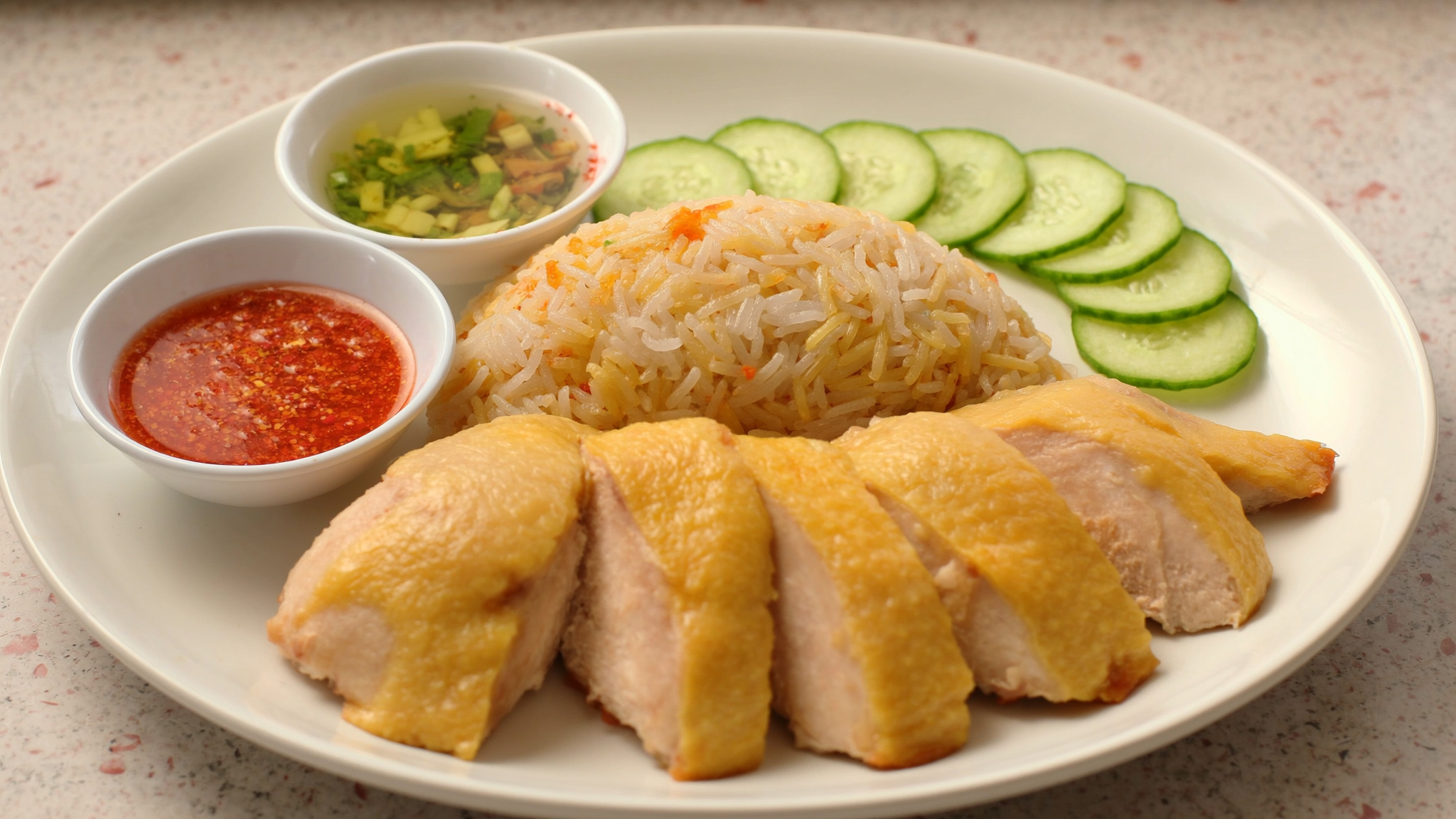
Hainanese chicken recipe made as a complete Singapore-style chicken rice dinner: gently poached chicken, fragrant ginger-garlic jasmine rice, sliced cucumber and two contrasting dipping sauces. Follow the steps for poaching, temperature verification at 165°F, rice cooked in chicken stock and serving. This original editorial formulation is not independently kitchen-tested and uses safe thermometer-based poultry guidance rather than promising doneness from a fixed cooking time.
Hainanese chicken recipe: the complete dinner at a glance
This hainanese chicken recipe makes a Singapore-style chicken-and-rice dinner with gently poached skin-on chicken, jasmine rice cooked in fragrant chicken broth, cucumber, ginger-scallion sauce, a simple red chili dip, and a little soy-sesame dressing. Use one fully thawed 3 to 3½-pound chicken, aromatics, 1½ cups uncooked jasmine rice, and the measured sauce ingredients below. Poach until a thermometer registers at least 165°F (74°C) in the thickest breast and thigh areas without touching bone. Strain and thoroughly heat the broth before using it to cook rice. The written recipe is a carefully researched editorial formulation rather than a dish physically kitchen-tested by MySavorista.
What makes the dish recognizably Hainanese-style
This is not fried chicken on steamed white rice. The central features are pale gently poached chicken, fragrant rice enriched with the bird’s stock and ginger-garlic aromatics, and the contrast of distinct dipping sauces. Singapore’s SG101 heritage explanation traces the dish’s development from Hainanese cooking into a Singapore favorite. Our recipe draws on that recognizable serving format while specifying an American-market whole chicken, ordinary grocery ingredients and the USDA’s safe 165°F endpoint. It is an accessible home adaptation, not a claim to reproduce one vendor’s protected family recipe or the only authentic historical method.
Why the chicken should look pale, not roasted
Properly poached chicken has an ivory-colored exterior, moist sliced meat and, when kept, soft yellowish skin. It does not have the dark crisp crust of roast chicken or browned edges from a frying pan. For an example of a genuinely different treatment, compare our oven-roasted whole chicken with lemon and garlic, which develops browning by design and should not be confused with this pale poach. Keep the cooking liquid at a gentle simmer rather than a violent rolling boil, and do not sauté the chicken itself before poaching. The point of the heat is to cook the bird safely while keeping the surface relatively smooth. A slightly golden cast from natural skin is plausible; deep brown lacquer, barbecue glaze or red chili-coated meat would represent a different dish. This difference matters for photographs and for setting accurate reader expectations.
Choose one whole chicken in a manageable size
A thoroughly thawed whole chicken weighing roughly 3 to 3½ pounds is manageable in a deep stockpot and usually provides about four family-style servings once carved, though actual meat yield varies. Skin-on chicken gives the plate a traditional visual cue and contributes flavor to the broth used for rice. Remove any packaged giblets from the cavity as directed by the product label; do not wash raw chicken in the sink, since splashes spread germs. Check that the bird fits comfortably under enough water for gentle poaching. A larger bird needs more room and potentially considerably more cooking time, so rely on measured internal temperature rather than a single clock figure.
What to buy for ginger and scallions
This recipe divides fresh ginger into measured portions rather than saying to add an unspecified large knob. Use about 30 grams in slices for poaching, 20 grams minced for the rice, and 20 grams finely grated for the ginger-scallion dip. Six scallions also have defined jobs: three tied loosely for the poaching pot, two minced for the green dip, and one sliced thinly as a minimal optional finish. Fresh ginger provides a clear spicy fragrance without relying on powdered mixes; scallions add mellow allium aroma. Rinse and dry produce before chopping, and use a separate clean board from the one that has held raw chicken.
Fresh garlic belongs in the rice and chili dip
Set aside four garlic cloves: three finely minced for the rice and one small clove for the red chili sauce. Garlic in the rice is briefly warmed in oil with ginger and dry jasmine rice, not deeply browned. The small clove in the chili dip gives a brighter bite; the sauce is blended separately and brought to a brief simmer with safe, fully cooked broth before chilling or serving. Avoid adding large handfuls of raw garlic to the plated chicken, since the resulting flavor and picture would change. Once all aromatics are prepared, keep each measured portion in a separate small dish to avoid accidentally using everything in the poaching water.
Use jasmine rice, measured while dry
Use 1½ cups uncooked jasmine rice, which has a characteristic fragrance and long slender grains. Rinse the rice gently in cool clean water until most loose surface starch has washed away, then drain thoroughly. The defined ratio for this recipe is 2¼ cups of strained, fully heated chicken poaching broth for the 1½ cups of dry rice, with package-specific adjustments if needed. Rice brands vary in age and hydration, so check the package and inspect for doneness. The finished rice should be tender, lightly glossy and separate enough to mound beside the chicken, not mushy congee or tomato-colored pilaf.
Poaching broth is a cooking ingredient, not waste
The chicken simmers in enough water to cover it, approximately ten to twelve cups in a suitable deep stockpot, with sliced ginger, three scallions and a little salt. After the chicken is fully cooked, the liquid becomes the fragrant stock for the rice and a measured small amount for the chili dip. Strain it through a clean mesh sieve into a clean pot, bring the reserved portion back to a full boil before use, and avoid allowing the large amount of hot liquid to cool slowly at room temperature. Broth made in contact with raw poultry must be handled as an ingredient requiring thorough cooking, not used uncooked to thin a sauce after the fact.
How much poaching water is needed
Start with enough drinking water to submerge the chicken without overfilling the pot; the volume is estimated at ten to twelve cups for the size of bird and pot described. If the water level is too low, use a slightly smaller pot or add hot water carefully so the chicken remains covered during simmering. Leave enough headroom to avoid hot splashes. More water produces a lighter broth, which can affect the rice’s flavor; less water risks part of the bird sitting above the surface. Do not assume any precise broth yield from our editorial measurements. The key is to reserve 2¼ cups for the rice and two tablespoons for the chili dip once the chicken is cooked.
The temperature rule that overrides every timing estimate
The USDA Food Safety and Inspection Service identifies 165°F (74°C) as the safe minimum internal temperature for whole poultry and poultry pieces. Insert a clean instant-read thermometer into the thickest part of a breast and inner thigh without contacting bone. Both areas must meet the safe endpoint. Because bone, bird shape, water temperature and starting temperature vary, a suggested 50-to-75-minute simmer is only a planning guide and could be shorter or longer. Never judge chicken safety only from clear juices, skin color or whether the meat seems tender when cut.
Preparing the chicken without cross-contamination
Unwrap the fully thawed bird over a clean tray, remove packaging and giblets, and keep raw juices away from cucumber, sauces, rice and ready-to-eat serving plates. Do not rinse or soak the raw chicken in the sink. Wash hands with soap after touching the bird, use a dedicated cutting board if cutting raw poultry, and clean contact surfaces with appropriate food-safe methods. Place the chicken carefully into the pot with long tongs or sturdy equipment rather than dropping it into hot water. Prepare the vegetables for garnish on a separate clean surface. CDC chicken-safety guidance likewise emphasizes avoiding cross-contamination and confirming 165°F internally.
The poaching-pot aromatic base
Put thirty grams of fresh sliced ginger and three washed scallions into a deep pot with the fully thawed chicken. Add enough water to cover and about one teaspoon of kosher salt as an initial seasoning. Bring the pot toward a boil over medium-high heat, then immediately reduce to a gentle, steady simmer. A few small bubbles should rise but the liquid should not churn as if boiling pasta. Use a lid partly ajar if needed to keep the temperature stable, and skim foam with a clean spoon only if it becomes excessive. Avoid adding soy sauce to the entire broth, since it would darken the chicken and rice.
Gentle simmering keeps the skin intact
After reducing the heat, let the chicken poach without vigorous agitation. Strong boiling can tighten and tear the skin and produce a cloudy frothy stock. If one side of the bird rises above the surface, add enough hot water to cover, lower the heat and carefully adjust its position. A lid can help sustain a gentle simmer, but check the pot periodically instead of leaving it unattended. Begin checking temperature before the expected finishing time, using a clean sanitized probe and avoiding bone. Cooking is complete only when the measured thick breast and thigh areas each reach at least 165°F. Do not prescribe a shorter unsafe cook merely to preserve traditional pale skin.
How to know when to remove the chicken
Lift the bird carefully from the pot with sturdy tongs and a slotted support, avoiding spills of extremely hot broth. Insert the thermometer into the thickest portions of breast and thigh; if either reading is below 165°F, put it back into the simmering pot and continue cooking until both meet the minimum. Once safely cooked, allow the chicken to rest briefly on a clean tray for easier handling and carving. Do not return the cooked bird to a tray that held it raw. The final skin may be soft and the meat pale, which is normal for this cooking method. No timed ice-bath step is required in this simplified version.
Reserve and reheat stock for the rice
Once the chicken is removed, strain the poaching liquid through a clean mesh strainer into a clean heat-safe container or pot. Take the 2¼ cups required for cooking the rice and bring that measured liquid to a full boil before pouring it into the rice pot. Set aside two tablespoons to heat thoroughly for the chili dip. If you plan to serve additional broth, reheat it thoroughly and season separately. Excess broth should go into shallow containers and be chilled promptly rather than left in one large stockpot on the counter. Keep raw-chicken tools away from the now-cooked components.
The rice starts with oil, ginger and garlic
Heat two tablespoons of neutral cooking oil in a medium saucepan over medium-low heat. Add twenty grams of minced ginger and three minced garlic cloves, stirring for about a minute until aromatic but not browned. Add the drained 1½ cups of jasmine rice and stir gently another minute to coat the grains. This is a light aromatic toast, not a deep-frying step; the grains should stay pale. Pour in the 2¼ cups of reheated boiled chicken stock carefully, since steam may rise. The oil and aromatics give the rice a fuller flavor without needing a commercial seasoning cube. Remember that hot broth can splatter when it hits the oil-coated rice.
Cooking the chicken-stock rice
Bring the measured broth and rice to a lively simmer, stir once to distribute the ginger, then reduce to the lowest effective heat and cover tightly. Cook according to the rice package’s general timing, around fifteen to eighteen minutes for many jasmine rices, until liquid is absorbed and grains are tender. Leave covered off heat another ten minutes before gently fluffing with a fork. If the brand instructs a different liquid ratio or duration, adjust cautiously while preserving the cooking technique. The rice should be off-white with faint pale golden specks from ginger, not colored red or brown. Avoid removing the lid every minute, which disrupts steaming.
Why rice texture matters as much as chicken texture
A plate with carefully poached chicken but gummy rice does not show the character of Hainanese-style chicken rice. Draining the washed grains well, avoiding excessive stirring and respecting the simmer-and-rest stages help individual rice grains remain defined. If rice is firm and the bottom is dry, add a small amount of boiling stock or water and continue steaming briefly; if wet, rest a little longer off the heat with a clean towel under the lid only if safely arranged away from heat. Do not use rice left unrefrigerated from another day in place of freshly cooked rice. The chosen rice is a food safety consideration as well as a texture ingredient.
Ginger-scallion sauce needs its own small bowl
Mix twenty grams of finely grated ginger, two finely chopped scallions and one-quarter teaspoon salt in a clean heat-resistant bowl. Warm one tablespoon of neutral oil in a small saucepan just until shimmering, not smoking. Pour carefully over the ginger and scallions while keeping hands and face clear of splashes; stir with a clean spoon to distribute the aroma. Let this sauce cool to a safe serving temperature. The texture should be finely chopped green-and-pale ginger flecks in a little oil, not a smooth pale green ranch dip or a thick avocado cream. If preparing in advance, refrigerate promptly in a clean closed container.
A bright red chili sauce for contrast
For a small dipping bowl, combine one seeded small red fresh chili, one small garlic clove, two tablespoons lime juice, two tablespoons of reserved fully boiled chicken broth, one-half teaspoon sugar and a small pinch of salt. Blend briefly with a clean mini blender or chop very finely, then bring the mixture to a brief simmer in a clean small saucepan. Cool safely before serving or refrigerate promptly if not eating straight away. The color should be naturally red-orange and the texture spoonable, not a glossy bottled sweet-chili glaze. Adjust the pepper type to your household’s heat tolerance as a variation, but do not add unlisted tomato ketchup or food coloring.
A soy-sesame drizzle is the third flavor note
Stir together two tablespoons light soy sauce with one teaspoon toasted sesame oil in a separate small clean cup. Add a little over the safely cooked carved chicken immediately before serving, leaving most in a side dish so diners can choose how much to use. Soy sauce adds savoriness while the sesame oil gives a recognizable aromatic finish. Because both soy and wheat can be present in conventional soy sauce, check the label when serving people with allergies. Sesame is also an allergen. The soy drizzle should lightly tint a few chicken slices but not make the entire plate black, and it should never look like a sticky barbecue glaze.
Cucumber is the deliberately simple vegetable side
Half of a large fresh cucumber, washed and sliced into six to eight thin rounds or half-moons, provides a cool crisp contrast to the warm rice and pale poached chicken. Keep it off the raw poultry cutting board. The slices belong at the edge of the plate, not mixed into the rice while it is steaming. There is no tomato, cilantro, lettuce bed or roasted pepper garnish in this base recipe. Leaving the cucumber clean and simple helps the plated result look like the classic hawker-style combination without trying to replicate every regional variation. If children are eating, adapt the cucumber cut to their needs.
Carving a whole chicken without losing juices
Use a clean stable cutting board and sharp knife once the bird has reached the safe temperature and rested briefly. Remove legs at the joints, slice the breast across the grain, and arrange manageable pieces with some of the skin visible if preferred. Take care around bones, especially when serving younger diners. You can remove bones for a family-friendly plate, but do not claim all pieces are boneless without checking. Keep pieces reasonably thick so they remain recognizable as poached poultry rather than very thin deli-meat shavings. Set aside meat that will not be served immediately and refrigerate it promptly in shallow covered containers.
Plate the chicken and rice as two distinct elements
Pack a modest scoop of the aromatic rice lightly into a small serving bowl, then turn it onto one side of a warmed plate or simply spoon it into a relaxed mound. Fan several pale slices of poached chicken alongside rather than burying the meat under the rice. Place cucumber rounds at the edge and offer two separate tiny sauce bowls, one greenish ginger-scallion and one red chili. A small amount of soy-sesame dressing can gloss the chicken. This layout matters: it communicates Hainanese chicken rice immediately in both editorial text and images. Do not pour both sauces over everything until the distinctive colors and textures disappear.
Serving broth as an optional accompaniment
The remaining strained poaching stock can be used as a light soup served separately if it has been handled, heated and seasoned safely. Ladle a modest amount into small bowls, perhaps with a few reserved scallion slices. This is part of the same original cooking pot, not a separate soup formula containing noodles, carrots or dumplings. If you decide to keep extra broth, cool in shallow containers and refrigerate promptly; a large hot stockpot should not sit unrefrigerated overnight. The photo package focuses on the chicken, rice, cucumber and two dipping bowls, so an additional broth bowl is not mandatory in either image.
An adaptation rather than a claim of one definitive recipe
Hainanese chicken rice developed across communities and vendors, so different cooks use pandan, chicken fat, ginger paste, chili, dark soy or variations on serving temperature. The Singapore chicken-rice heritage article describes poached chicken and rice with sauce as central elements. Our adaptation uses neutral oil for reliable grocery access, a thermometer-tested poach and defined dip recipes. It does not pretend to reproduce every hawker stall or original Hainan Island version. This distinction is useful to readers searching for a practical home-cooking method in the United States.
Why we skip an ice-water bath here
Some traditional recipes use a rapid cold-water step to tighten the chicken skin. This version omits that stage to keep equipment and food-safety instructions straightforward for beginner home cooks. Instead, remove the thoroughly cooked bird to a clean tray, rest it briefly and carve for serving. Adding an arbitrary ice-water soak after cooking can introduce contamination if the water and container are not food-safe, and long immersion may cool the meat excessively before serving. The pale silky appearance can still be represented with gently poached, unroasted chicken. Our exact preparation method and photographs must reflect this simple process, not promise a restaurant-style cold-skin technique that was never performed.
Do not rely on chicken color for safety
Poached meat can remain pale, and some safely cooked poultry may retain slight pinkness near bones depending on its chemistry. Conversely, poultry that looks white may still be unsafe. This is why the thermometer is not a decorative accessory but a required tool. Measure both the breast and thigh away from bone; the reading must be at least 165°F (74°C). If you do not own a food thermometer, obtain one before attempting the recipe rather than improvising a timed shortcut. The USDA endpoint applies even when other online versions suggest that simply steeping the bird for a fixed period is enough. Food safety takes priority over a particular silky texture.
Handling broth that touched raw poultry
Stock develops while the raw chicken is being heated, which means utensils and splashes deserve care. Once the bird is fully cooked, strain the stock into a clean pot or vessel, then bring the portion used for rice and sauce back to a full boil before use. Clean counters and utensils that held raw chicken; do not pour uncooked poaching liquid over finished rice as a finishing sauce. Do not dip tasting spoons that touched raw poultry into the finished dipping sauces. Keep the red chili and ginger bowls in separate clean containers. This recipe provides a full meal, so attention to separation helps avoid cross-contamination among chicken, rice and uncooked cucumber.
How to prevent bland chicken and rice
Poaching uses water and gentle aromatics, so it will taste subtler than roasted chicken with a crust. The rice supplies most of the ginger-garlic fragrance, and the three condiments add contrasting savory, sharp and warm flavors at the table. Start with the measured salt rather than oversalting the broth, because soy dressing is already salty. Give the rice time to absorb hot stock and rest, and serve chicken with a light soy-sesame drizzle rather than burying it under excessive sauce. These elements work together; without dipping condiments, the plate may seem unusually understated to someone expecting spicy fried chicken.
How to prevent overcooked dry breast meat
Keep the poaching pot at a gentle simmer and begin checking temperature before the estimated endpoint. The breast and thigh cook at different rates, particularly in a whole bird, so check both sites. The fixed safety minimum of 165°F must still be met; do not stop early merely to preserve moisture. Once the bird is safely cooked, remove it instead of boiling for an additional hour. Rest and carve carefully across the breast grain. Serving slices with a little soy-sesame dressing can help the mouthfeel. The time range cannot guarantee a precise texture because it depends on actual bird size, shape and stove performance.
How to avoid rice that tastes oily
Two tablespoons of neutral oil for 1½ cups dry jasmine rice give the ginger and garlic a cooking medium without turning the grains greasy. There is no instruction to add a separate half cup of chicken fat. If the reserved broth has a thick fat layer, you can skim some before measuring. Stir the rice gently when adding the hot broth, then let it steam instead of frying continually. The serving mound should look pale and lightly glossy, not soaked in yellow oil or dark soy sauce. A small additional sauce cup can offer richer flavor to individuals who prefer it without changing the entire pot or altering the photograph.
How to adjust the red dipping sauce’s heat
A small red fresh chili is specified as the starting point, but actual heat varies by variety and season. Remove seeds and pale inner membranes if you want a milder sauce, wear gloves if needed, and keep hands away from your eyes. The sauce should remain tangy from lime and aromatic from garlic, with only a little sugar to balance. Do not add several habaneros to this formula and describe the result as mild. Taste only once the sauce has been simmered and cooled to a safe temperature, then serve small drops alongside chicken rather than covering the whole plate. Avoid allowing a child to handle or blend hot chili without supervision.
What to do if you do not have pandan leaves
Pandan is a familiar fragrance in some Singapore-style chicken rice recipes, but it may be difficult to find in mainstream American supermarkets. We do not require it here; the measured ginger, garlic and broth define the aromatic rice. This is a deliberate accessible adaptation, not a claim that pandan never belongs in the dish. If you have a reputable fresh pandan source, adding a leaf would be a personal variation and should be described separately. The article’s two photos should not show mysterious long green leaves beneath the rice because that would be an unlisted ingredient in the approved source recipe. Keep the core dish recognizable without inventing inaccessible extras.
Can you use boneless thighs instead?
Bone-in or boneless chicken thighs can be used in a separately developed quick variation, but the liquid volume, cooking time and resulting broth would change. The current card specifies one whole skin-on bird so the broth can flavor the rice and a platter of carved chicken can be served in a recognizable format. Thighs must also reach 165°F when measured away from bone, and the time cannot simply be copied from the whole-bird method. If you prefer to cook thighs, adjust quantities and method intentionally rather than replacing the chicken while leaving all other measurements unchanged. This original article remains anchored to the whole-chicken version.
Serve with vegetable dishes without mixing the recipe
A simple side can balance the richness of rice and chicken. MySavorista’s garlic-ginger Chinese long beans skillet makes a separately cooked vegetable accompaniment that shares ginger-garlic flavor notes. For another dinner context, compare our crispy honey garlic chicken thighs on rice, which is an entirely different caramelized, browned chicken recipe. Do not add crispy sticky chicken to the Hainanese platter or imply the methods are interchangeable. Internal links should help readers choose between distinct dinner styles and not dilute this page’s precise original recipe intent.
Why the photographed food must match the directions
A search-result photograph can attract clicks only if it represents the actual dish. For this recipe, that means plain pale poached chicken slices with soft skin, a separate mound of pale ginger-garlic jasmine rice, several cool cucumber rounds and two small dipping bowls with distinct red chili and greenish ginger-scallion sauces. The image may show a light soy-sesame glaze on chicken but not a dark barbecued crust. Do not show deep-fried poultry, bright turmeric rice, scrambled eggs, curry sauce, chopped tomato, cilantro sprigs, lettuce or a giant pool of spicy sauce that the ingredient list never included. Both original images must show an assembled finished plate, not separate piles of raw ingredients.
Food safety and storage after serving
Cooked poultry and cooked rice are perishable; do not leave a family platter on the counter for an afternoon. Refrigerate leftovers promptly in shallow clean covered containers within two hours, or within one hour at ambient temperatures above 90°F, keeping the refrigerator at 40°F or below. General CDC advice emphasizes chilling, clean handling, and separating raw poultry from ready-to-eat foods. For rice, rapid cooling is especially important; do not leave a large pot of warm rice at room temperature overnight. Reheat leftovers thoroughly to 165°F and discard food that has not been handled safely. The specific batch has no laboratory-validated keeping-life claim.
Editorial testing and accuracy disclosure
This is an original MySavorista editorial recipe not independently kitchen-tested in a real home kitchen. Cooking times, the estimated four servings, sauce yield, rice texture and sensory notes are reasoned instructions informed by reputable culinary and food-safety guidance, not results collected in a documented physical trial. The exact chicken and rice quantity used in a reader’s kitchen may differ slightly by product. Use the thermometer and packaging instructions rather than claiming any time-based safety guarantee. Two AI images, if they pass full original-pixel review, are illustrative food representations and must not be described as proof that a chef actually prepared the food. No invented nutrition table, measured calorie count or historical exclusivity claim is made.
Hainanese chicken recipe: frequently asked questions
What is a Hainanese chicken recipe?
In this Singapore-style home adaptation, a whole chicken is gently poached with ginger and scallions, then served with jasmine rice cooked in chicken broth, cucumber, ginger-scallion sauce and chili sauce. The meat stays pale rather than roasted.
Is Hainanese chicken boiled or fried?
It is generally gently poached in the version described here. Keep the water at a controlled simmer and cook until the thickest breast and thigh areas reach 165°F; no browning or frying of the bird is involved.
What temperature must the chicken reach?
USDA guidance requires whole chicken and other poultry to reach 165°F (74°C). Use a clean food thermometer in the thickest breast and thigh away from bone, regardless of any estimated time range.
Is Hainanese chicken rice the same as regular chicken and rice?
No. It is distinguished by aromatic poached chicken, jasmine rice flavored with its broth and garlic-ginger, and bright separate dipping sauces. Other chicken-and-rice meals may be baked or use entirely different seasonings.
Can you use boneless thighs instead of a whole bird?
Yes as a separate variation, but broth volume, poaching time and yield change. This specific recipe uses a 3 to 3½-pound whole chicken; thighs still require 165°F internal temperature.
Does the rice need chicken broth?
The rice in this version cooks in strained, reheated chicken-poaching broth with ginger, garlic and oil. Plain water would make it less fragrant and move away from the specified recipe.
How do I make the ginger sauce?
Combine freshly grated ginger with finely chopped scallions and salt, then carefully add a tablespoon of shimmering neutral oil. Keep the texture finely chopped and aromatic rather than creamy.
What is the red sauce with Hainanese chicken?
This is a small chili-lime dip made with fresh red chili, garlic, lime juice, a little fully heated chicken broth, sugar and salt. It is briefly simmered before serving.
Why is the poached chicken pale?
The chicken is cooked in liquid rather than browned in a pan or oven, so its skin can look pale and soft. Appearance cannot prove safety; a thermometer reading of 165°F is the required check.
Can I make the components ahead?
Prepare components with safe cooling, refrigerate quickly, and reheat thoroughly when appropriate. For best texture, cook rice fresh or cool it rapidly rather than leaving a warm covered pot at room temperature.
Is Hainanese chicken rice gluten-free?
Not automatically. Ordinary light soy sauce often includes wheat, and cross-contact can occur. Use a verified gluten-free soy alternative only after checking ingredient labels and accounting for the flavor change.
Was this recipe physically tested by MySavorista?
No. This is an original editorial formulation with conservative poultry safety instructions. Timing and yield are estimates, and any AI images are illustrations rather than evidence of a real cooking test.
Print
Hainanese Chicken Recipe With Ginger Rice and Chili Sauce
- Prep Time: Approximately 25–35 minutes for chicken preparation, measured aromatics, rice rinsing and dipping sauce setup; editorial estimate
- Cook Time: Approximately 50–75 minutes for a 3–3½ lb whole chicken, or as long as necessary to reach at least 165°F/74°C in breast AND thigh, plus 15–18 minutes for rice and short sauce cooking; not a guaranteed cooking time
- Total Time: Approximately 1 hour 45 minutes to 2 hours 15 minutes allowing measured safe chicken poaching, rice cooking, sauce prep and carving; editorial estimate, temperature rules override clock
- Yield: About 4 family-style portions from a 3–3½ lb whole chicken and 1½ cups uncooked rice; actual yield depends on bird 1x
- Category: Chicken & Poultry Creations
- Method: Poach whole chicken with ginger and scallions at a gentle simmer until thermometer confirms 165°F in breast and thigh; strain and bring broth to full boil; cook ginger-garlic jasmine rice in broth, prepare chili and ginger scallion dips, and plate pale sliced chicken and cucumber
- Cuisine: Singapore-style Hainanese chicken rice, practical United States home adaptation
Description
Hainanese chicken recipe for Singapore-style poached whole chicken with ginger-garlic chicken-stock jasmine rice, cucumber, chili-lime dip and ginger-scallion sauce. Chicken must reach 165°F (74°C). Original untested editorial formulation.
Ingredients
CHICKEN AND STOCK:
1 fully thawed WHOLE CHICKEN, skin on, approximately 3–3½ pounds (1.36–1.59 kg), giblet packet removed if present
10–12 cups drinking WATER or enough to cover chicken safely in a deep pot without overflowing
30 g FRESH GINGER cut into thick slices for stock
3 SCALLIONS tied loosely for stock
About 1 tsp KOSHER SALT for stock, adjust with actual salt label
RICE:
1½ cups (approximately 275–300 g depending on brand) UNCOOKED JASMINE RICE, rinsed and drained
2¼ cups (540 ml) STRAINED CHICKEN POACHING BROTH from fully cooked chicken, brought to full boil before use
2 tbsp NEUTRAL COOKING OIL, such as canola oil
20 g FRESH GINGER finely minced for rice
3 GARLIC CLOVES finely minced for rice
GINGER-SCALLION DIP:
20 g FRESH GINGER finely grated
2 SCALLIONS finely chopped
1 tbsp NEUTRAL COOKING OIL warmed until shimmering, not smoking
¼ tsp KOSHER SALT
RED CHILI DIP:
1 small FRESH RED CHILI, stem removed, seeds or ribs removed for milder sauce
1 small GARLIC CLOVE peeled
2 tbsp (30 ml) FRESH LIME JUICE
2 tbsp (30 ml) reserved strained chicken broth, reheated thoroughly before sauce cooking
½ tsp SUGAR
Small pinch SALT
SOY-SESAME DRESSING:
2 tbsp LIGHT SOY SAUCE (contains soy; often wheat)
1 tsp TOASTED SESAME OIL (contains sesame)
TO SERVE:
½ large CUCUMBER, washed and sliced into about 6–8 rounds or half-moons
1 remaining SCALLION, finely sliced as optional listed minimal garnish
NO fried chicken, NO browned skin, NO cilantro, NO tomato, NO curry sauce, NO crunchy fried shallots, NO roasted peppers, NO unlisted greens
Instructions
1. Prepare a deep stockpot that holds a 3–3½ lb fully thawed whole chicken under water with space at top. Remove packaging and any giblet packet; do NOT wash raw chicken in the sink. Wash hands and sanitize surfaces after handling raw poultry. Prepare separate clean utensils and boards for cucumber and dips.
2. Place chicken in pot with 30 g thick-sliced ginger, 3 scallions and about 1 tsp kosher salt. Pour roughly 10–12 cups clean water, or enough to cover without overfilling. Bring toward a boil, then immediately reduce to a low, gentle simmer; do not boil violently.
3. Poach with a steady gentle simmer, checking periodically. Approximately 50–75 minutes is only an editorial planning estimate. Insert a clean instant-read food thermometer in the THICKEST breast AND inner thigh without touching bone. The chicken MUST reach at least 165°F (74°C) at BOTH sites; simmer longer if either is below 165°F. Color and fixed minutes are NOT substitutes for measurement.
4. Carefully lift fully cooked chicken onto a clean tray using suitable sturdy tools, allow a brief rest, and carve safely into moderate slices and portions with pale soft skin if desired. Do NOT put cooked chicken onto a board or plate that held raw meat.
5. Strain the poaching liquid into a clean pot. Measure 2¼ cups for the rice and 2 tbsp for the chili dip and bring those portions to a FULL BOIL before adding to rice or sauce. Keep extra stock safe by cooling promptly in shallow containers if not serving now. Do not use unheated poaching broth on cooked food.
6. Rinse and thoroughly drain 1½ cups dry jasmine rice. Heat 2 tbsp neutral cooking oil over medium-low in a medium saucepan and gently cook 20 g minced ginger and 3 minced garlic cloves for around 1 minute until fragrant, without browning. Add drained rice and stir another 1 minute to coat lightly.
7. Carefully pour in the 2¼ cups FULLY HEATED strained chicken stock. Bring to a simmer, stir once, cover tightly and cook on low approximately 15–18 minutes or according to actual jasmine rice package until tender and liquid is absorbed. Rest covered off heat about 10 minutes, then fluff lightly with a fork. Rice must not be left warm at room temperature for hours.
8. In a clean heat-safe bowl combine 20 g grated ginger, 2 finely chopped scallions and ¼ tsp kosher salt. Heat 1 tbsp neutral oil in a small pan just until shimmering, NOT smoking. Carefully pour oil over aromatics and stir to make finely textured pale-green ginger-scallion dipping sauce. Keep clean and warm or refrigerate promptly.
9. For chili sauce blend 1 seeded small red chili, 1 garlic clove, 2 tbsp lime juice, 2 tbsp previously boiled strained broth, ½ tsp sugar and a small pinch of salt. Transfer to a small clean saucepan and bring to a brief gentle simmer, then cool to safe serving temperature. Use a separate small dipping bowl; do not pour raw-poultry-contact broth directly into uncooked finished sauce.
10. Stir 2 tbsp light soy sauce with 1 tsp toasted sesame oil for a separate simple dressing. Wash ½ large cucumber and slice into rounds or half moons, using a surface never touched by raw poultry.
11. Plate a mound of pale ginger-garlic jasmine rice beside several carved pieces of fully cooked PALE POACHED chicken with some soft skin visible. Add cucumber rounds. Spoon a small amount of soy-sesame dressing over chicken or serve it separately. Set out two DISTINCT dipping bowls: greenish ginger-scallion and bright red chili-lime. Optional finish: only the last finely sliced scallion already on the ingredient list.
12. Serve promptly. Refrigerate all leftover chicken, rice and sauces in shallow clean covered containers at 40°F (4°C) or colder within two hours, or one hour if ambient is above 90°F (32°C). Cool rice rapidly, do not leave a pot overnight. Reheat leftovers thoroughly to 165°F. Never rely on color, smell, or a timed steep as proof of safe chicken cooking.
Notes
ORIGINAL MySavorista editorial formula, NOT independently kitchen-tested. Poaching times and 4-portion yield are estimates; the USDA thermometer minimum is mandatory for whole bird: both breast and thigh thickest parts at least 165°F/74°C, avoiding bone. Never wash raw chicken. Bring stock used for rice and dips back to a full boil, avoid cross contamination, and promptly refrigerate cooked chicken and rice in shallow containers. Rice requires quick cooling because of bacterial growth risk. Contains SOY, often WHEAT in light soy sauce, and SESAME. Check all commercial labels; no measured nutrition or tested storage life. AI images only illustrative. EXACT photo identity: pale poached SKIN-ON chicken pieces arranged beside separate mound of PALE lightly golden jasmine rice, cucumber rounds, two small side dipping bowls one finely greenish ginger-scallion and one red chili-lime, small soy glaze but NO browned chicken, curry, roasted crust, tomatoes, cilantro, lettuce, extra garnish, or fake text. No assumption that recipe is the only authentic historical method.
Nutrition
- Serving Size: About one quarter of carved cooked bird plus one quarter cooked rice and chosen dips; final weights not measured
Keywords: hainanese chicken recipe, hainanese chicken rice recipe, Singapore chicken rice, ginger garlic chicken rice, poached whole chicken